 Join on WhatsApp
 Join on Telegram
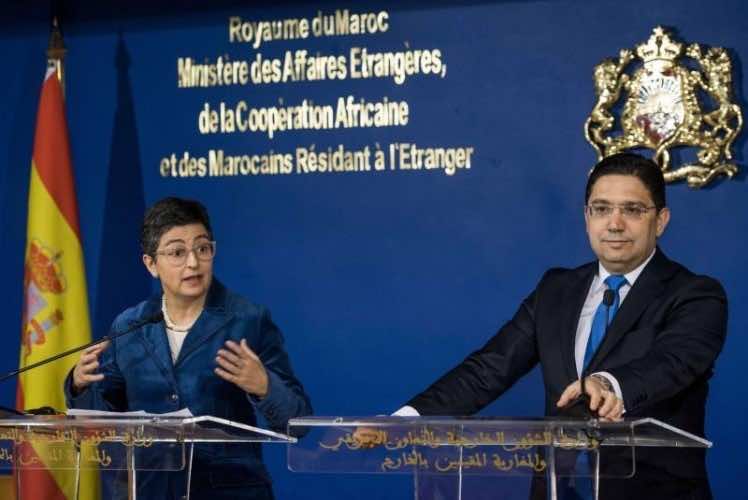
Rabat – Morocco’s Minister of Foreign Affairs Nasser Bourita answered questions on the Morocco-Spain crisis following a meeting with the Hungarian Minister of Foreign Affairs and Trade, Peter Szijjarto, this Wednesday.
A press conference followed the signing of a dozen Moroccan-Hungarian conventions that touched on culture, economics, and diplomacy. During the conference, Nasser Bourita answered questions on the Morocco-Spain crisis. He declared that Morocco’s position has not changed since his last appearance.
“We published a declaration on May 31, clearly stating in four points the position of Morocco in relation to the development of this bilateral crisis.”
In the statement, Morocco emphasized that the diplomatic crisis with Spain had nothing to do with migration, nor with the arrival and subsequent departure of Brahim Ghal from Spain.
According to the minister, the crisis was sparked by Spain breaking Morocco’s trust, with utter disregard to the decades-long partnership linking the two countries.
The Moroccan Ministry of Foreign Affairs emphasized the country’s position in a press release from May 8, stating: “Preserving bilateral partnership is a shared responsibility, nourished by an ongoing commitment to safeguarding mutual trust, maintaining fruitful cooperation, and protecting the strategic interests of both countries.”
The statement also touched on the inconsistency plaguing Spain’s rhetoric on separatism, a problem both countries are actively fighting against. On this matter, Bourita said: “You cannot fight separatism in your own land and simultaneously encourage it in your next-door neighbor’s.”
Read Also: Spain Morocco Crisis Timeline
Nasser Bourita reiterated at Wednesday’s press conference Morocco’s position on the nature and parties involved in the dispute, stating that the crisis is purely bilateral, and has nothing to do with the European Union.
The European Parliament processed a draft resolution, aiming to condemn Morocco’s alleged “abuse” of children and unaccompanied minors. The controversial resolution suggests that Morocco acted in “violation” of the United Nations Convention on the Right of the Child (UNCRC), in light of the recent Ceuta migration incident.
Renew Europe, alongside the Greens/European Free Alliance (Greens/EFA) groups, were responsible for tabling the draft resolution.
Morocco strongly condemned the draft resolution. Parliament, and the President of the Mixed Parliamentary Committee on Morocco-European Union (MPC Morocco-EU), Chaoui Bellassal, called out Spain’s indirect trials to involve the EU in the bilateral dispute.
In addition to Morocco’s position on the draft, international actors unrelated to the conflict also expressed disappointment with the meddling taking place on the EU parliament floor.
Tomas Zdechovsky, an EU parliament member, directly called out Spain for attempting to “aggressively” lobby for the adoption of the resolution against Morocco, which according to him “will only lead to escalation.”
The draft resolution is not only contrary to the spirit of the long-standing strategic partnership between Morocco and the EU, but it could also run the risk of escalating already-tense relations between Morocco and Spain, Moroccan officials argued.
During Wednesday’s press conference, Nasser Bourita affirmed that Morocco “is satisfied with its relationship with the European Union with whom it developed a very effective multifaceted cooperation over the last few years.”
He added: “The attempt to Europeanize it is only a headlong rush, a way of getting around the reality of this crisis, which is primarily linked to unfriendly and even hostile acts and attitudes of our northern neighbor.”
When asked about a possible resolution to the dispute, Bourita said that “the resolution lies with those who created it because it is not Morocco that is at its origin.”