 Join on WhatsApp
 Join on Telegram
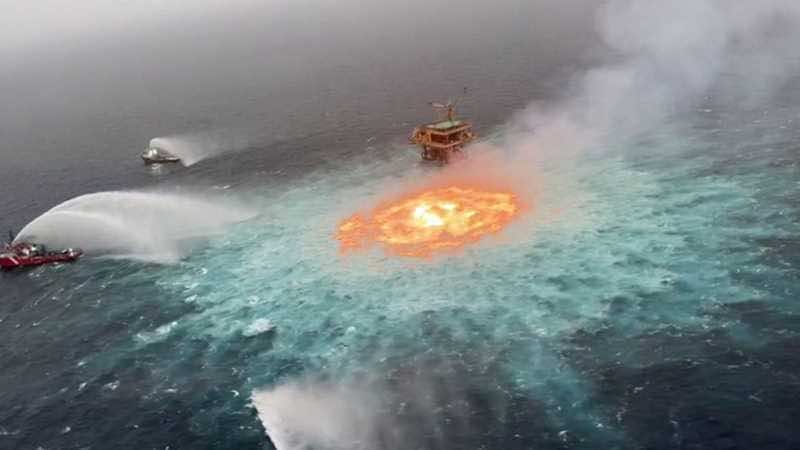
Rabat – In the early hours of Friday morning off the southern coast of the Gulf of Mexico, a state-owned Pemex oil rig gas leak caused a large fire to spread across the surface of the ocean.
According to Pemex, an underwater gas line leak led to the natural gas fueled flames to rage atop the ocean water.
Pemex, Mexico’s state oil conglomerate, has launched an official investigation into the incident.
<blockquote class=”twitter-tweet”><p lang=”es” dir=”ltr”>? Incendio registrado en aguas del Golfo de México <br><br>A 400 metros de la plataforma Ku-Charly (dentro del Activo Integral de Producción Ku Maloob Zaap)<br><br>Una válvula de una línea submarina habría reventado y provocado el incendio<br><br>Esta fuera de control hace 8 horas <a href=”https://t.co/KceOTDU1kX”>pic.twitter.com/KceOTDU1kX</a></p>— Manuel Lopez San Martin (@MLopezSanMartin) <a href=”https://twitter.com/MLopezSanMartin/status/1411045300781948931?ref_src=twsrc%5Etfw”>July 2, 2021</a></blockquote> <script async src=”https://platform.twitter.com/widgets.js” charset=”utf-8″></script>
In a tweet, the head of Mexico’s oil safety regulator ASEA said that the gas leak “did not generate any spill.” Many critics have questioned what could have caused flames to burn on the ocean’s surface.
Pemex noted that the fire took more than five hours to extinguish and nautical firefighters used nitrogen to control the fire.
Ku Maloob Zaap, the oil rig responsible for the alleged gas leak, is Pemex’s largest crude oil supplier and accounts for upwards of 40% of the company’s production, according to the Guardian.
Pemex operated 84 off-shore drilling rigs in 2020 and has 151 drilling operations in total.
A Pemex incident report also added that “the turbomachinery of Ku Maloob Zaap’s active production facilities were affected by an electrical storm and heavy rains.”
“The development was producing 726,000 barrels per day (BPD) of crude at the moment of the incident,” adds the report.
Critics of the Mexican oil conglomerate have criticized the company’s poor track record for off-shore operations.
“The company that set the Gulf of Mexico on fire has sucked the easiest-to-extract oil out of the seafloor, seen production fall off, and as a result, is failing financially with $114 billion in debt,” stated Earther managing editor Brian Kahn in a tweet following the oceanic blaze.
<blockquote class=”twitter-tweet”><p lang=”en” dir=”ltr”>The company that set the Gulf of Mexico on fire has sucked the easiest-to-extract oil out of the seafloor, seen production fall off, and as a result, is failing financially with $114 billion in debt <a href=”https://t.co/FHfu0xMTOj”>https://t.co/FHfu0xMTOj</a> <a href=”https://t.co/HAkjGmH0d1″>pic.twitter.com/HAkjGmH0d1</a></p>— Brian Kahn (@blkahn) <a href=”https://twitter.com/blkahn/status/1411082011280871427?ref_src=twsrc%5Etfw”>July 2, 2021</a></blockquote> <script async src=”https://platform.twitter.com/widgets.js” charset=”utf-8″></script>