


 Join on WhatsApp
  Join on Telegram
 Rabat – The year of 2021 marks a significant milestone for Morocco and the US; 200 years of ties between the two countries.
Morocco has historically been one of the US’ strongest and oldest allies in the region, famously becoming the first country to ever recognize the US as an independent nation in 1786, through the Moroccan-American Treaty of Friendship.
The Tangier American Legation Institute for Moroccan Studies, or as it is more commonly known, The American Legation in Tangier, has stood in the city for 200 years now, and acts as a symbol of the ties between the two countries.
A Brief History
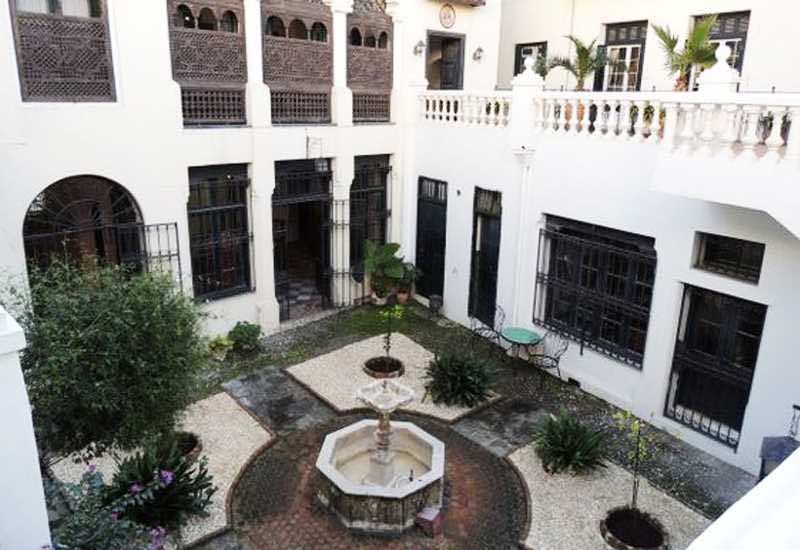
The legation is housed in a two-story Moorish building which was presented to the US government in 1821, as a courtesy of Sultan Moulay Slimane, who ruled over Morocco during the period.
The building was the first property of the US government abroad, and was the home of US diplomatic missions in Morocco for the next 140 years, which also marks the longest that any US diplomatic mission has occupied one building, being only abandoned after Morocco moved its political and diplomatic capital to Rabat in 1956, following its independence.
Despite its abandonment, the building still served various other purposes. During World War II, it served as a headquarters for US intelligence agents, due to Morocco’s geographical position and proximity to Europe, and its strategic status as a base.
The building was also used as an office for the US consul and Peace corps for a period of time after the move to Rabat, and as it expanded, several businesses and housing arrangements showed up near it.
The lack of its use by a proper diplomatic mission threatened the monument, however, as it was gradually abandoned and even threatened with demolition in the 1970s.
Fortunately, the historic building was saved when a group of US citizens started a non-profit organization for that very purpose in 1976. This led to the Legation’s current state, where it is rented from the US government by the Tangier American Legation Museum Society, who operated it.
Seemingly in an effort to protect the building from similar threats in the future, it was listed on the US National Register of Historic Places, as well as designating it a National Historic Landmark in the 80s, becoming the only US property abroad to receive the treatment.
Today’s Legation
Today, the Legation building houses the Tangier American Legation Institute for Moroccan Studies (TALIM), becoming an important activity center for Tangier’s old Medina.
TALIM’s new quarters boast a museum, library, and a research center, making it the main center for research conducted by the American Institute for Maghrib Studies (AIMS), due in part to its historical value.
The TALIM facilities exhibit mainly old artifacts and documents that showcase the old and strong relationship between Morocco and the US, but the building also regularly hosts tours, seminars, and other cultural activities focused on the history of the two countries.
One of the Legation’s most significant projects is an ongoing digitization of the works of US composer Paul Bowles, who lived in Tangier for the better half of the 20th century.
The musician’s collection, which was entered into the Library of Congress, was transferred to Morocco in 2010, which marked the beginning of the extensive digitization project, with the assistance of the US Embassy in Rabat.
The Tangier building also contains a wing named after the musician, which contains an exhibition of various possessions and items related to the composer.
The Legation also attempts to give back to its local community of the Old Medina in Tangier by providing various educational programs to the residents, such as literacy and skills courses.
According to the institute itself, the courses aim to promote literacy and skills such as tailoring and embroidering to unemployed classes in the city, especially women, to help them with social mobility and with gaining beneficial skills.
The Legation’s building and TALIM’s activities remain open to the public at no cost, subsidized largely by proceeds that the institute makes from renting out event spaces, as well as donations from the public to keep it alive.
Significance in US-Morocco Relations
It is evident that this building occupies a very important place in the history of relations between the US and Morocco, being a symbol of the friendship between the two since the formal start of the relationship.
The Moroccan-American Treaty of Friendship, which the Legation continues to be a symbol of, is still going strong and still holds force to this day, and Morocco continues to be a strong partner for the US in the region.
The Legation also proved to be a central location in the US’ war efforts against the Axis Powers during the Second World War. As previously mentioned, Tangier’s proximity to Europe made it a strategic location for US intelligence officers to station their operations, choosing the legation’s building to do so.
Throughout 2021, the Legation- along with other American institutions in Morocco- has been celebrating the 200th anniversary of the ties between the two nations, with various events and visits scattered throughout the year.
With its inclusion in the US’ national registries as a historic site, it is certainly expected that the building and its current occupiers will continue to play their role locally in Tangier, nationally in Morocco, and internationally as US representatives to the country well into the future.


