


 Join on WhatsApp
  Join on Telegram
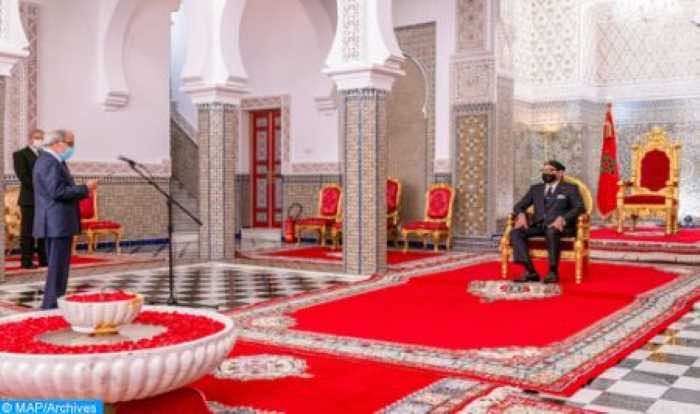
 Rabat – King Mohammed VI received today in Fez’ royal palace the governor of Bank Al Maghrib (BAM), Abdellatif Jouahri, who presented an overview on Morocco’s economic situation.
The reception comes before King Mohammed VI’s speech on Throne Day, marking the 22nd anniversary of the monarch’s accession to the throne.
In his overview of the Moroccan economy, Jouahri emphasized that the year 2020 was marked by the persistence of the socio-economic repercussions of the COVID-19 crisis.
Morocco’s top banker also acknowledged that the country’s economy suffered unfavorable climatic conditions, resulting in a contraction of 6.3% as a loss of 432,000 jobs.
The news comes as no surprise since earlier government-sponsored surveys and reports had established that COVID-19 crisis caused a significant dent to Morocco’s investment and labor landscape.
One recent report by the High Commission of Planning (HCP) found that, compared to 2021, Morocco’s unemployment rate increased by 2% in the first quarter of 2020.
According to the report, both remote rural areas and cities witnessed a significant rise in the unemployment rate.
While presenting his report on the state of Morocco’s economy in the past year, Jouahri also informed the King of the crisis in the budget deficit, which he said increased to 7.6% of GDP. Public debt also increased to 76.4% of GDP, he noted.
As part of its ongoing efforts to tackle the COVID-19 crisis, Morocco has received several loans from a number of international institutions , including the African Development Bank and the World Bank.
According to statistics compiled by digital platform Statistica, Morocco’s national debt amounted to $85.04 billion in 2019.
“The current account deficit now stands at 1.5% of GDP,” Jouahri emphasized, saying that this development is driven by the sharp decrease in foreign trade.
Meanwhile, official reserve assets of Morocco’s central bank, Bank Al-Maghriib, experienced a boost and reached the equivalent of more than seven months of imports of goods and services.
Inflation level was however limited to 0.7%, Jouahri said, citing Bank Al Maghrib’s efforts to help the country’s economy mitigate the crisis by lowering its key rate twice.
He said that Bank Al Maghrib brought the key rate down to 1.5% and fully released the account from the compulsory reserve.
“All of these measures have made it possible to ensure adequate financing of the economy, in particular with a sharp drop in interest rates, and sustained rate of growth in bank credit,” Jouahri said after citing a list of measures Bank Al Maghrib took during the crisis.
The monarch also received applause from Bank Al Magrib’s top official for his leadership to tackle COVID-19 crisis, particularly in the vaccination campaign and recovery of the economy.
In addition to providing a positive assessment of Morocco’s economic response to COVID-19 crisis, Jouahri vowed that a “real boost” to investment and job creation is expected from the operationalization of the Mohammed VI Fund for investment.
“Many projects in projects in progess…. are contributing to this recovery and to accelerating the pace of growth in the longer term,” he said.
As Morocco comes to terms with the pandemic amid fears of yet another wave of infections, Jouahri emphasized, the country’s biggest challenge is whether it can succeed in implementing the projected employment-generating and value-creating investments in a smooth and timely manner.
Jouhari’s report emphasized the need to invest in reforms aimed at improving the education system.
The official described the need for reforms to the sector as a “top” priority.
Jouahri also expressed satisfaction with reforms made in the public sector, saying that it is making “significant progress in certain areas.” He noted, however, that more efforts are required to accelerate the implementation of “all of its components in accordance with the objectives set for it.”
For the BAM chief, the success of Morocco’s post-COVID vision passes through avoiding Morocco old habits and practices like unfair competition, tax evasion, and unprofitable government subsidies.
“It is also imperative to ensure the rigorous application of the law relating to the body in charge of the fight against corruption,” Jouahri said.
The head of Morocco’s central bank concluded his presentation by stressing the importance of turning the ongoing, unprecedented crisis into an opportunity that “will allow” Morocco to unleash new momentum and build its post-COVID economy on a “strong, sustainable, and inclusive” growth.


