


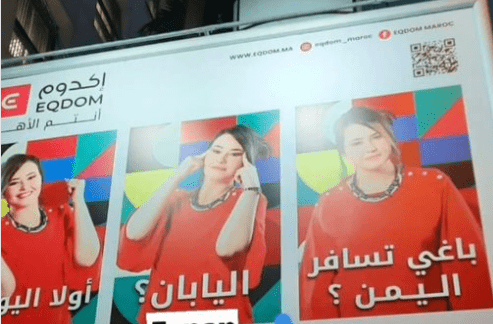
Rabat – Public outcry erupted on social media after people spotted a racist advertisement displayed on public billboards across cities. The ad was by the company EQDOM, a Moroccan agency that offers credit and loan services across several cities.
The billboard in question was advertising a loan plan for travel. It symbolized the destination “Japan” with slanted eyes, a stereotypical gesture that singles out the Asian community and reduces them to a single facial feature.
Several members of the Asian community in Morocco expressed their discontent with the advert on social media, decrying its “racist undertone” and lack of sensitivity towards the community.
Similarly, users across social media posted pictures of the billboard, tagging EQDOM and urging the company to remove the advert and issue a public apology.
Haneul Shin, a Korean living in Morocco, reached out to Morocco World News to express her discontent with the situation.
“When I first saw the street panel, I could not believe my eyes. The woman in the advertisement was stretching her eyes to represent Japan. Why did they choose not to use a flag? Why didn’t they employ a Japanese person?” she said.
Haneul said that although she is not Japanese, she has been part of the Asian community in Morocco for twelve years now and feels personally attacked and disappointed that “a big company such as EQDOM employs racist gestures.”
“It just strikes me how in 2021, a big company like EQDOM is still unaware of the problems behind these gestures,” she added.
Following the social media uproar, EQDOM removed the billboards but failed to apologize to the public until recently. When contacted by Morocco World News last Tuesday, EQDOM’s communication department representative responded this Saturday saying:
“EQDOM thanks you for drawing attention to this advertisement that has offended many people. This was not our intention. We are very responsive to our audiences and immediately removed the visual that is no longer part of the campaign. EQDOM apologizes for unintentionally offending our audience; we fully support the values of diversity and tolerance. The most important thing for us is you!”
The company also posted the same apologetic message to comment on the controversial advert on its social media pages.
The slanted eye gesture is often used by ordinary Moroccans on the street when they come across a person of Asian descent. More times than not, the gesture stems from ignorance rather than racism, yet it still is problematic.
“Actions such as slanted eyes and ching chong or calling Asian “Chinese” make me uncomfortable,” said Xynie, a Chinese student living in Morocco.
According to Haneul, having the slanted eye gesture used in an advertisement by a company like EQDOM further normalizes microaggressions instead of educating society that such mocking gestures are harmful.
Microaggressions are unintentionally or intentionally hostile or derogatory attitudes towards minority groups. Microaggressions come in different forms, from bluntly insulting words to veiled comments and mocking gestures.
The particularity of microaggression is that contrary to overt discrimination, people who perpetuate them might not even be aware of it.
This seems to be the case in this scenario, so it is essential to speak up against the advertisement and other microaggressions so more people realize its problematic nature.
It should be the mission of big companies such as EQDOM to enhance the public’s understanding and raise awareness among people by fostering tolerance and respect towards other ethnicities by avoiding such demeaning gestures, such as the slanted eyes one.
“Moroccans who see these posts might think that it is okay to do these types of gestures, but it’s not,” said Haneul, highlighting the importance of raising awareness to tackle this issue.
Everyday experiences of Asian people in Morocco share elements of similarity when it comes to how they are treated and talked to in the streets.
Hearing words such as “Nihaos” and “Ching Changs” and people shouting the names of countries such as Japan and China when they see Asians on the streets has become common and normalized.
While these practices stem more from ignorance than acute prejudice against Asian communities, they are nonetheless condemnable.
“Our community is tired of all the racism portrayed as “normal” AND ‘funny” in Morocco,” said Haneul.
She also noted that it is time that the Moroccan the community realizes that these words and acts are offensive to the Asian community and that the first step towards change should be to speak up against adverts that further normalize such attitudes.
“I want to clarify that most of the time, I understand that gestures such as the slanted eye or calling us Chinese in the street is not out of meanness but an expression of interest.
Nevertheless, people need to understand that good intentions do not make actions and words such as these any less racist,” she added.
EQDOM’s advertisement is problematic because it fails to demonstrate that such gestures are inappropriate and offensive to the Asian community.
In the wake of such normalized manifestations of racism, we as a community need to tackle this issue and raise awareness among people young and old.
The slanted eye gesture may appear innocent, but it is offensive and a microaggression against the Asian community. Our society must come to understand and address such racial aggressions instead of further normalizing them.
As a big company with a large reach and audience, EQDOM should not be complicit in encouraging racialized rhetoric and gestures. Instead, it should strive to showcase its commitment to the values of diversity and inclusion by avoiding clumsy campaigns that may hurt sensitivities.
The need to educate the next generation about these seemingly banal gestures that some Moroccans think are “okay” or “no big deal” is vital to enlighten our society and make it more inclusive.
Having such conversations may be uncomfortable or hard for some people. Still, it is necessary to tackle this larger issue and educate people about the dangers of stereotyping entire communities.
“Stereotypes are harmful and problematic because they give wrong impressions about one’s cultural background and even ignore that person’s personality,” said Xinye, a Chinese student living in Morocco in a statement to Morocco World News.
Xinye told Morocco World News about her experience as a member of the Asian community growing up in Morocco.
She said that she has met many people who have shown genuine interest in Asian culture and have approached her out of curiosity, but that she also came across individuals who rushed to judge her based on her looks.
“Some people label my Asian friends or me as “dog eaters” without giving us a second to explain the different cultures and traditions. Most of the time, they do that because they think it is funny, “she said.
Shying away from having an honest and open conversation on how our actions towards minority groups can be problematic is not the solution. The Asian community in Morocco deserves to be respected and listened to, and avoiding words and actions that can be offensive is a big step towards positive change and inclusivity in our society.




