
Rabat – The National Evaluation Body of the Higher Council for Education, Training and Scientific Research (INE-CSEFRS) published a report which examines the professional career of Moroccan university graduates four years after their graduation.
The study focused on 9,899 students from various universities across the country, from the 2014 graduating class. The information obtained from the students pertains to the difficulties encountered since graduation such as employment, unemployment, and pursuit of academic studies.
According to the results, more than two-thirds (69.4%) of higher education graduates are employed whereas 13.3% are actively looking for a job.
Meanwhile, 9.4% of students decided to pursue higher education while 7.9% are inactive in any educational or training program.
The survey also revealed that 82.1% of male graduates obtained their first jobs within the observation period following their graduation in 2014, compared to 66.7% of female graduates.
The study reveals a 15.4% gap in securing a first employment opportunity between both genders.
On average, the graduates of the 2014 graduating class took a period of nearly 11 months to find employment.
In general, fresh graduates find their first jobs in the private sector, and in small and medium-sized enterprises.
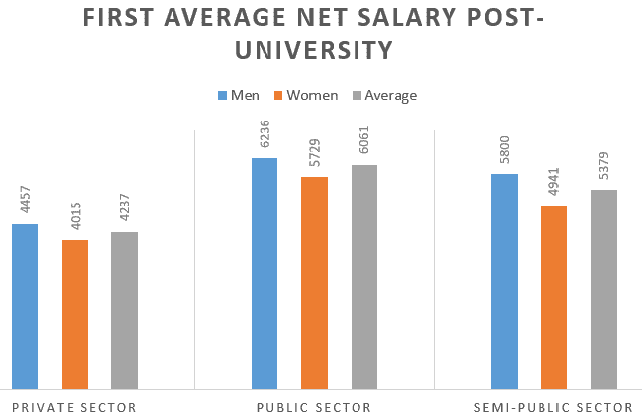
The first average net salary received by university graduates does not exceed MAD 4,959 monthly.
The pay gap varies according to each sector, with the public sector wage reaching MAD 6000 monthly, followed by MAD 5,379 in the semi-public sector and MAD 4,237 in the private sector.
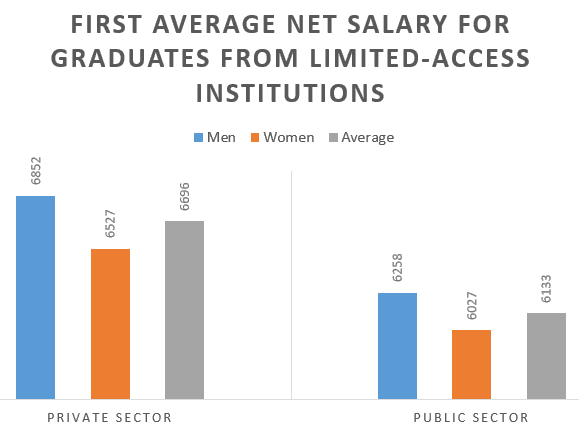
The data shows that graduates from institutions with limited access receive a monthly salary of MAD 6,133 in the public sector, compared to MAD 6,696 in the private sector.
The activity rate varies depending on gender and the type of diploma. Thus, the rate is relatively higher among men (89%), graduates of non-university institutions (93.9%), and those from private educational institutions (79.1%).
Meanwhile, women’s activity rate represents 76% whereas those graduated from post-baccalaureate vocational training institutions indicate an employment rate below the national average (66%).
The study saw a relatively higher rate of unemployment among women, with 20.9% compared to 12.3% for men.
Unemployment rate of graduates from post-baccalaureate vocational training and those of open-access university institutions represents 20.5% and 18.7% respectively, compared to only 2.9% among graduates of non-university institutions, 5.6% for graduates from private institutions, and 8.5% for students from educational institutions with regulated access.
The study concluded that 14.2% of open-access universities graduates face constant unemployment, with an average duration of 41 months.