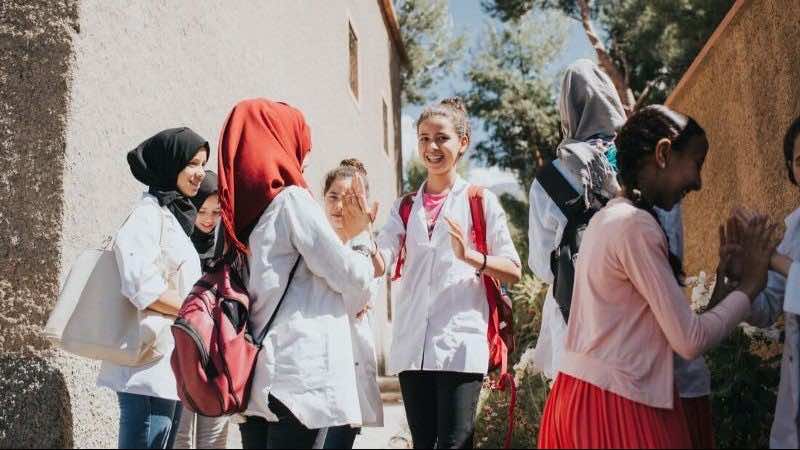
Rabat – The United Nations system for development in Morocco has launched an appeal to “reinvent the future for every girl.”
The UN’s call comes on the occasion of the International Day of the Girl, celebrated on October 11 of each year, and is part of the “reinventing the future for every child” campaign launched on May 25.
As part of the campaign, the UN Development System in Morocco is calling for the adoption of an integrated vision and approach to support and accompany the governmental program to place the realization of girls’ rights among the priorities that will determine the success of other goals.
Reinventing the future for girls means unleashing their potential to shape their own future through access to quality education, basic healthcare coverage, effective social protection services and functioning participation, as well as empowerment mechanisms, according to the UN system’s statement published this Saturday, October 9.
The statement emphasized Morocco’s “commendable” efforts on l children’s rights. While the country has made significant progress in terms of promoting and respecting children’s rights, it said, the current progress can still be reinforced with further efforts to overcome persistent challenges to equity and equality.
Challenges are still present, while Morocco’s ambitions remain dependent on the reinforcement of girls’ rights in the country, the statement suggested.
For instance, the net enrollment rate in the 1st year of high school is 11.2% among girls in rural areas, while girls constitute 76% of young Moroccan NEETs (Neither in education, nor in training, nor in work).
In terms of child marriage, 31.5% of married, divorced or widowed women were victims of early marriage before the age of 18, 41% in rural areas and 26.3% in urban areas.
This data is relevant to almost 30% of young women under 35 years of age and close to 27% among those aged 35 to 59 years.
As for the COVID-19 pandemic’s effects on Moroccan girls and women, the UN system said “it has accentuated the multiple vulnerabilities of girls, particularly girls with disabilities, those born out of wedlock,and those living in isolated rural areas.”
The right to quality education and/or training is essential to fully unleash Moroccan girls’ potential and have them contribute to the development of their society, argued the UN’s statement.
It added that reinventing the future for each girl is also about offering real opportunities to make the country’s ambition of the new development model a reality.
“In 2035, Morocco will be democratic in its full capacity to give girls control of their future and unleash their potential, to live in dignity within an open, diverse, fair and equitable society,” says the statement.
In reference to Morocco’s long term ambitions, detailed in the New Developpement Model, the statement added that the North African kingdom is set to become “a value-creating country that is developing its potential in a sustainable, shared, and responsible manner.”
Capitalizing on its significant progress at the national level, Morocco appears eager to establish itself as an exemplary regional power, at the forefront of the major challenges facing the world.
But, says the UN’s statement, this courageous ambition can only be fully realized if Morocco takes advantage of the contribution of each girl.
The statement concluded by calling for the rapid adoption and implementation of urgent actions, designed in an integrated perspective, to overcome the challenges that still persist in Morocco, particularly in education, social protection, and healthcare coverage.