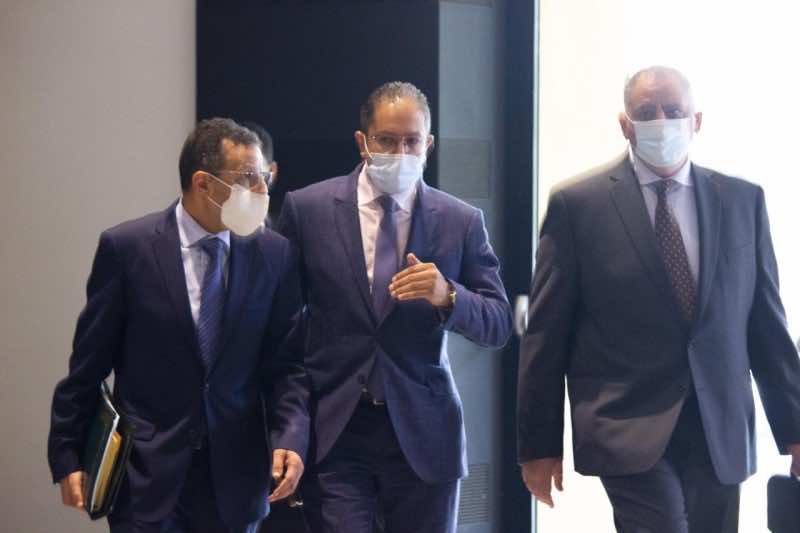
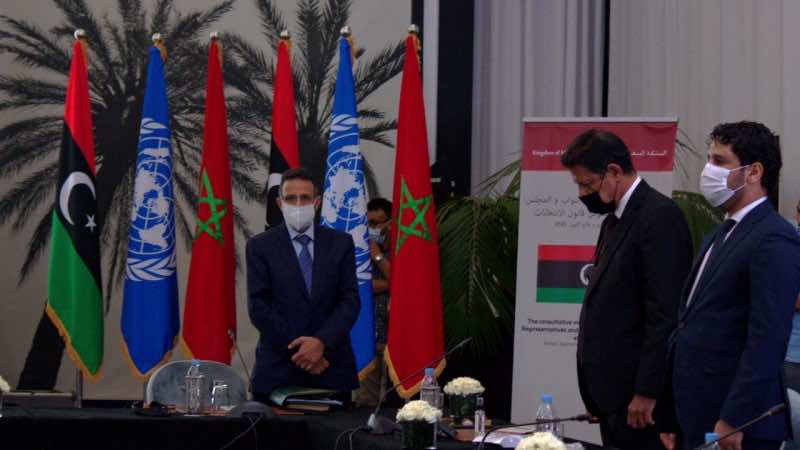
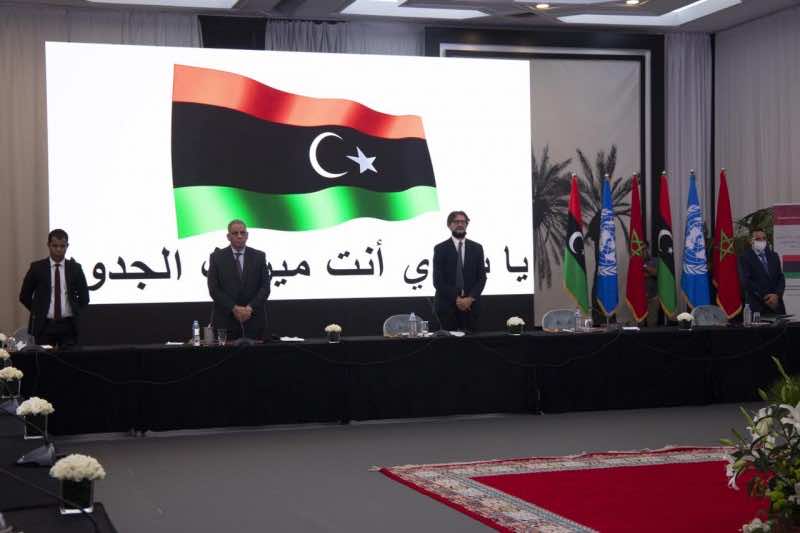
Rabat – The first day of consultative meetings between the Libyan High State Council and the Libyan House of Representatives commenced this Thursday, September 30, in the Moroccan capital, Rabat.
The consultations are held to discuss a pending Libyan electoral law, a crucial requirement ahead of the presidential and parliamentary elections in Libya scheduled for December 24.
The Libyan parties are yet to reach an agreement on a constitutional framework that establishes the required guidelines and details for the elections scheduled for the end of this year.
During this two-day meeting held behind closed doors, the two parties will discuss the primary issues concerning the organization of presidential and parliamentary elections, which are a vital element to the full restoration of stability in the country.
US stresses importance of talks
The Special Envoy and Ambassador of the US to Libya, Richard Norland, was also present at the meeting.
Norland stressed the importance of supporting all Libyan parties in order to formulate a road map for Libya’s recovery and stability.
In a statement to the media, the US official noted it was imperative that all Libyan leaders cooperate and make the necessary compromises in order to meet the aspirations of the Libyan people, and to hold free and fair elections this December 24.
The US ambassador spoke about the importance of the timing of the meeting, hosted by Morocco. The event brings together the House of Representatives and members of the Supreme Council of State, with Norland noting that “America supports Moroccan and international steps to unify Libya.”
A delegation representing the United Nations Support Mission in Libya (UNSML) is participating in the consultation meetings, urging the Libyan parties to “live up to their historical responsibilities and move forward with completing the legislative framework for the elections.”
Uncertain times
After years of intense fighting in Libya suddenly ended in the summer of 2020, Abdelhamid Dbeibah, a businessman and interim Prime Minister of Libya, formed a transitional government in March under UN auspices to oversee the democratic transition underpinned by the upcoming elections in December.
Last week, the country’s parliament censured the transitional government, a vote that raised “concern” from the UN and heightened tensions between the former warring parties as the country tries to turn the page on a decade-long state of chaos.
The High Council had stressed its “rejection of the procedure,” calling the move “void.”
On Thursday, the UN Security Council unanimously adopted a resolution extending its political mission in Libya until January 31.
Tensions between ruling institutions have recently resurfaced, largely due to disagreement between the House of Representatives, the High Council of State, the Government of National Unity, and the Presidential Council, particularly over prerogatives and electoral laws.
Morocco’s support for the Libyan peace process
Morocco’s hosting of the consultative meeting on the Libyan electoral law follows several Libyan dialogue sessions held in the Kingdom.
Earlier talks were marked in particular by the agreement on the mechanism of accession to the seven positions of sovereignty provided for in Article 15 of the Libyan Political Agreement concluded in 2015 in Skhirat.
On September 21, Khaled al-Mechri, President of the Libyan High State Council, visited Morocco, two weeks after the Speaker of the House of Representatives, Aguila Saleh’s visit.
Morocco had previously hosted five rounds of dialogue between rival parties in Libya, the last of which took place in January 2021, during which the various parties agreed on the partition of ruling positions and prerogatives.
Morocco has maintained, on more than one occasion, that a democratic election is the only viable solution to end the Libyan crisis, and bring peace to the North African country.
For over a decade, Libya has been embroiled in conflict. With the support of Arab and Western countries as well as mercenaries and foreign fighters, forces led by Khalifa Haftar nearly overthrew the internationally recognized government.
Fighting unexpectedly stopped in 2020, starting a tenuous peace process that has faced significant obstacles. On March 16, a new unity government and Presidential Council took power with the express duty to organize legislative and presidential elections scheduled for December 24.