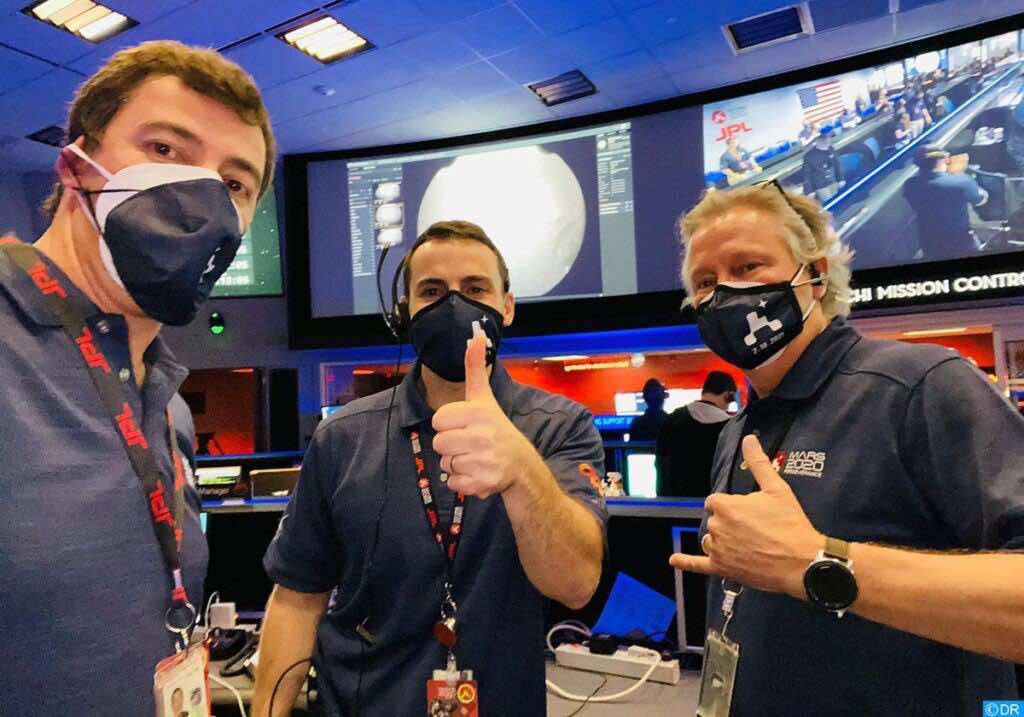
Rabat – Moroccan scientist Kamal Oudghiri is part of the NASA team that uncovered startling new findings relating to Jupiter’s atmosphere.
On October 28, NASA published a piece to announce new findings from the Juno probe orbiting Jupiter.
The space agency emphasized that the findings provide a “fuller picture of how the planet’s distinctive and colorful atmospheric features offer clues about the unseen processes below its clouds.”
NASA said that the outcome of research and exploration shed light on the “inner workings of the belts and zones of clouds encircling Jupiter, as well as its polar cyclones and even the great Red Spot;”
NASA also emphasized that scientists and observers published multiple findings and research papers on atmospheric discoveries.
Morocco’s state media agency reported that Oudghiri is part of the NASA team that contributed to the new discovery.
The news agency emphasized that Oudghiri co-authored one of the research papers published by the prestigious scientific journal Science. The piece investigated the depth of a massive continual storm on the planet, known as the “great red spot of Jupiter” which the team determined through “gravity flyovers” by NASA spacecraft Juno.
“We have known for a long time that the diameter of the great red spot is over 10 miles wide, which means that our planet Earth could fit completely inside this storm. But we had no idea what it was.”
Oudghiri, a gravity sinaiticus at NASA’s Jet Propulsion Laboratory in southern California, emphasized that the storm is considered the largest in our solar system.
“Wider than the earth, this votex has intrigued scientists since its discovery more than two centuries ago,” MAP said.
NASA’s Juno probe entered Jupiter’s orbit in 2016. The Juno probe discovered that the big red spot is deeper than what scientists previously thought.
“By relying on a very high precision gravity science instrument on Juno, we were able to limit the depth of the storm to between 300 and 500 kilometers,” Oudghiri said.
He added that the findings are important because “we can now begin to put all the pieces of the puzzle together of this gigantic storm. This will allow us to better understand the atmosphere of Jupiter, how the giant planet was formed, and its role in our solar system,” the Moroccan scientist argued.
One of the main goals of the Juno mission is to understand the evolution and origin of Jupiter.
The probe sets out to study the existence of a solid planetary nucleus to map the intense magnetic field of Jupiter and to measure the quantity of water and ammonia in the deep atmosphere.