


 Join on WhatsApp
 Join on Telegram
Agadir – As Morocco celebrates the return of international travel, workers in tourism continue to feel the loss of regular revenue for two years. It will be a slow and difficult crawl out of debt and return to business as usual for the untold millions of people who serve in Morocco’s tourism industry.
From the outside, Karim Riah’s family business, World of Waves Surfhouse in Taghazout, looks like a healthy business with a handful of customers sipping beverages on their patio overlooking the Atlantic Ocean. Above Riah’s restaurant is a hotel serving mostly the surfers and yoga enthusiasts who normally flock to the coastal city. The hotel is open, though they have admitted only one guest at the end of January, which is the high season for surfing.
National Geographic named Taghazout among the “Best Adventure Destinations to Visit in 2022” but currently the village is extraordinarily quiet with uncountable storefronts closed. Riah explained to Morocco World News how the entire village has been devastated by the border closures.
The effects of a complete halt to international tourism has affected not just businesses directly working in the sector. Riah says “it is not just hotels and restaurants” that are hard hit. Businesses that survive on “tourism-related revenues” have closed. “For example… the guys who sell meat, the guys who sell vegetables, the guys who sell carpets, the guys who have camels… even the haircut shops, all the services because, in fact, the whole village has been built around the business of tourism.”
Riah describes how from his perspective, closing the borders to manage Morocco’s epidemic is “a complete disaster.” Riah says that in Morocco “we do not see the point in closing the borders.”
Just as the virus is circulating all around the world and in countries that did not close borders “the virus is circulating here as much as Europe… everyone around us has gotten sick. So it doesn’t make any sense to close the borders and think we are protected by that. We are literally only one of a few countries in the world doing this.”
Moroccan doctor and researcher in health policies and systems Tayeb Hamdi made similar statements in a Facebook post. He addressed that fully vaccinated travelers with a negative PCR certificate are “less risky epidemiologically” than people in Morocco who are not following preventive guidelines. Life goes on with children returned to school and those with jobs continuing to work, paid or not.
Because Riah’s restaurant remained open during the pandemic and border closures “people think we are really successful. This is really funny,” Riah huffs at the myth. On a Thursday night, which is usually very busy for the restaurant, they have two guests. “Why are we open? We have no choice. If we are closed we lose even more money than if we are open.”
Like most businesses in the tourism sector, Riah has fixed costs that he must continue to pay with or without clients or else he will lose his business and be left with nothing. “We have to pay rent, pay credits to the banks, and salaries. We have more than 20 people working and we don’t want to fire them. We don’t want to fire the people who helped us make this project successful.”
Another myth Riah addresses is regarding government aid. His business is not receiving aid from the Moroccan government.
Even though his family’s business serves almost entirely tourists he says, “We are not classified by the tourism ministry to get any subsidies.” Their classification as a restaurant outside of Agadir city leaves them and their employees without any help from the government.
Far too many people are left out of the aid the Moroccan government has earmarked for the tourism industry.
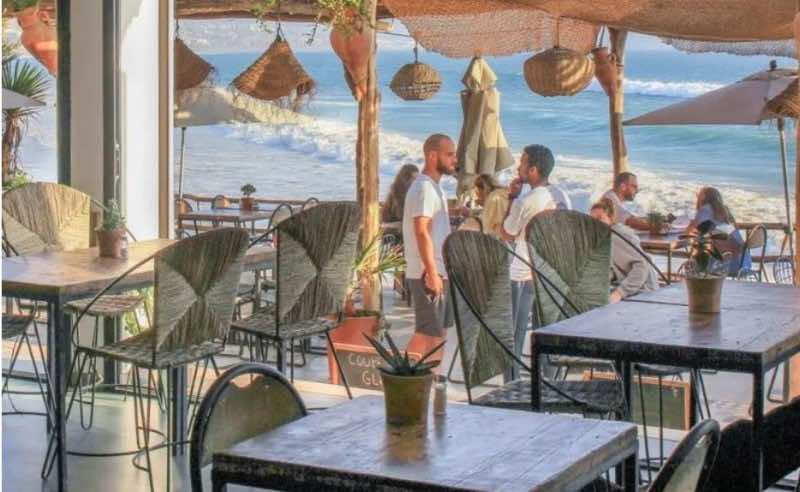
World of Waves Surfhouse, Taghazout
Those left behind
Some of those excluded from subsidized help staged a nationwide sit-in organized in Marrakech, Agadir, Tangier, Laayoune, Dakhla, Casablanca, and other cities. The union office of restaurants and coffee shops, the association of taxi drivers, the organization of tourist transport, and travel agencies were among those protesting exclusions from the emergency plan for tourism.
Riah notes that even though the subsidies are a “nice help” for those who receive them, “2000 dirhams is not enough to run families. It is impossible.”
Soufiane Boulahyaoui was an employee who worked up to a management position at a multi-operational business in Taghazout and briefly received the MAD 2000 ($212) monthly subsidy. During border closures, his employers could not renew his contract and he has not received any proper wages or subsidies since March 2021.
Boulahyaoui studied economics at a university in Agadir. He chose to go into the tourism sector because when he grew up, tourism appeared to be the most affluent field in Agadir. He has found his outgoing personality suits the work and enjoys helping tourists find the “good vibes” in his beautiful region.
As much as Boulahyaoui “loves” working in the tourism sector, the young man feels the Moroccan government should take more responsibility for the workers’ suffering as it built the economy on tourism, leaving people like him with few other job options.
With the borders now open, there will not be an immediate return to business as usual. Even for those who can reopen and return to work, there is debt and emotional impact to heal from. As well, there are lingering fears that the Moroccan government will close borders again as an impractical solution to an ongoing pandemic.
What remains absent from these conversations is how the already disadvantaged uncontracted workers have been grossly affected. Already hired and used illegally, workers without contracts have not received any social support and are unlikely to easily find jobs with remaining businesses running on a bare minimum.
Read also: National Geographic: Morocco’s Taghazout Among Best Adventure Destinations to Visit in 2022




