


 Join on WhatsApp
  Join on Telegram
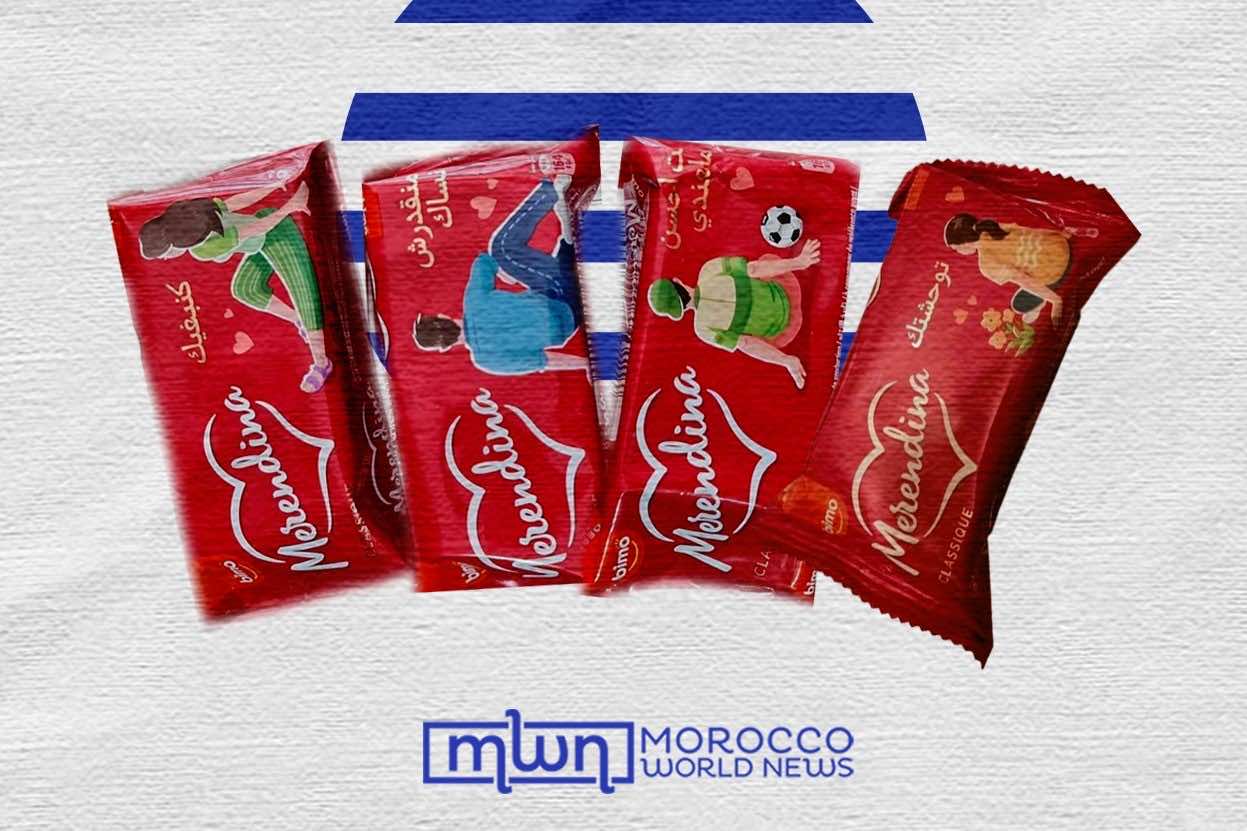
 Rabat – Ahead of Valentine’s Day, Bimo has introduced new packaging for its popular product, Merendina. It features drawings and love-themed catchphrases written in darija (Moroccan Arabic dialect). Soon after its release, the Moroccan public quickly divided between supporters and condemners of the messages.
Is it a first for Merendina?
The new Merendina packaging contains common love-themed catchphrases, such as Kan Bghik (I love you), twahachtek (I miss you), mankdarch nsak (I can’t forget you), ana wiyak wahed (you and I are one), rak dima fkalbi (you are always in my heart), and nta ahssan maa’ndi (you are the best thing I have).
This isn’t the first love-themed campaign for the company. In 2017, Merendina partnered with Raibi Jamila to release a Meredina cake with Raibi Jamila filling. The two companies launched a social media campaign, producing visual and audiovisual content about the love story between Merendina cake and Jamila drink. The campaign was the subject of heated discussion on social media platforms across Morocco.
In 2020, Merendina rebranded its cake using the phrase khelli kalbek ydoub (let your heart melt). The expression is still used in social media posts by Bimo and its parent company Mondelez International.
Morocco World News was not able to find any press release by Bimo or Mondelez International commenting on the packaging controversy. When contacted via email, their marketing company did not react to a request for comment for this story.
Public reaction
The newest statements raised another heated debate on using love-themed catchphrases in Moroccan society. With the public divided between supporters and condemners, social media is flooded with a scope of opinions on the case. Public figures joined the conversation as well.
Some view the love-themed expressions as “indecent” and “conflicting to Islamic and Moroccan morals.” News of a Merendina boycott spread quickly on Moroccan social media after the circulation of a picture taken in a grocery shop. The image captured a box of Merendina cakes with a handwritten note on top saying “Not for sale, it contains indecent language.”
The Merendina discussion grew in Facebook groups, including some particularly for shopkeepers. While some shopkeepers did not mind selling the product, others called for a boycott. Among the boycotters there is the Bab Al Sahara Food Retailers Association in Guelmim that released a statement condemning the product.
The retailers association wrote that “following Mondelez International’s placement of suggestive graphics on Merendina packaging that promote moral decay and degradation, the members and associates of the Bab Al Sahara Food Retailers Association in Guelmim condemn this act,” the post added that the act is “unusual for Bimo.”
The association concluded the post by stating “May God safeguard our country, our King, our people and the entire Islamic nation.”
The boycotters launched two hashtags in Arabic to denounce the new packaging, #our_children_are_a_red_line and #boycott_campaign_meredina.
In contrast, another segment of Moroccans supported the Merendina initiative. The Moroccan social movement Moroccan Outlaws 490 launched #Meredinagate as a response to the public opposition to the new packaging. The group took to Twitter stating:
“For the Merendina gate, we will NEVER repeat it enough: Love is not a crime, Lhob machi jarima. And as long as we have laws that, on top of everything, criminalize Love, then we must fight!”
In a statement to Morocco World News, Narjiss Benazzou, President of the 490 collective, commented on the Merendina controversy.
“We were shocked by the violence of certain remarks and in particular the call for a boycott provoked by a few words expressing love or tenderness in Moroccan dialect,” she said.
Benazzou also “denounced the hypocrisy” and “self-censorship” present in Moroccan society as these acts “condemn the freedom to love and to be loved.”
Some Moroccan netizens highlighted the “hypocrisy” of Moroccan society, noting that Moroccans privately admire love songs, series, and movies, as well as commonly date but, refuse to read expressions of love on a cake packaging.
Some users even expressed “disgust” with the “narrow-minded” and “conservative” individuals supporting the boycott.
Why did some people refute the packaging?
The conflict over love-themed expressions on the Merendina packages could be explained by a disagreement between two approaches towards expressing love. In relatively conservative societies, the direct expression of love is a matter reserved for private spaces.
Public displays of affection, whether physical or verbal, are considered hchuma (shameful or inappropriate).
In 1997, American author and pastor Gary Chapman published “The Five Love Languages.” The book argues that there are five languages of love expressed by humans, including words of affirmation, quality time, receiving gifts, acts of service, and physical touch.
“The Five Love Languages” has remained on the New York Times Best Seller list since August 2009, sold over 20 million copies, and is translated into Arabic among other languages.
In Morocco, people tend to express love through acts of service or receiving gifts like on Eid or other special occasions. Physical touch and words of affirmation are rarely used in the public space. In incidences of their use, some segments of Moroccan society tend to strongly disagree with such acts.
While the new Merendina packaging may attempt to fall under the love language of receiving gifts, it remains problematic as it is a public expression of love.
Still, an ideological shift witnessed over the past decade within Moroccan society led to the emergence of new reformist ideas. Youth gradually reject the “narrow-minded,” “conservative,” and “outdated” understanding of love as they refuse to perceive love as taboo or hchuma whether it is within or outside wedlock.
Sociologist Laura Menin, a postdoctoral fellow at the University of Milano Bicocca, explained this shift in her 2018 article “Texting romance: mobile phones, intimacy and gendered moralities in Central Morocco” published by Taylor and Francis Group.
Menin followed the intimate communications of a young unmarried Moroccan couple, Zahra and Yassine, in urban Central Morocco. She sought to study the texting romance phenomenon in the North African Muslim country.
“Following the emergence of a ‘youth culture’ of love and dating in the past decade, both the romantic desires and the gendered norms shaping the dynamics of intimate exchange have been (re)mediated, performed and reimagined through digital technologies,” she said.
She found that the mobile phone was not “only a powerful ‘mediator’ between intimate desires, social expectations and public morality” but also “integral to the ways Zahra and Yasmin reflect on, and act in, their intimate and moral worlds.”
While Menin’s study focuses on intimate and private exchanges of love within a relationship, it highlights the role of technological developments in reforming Moroccans’ approaches to issues such as love and intimacy.
As 84% of Moroccans have access to the internet, as the World Bank reported in 2020, Moroccans and particularly youth are increasingly exposed to other expressions of love that do not necessarily conform to Moroccans’ traditional understanding of love. The exposure might lead to a gradual acceptance of more overt and public displays of love.
This shift is highlighted in comments and posts by supporters of the new Merendina packaging as they describe the love-related phrases as “normal.” Through supporting the Merendina campaign, they are setting a new Moroccan norm on love – particularly outside of wedlock or private settings.


