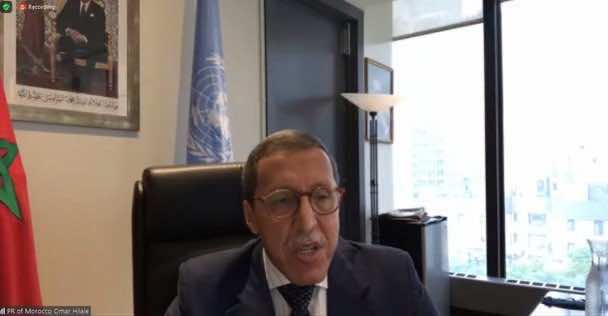
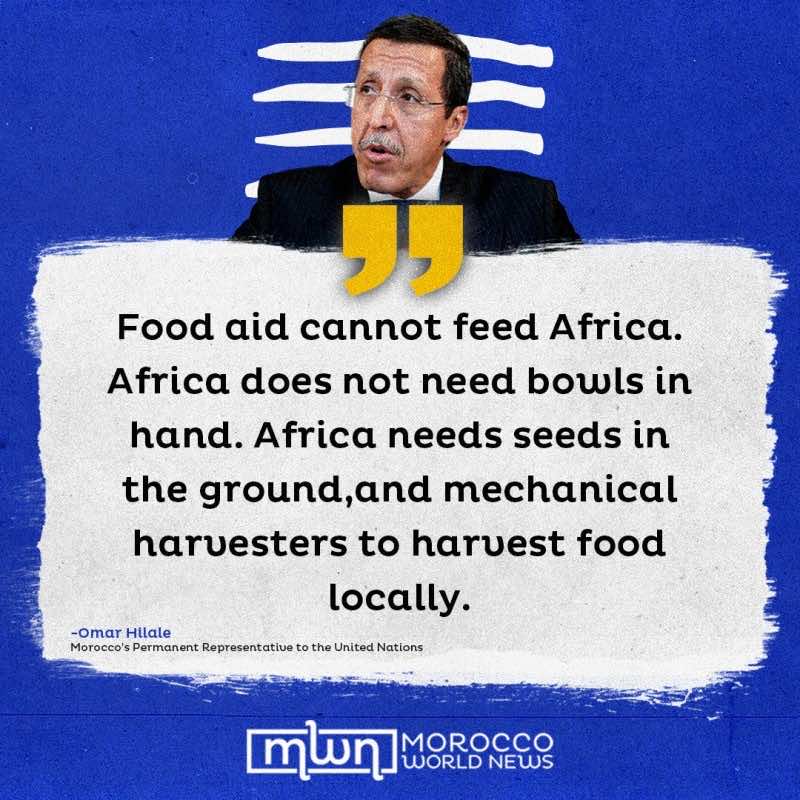
Rabat – Morocco’s Permanent Representative to the UN Omar Hilale on Thursday said that “Food aid cannot feed Africa,” adding that “Africa needs seeds in the ground and mechanical harvesters to harvest food locally.”
The Moroccan ambassador shared his country’s perspective on tackling the current food crisis, stressing the necessity to prioritize food resilience and sovereignty in African policy-making.
“With the world’s geopolitical tensions, food security in Africa demands even more urgent and serious attention,” Hilale said.
Faced with conflicts, food insecurity, climate change, and a pandemic, UN Secretary-General Antonio Guterres argued in the same talk, that Africa’s “decades of progress on hunger are being reversed.”
The UN’s top official called for addressing the present problems as “systematic” issues that “are getting worse.” His statement urges a break from the traditional understanding and tackling of African burdens as “separate issues.”
Guterres further recalled the obligation of “developed countries” in delivering “their $100 billion climate finance commitment to developing countries” to accelerate their economic recovery from the pandemic.
In 2009, rich countries pledged to support less fortunate nations by providing $100 billion in financing every year. Unfortunately, 13 years later this annual commitment still lacks more than one-fifth of the pledged amount despite the growing climate crisis.
Considering that one in five Africans were undernourished in 2020, the UN diplomat said that women and girls are the most affected by food shortages, as they are “often the last to eat; and the first to be taken out of school and forced into work or marriage.”
Read Also: Morocco Reaffirms Food Security Commitments in Security Council
To address this lingering issue, the Central Emergency Response Fund (CERF) allocated $30 million to address “urgent food security and nutrition needs” in Niger, Mali, Chad, and Burkina Faso. “But, this is a drop in the ocean,” Guterres noted.
While food aid helps address urgent situations, sustainable and long-term investments in resilient agricultural solutions in Africa are essential, as Hilale and many development experts have argued.
In March, Morocco’s Minister of Agriculture Mohamed Sadiki said that Africa has untapped natural resources that could ensure food security across the continent. He also underlined that climate change, population growth, and weak economic growth are major burdens on Africa’s sustainable development in the face of environmental and security issues.
He thus called for regional cooperation in the form of “fair, just and balanced economic relations between the Kingdom of Morocco and African countries.”
The south-south cooperation, a similar concept to peer-to-peer learning, can be helpful in addressing the structural issues threatening African food security. Yet this cooperation should focus on capacity-building and the development of sustainable, smart, and green solutions to break reliance on foreign aid.