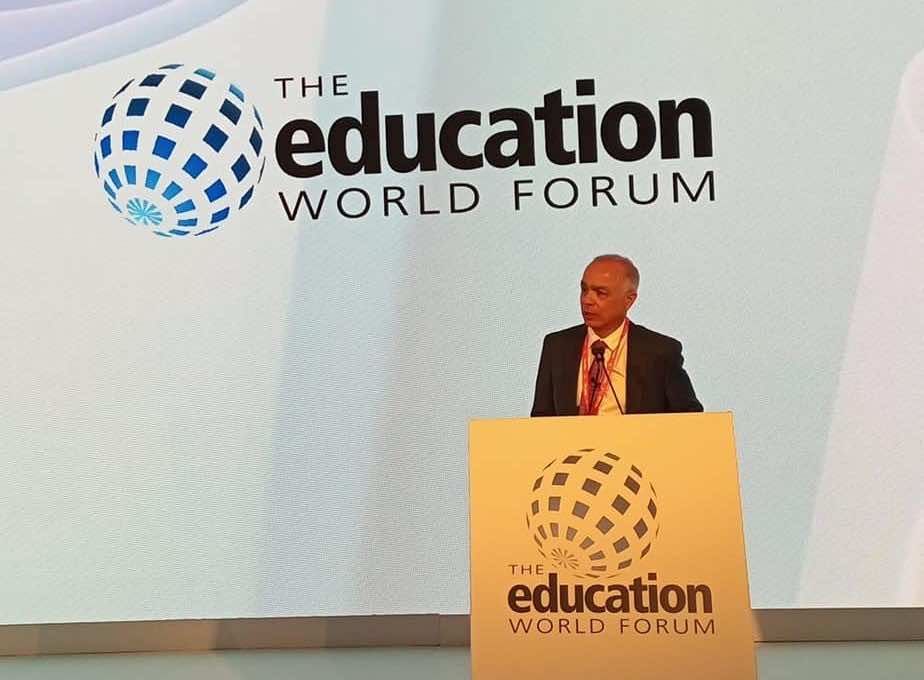
Rabat – Moroccan Minister of National Education, Pre-School, and Sports Chakib Benmoussa participated this week in the world’s largest gathering of education in London, where he reiterated Morocco’s interest in cooperating with the UK’s higher education institutes and the British council to promote the English language and educational and cultural exchange between Rabat and London.
Benmoussa participated in the three-day Education World Forum (EWF) from May 22 to 25 to share insights on prospects of cooperation between Morocco and the UK in the education and culture sectors.
The Moroccan minister addressed the EWF participants on Tuesday, making him the second Moroccan and Maghreb Minister of Education to do so.
Benmoussa discussed Morocco’s Roadmap for Education and its alignment with the New Development Model which calls for students’ and teachers’ capacity-building and the creation of modern, inclusive, and innovative educational and vocational establishments.
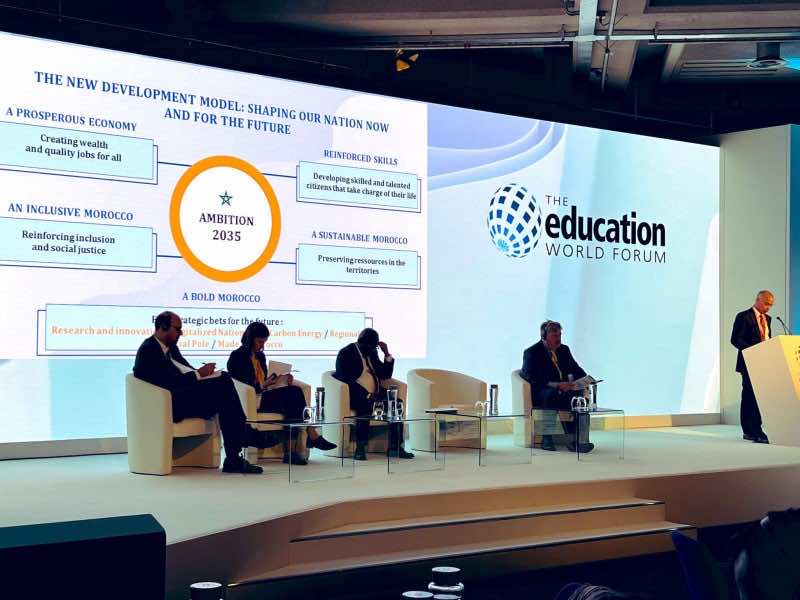
Addressing this year’s theme, “Education: building forward together; stronger, bolder, better?,” Benmoussa delivered a speech in the presence of senior officials from UNESCO, the World Bank, OECD, and the British Council. As well as experts and educational pioneers, more than 112 education ministers attended the international event.
On the sidelines of the EWF, Benmoussa took part in a series of bilateral meetings with British stakeholders in the education sector and called for the strengthening of educational and cultural exchange between London and Rabat. He further supervised preparations for the upcoming opening of a branch campus of Coventry University in Morocco.
Organized by the British Council in Morocco, in coordination with the UK’s Foreign, Commonwealth, and Development Office (FCDO), Benmoussa’s visit underpins the educational and cultural pillar of the UK-Morocco Strategic Dialogue.
Read Also: English to Take Center Stage in Morocco’s 2023 Education Reform
In December, the UK Secretary of State for Foreign Affairs Liz Truss and her Moroccan counterpart Nasser Bourita affirmed their commitment to capitalize on the Moroccan youth’s interest in the English language and UK-inspired education.
They spoke of creating new opportunities for learning the English language, training English teachers, as well as furthering research collaboration and transnational education.
Morocco and the UK have notably established a Higher Education Commission to consolidate deepening educational and cultural exchange as well as support the Moroccan student community in the UK which annually grows by 1,000 members.
In March, the commission’s 4th meeting concluded with the signing of two partnership agreements between Moroccan and UK institutions as well as a Memorandum of Understanding (MoU) between the UK’s Quality Assurance Agency (QAA) and Morocco’s National Agency of Evaluation and Quality Assurance (ANEAQ).
The agreements called for the promotion and implementation of innovative, English-speaking, and quality programs within Moroccan universities.
Promotion of the English language in Morocco
As Morocco partners with British institutions to promote the English language among its youth, the idea of replacing French with English has been at the center of public debate around the reform of Morocco’s education system.
Despite the increasing popularity of English among young Moroccans, recent studies have confirmed some concerns over Morocco’s readiness to shift to English teaching, notably reporting the country’s “low” ranking in the English proficiency index. In 2021, Morocco ranked 71th (out of 112) in the index.
Yet the growing interest of Moroccan youth in the English language and culture provides a promising future for the foreign language in the North African country.
The British Council in Morocco, for instance, noted in its 2021 “Shift to English” report that “English is expected to become Morocco’s primary foreign language in the next five years, as well as the foreign language most widely spoken among youth.”
The report concluded that 37% of English-speaking participants learned the language in schools or in training institutes (6%). The rest were self-taught either through online exposure to the language (17%) or with the help of language applications (7%).
Moroccan institutions’ willingness to promote the English language, the increase in British council representations in Morocco, and the growing interest of Moroccan youth in English as a complementary or alternative to French provide a strong ground for the internationalization of the Moroccan education system and the modernization of the job market to further make Moroccan graduates competitive on the global stage.
Read Also: Most Moroccan Scientific Publications are Written in English