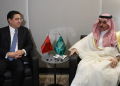
Casablanca – Morocco and Spain are set to enjoy a new phase of positive cooperation and stronger ties, according to both countries’ foreign ministers.
Following their long-awaited first bilateral meeting yesterday in Marrakech, Spanish Foreign Minister Jose Manuel Albares, and his Moroccan counterpart Nasser Bourita announced that the two countries have entered a new phase of diplomatic ties as a result of the joint declaration issued by the two nations.
The two countries released a joint statement following Spanish President Pedro Sanchez’s recent visit to Morocco which resulted in yesterday’s ministerial meeting. The statement aims to announce the start of a new chapter in bilateral ties.
According to Bourita, this important meeting was “necessary to address the steps we have taken in implementing the road map” that was agreed upon during the visit of the Spanish Prime Minister to Morocco last April, at the invitation of King Mohammed VI.
“On the basis of this commitment, and in accordance with King Mohammed VI’s clear instructions,” Bourita noted, during a press conference following the meeting, that “the Moroccan side is working toward the full implementation of all elements of the joint statement, including those related to the flexible movement of people and goods between the two countries.”
He further emphasized that Morocco will continue to implement the elements contained in the joint statement using the same logic of close dialogue in order to achieve the King’s and the Spanish Prime Minister’s vision of “a strong, renewed relationship and partnership in all fields.”
A win-win cooperation
The outcomes of bilateral collaboration are beginning to be realized on the ground, whether in the sector of migration, security, or economic cooperation. So far, Moroccan-Spanish cooperation has been exemplary and acknowledged at the regional, European, and global levels, Bourita said.
Since Morocco’s monarch held in-depth meetings with the Spanish Prime Minister, diplomats from both countries have been hard at work. Recent cooperation included discussing the transit procedure for Operation Marhaba 2022, reopening maritime links between the two countries, and the convening of Moroccan-Spanish working groups on migration.
Bourita added that the two parties are expected to meet for bilateral cooperation on culture and educational scientific exchange, as well as two additional teams for marine boundary demarcation and airspace management, in addition to the bilateral visits.
Bourita assured the Spanish foreign minister that “Spain can count on Morocco as a reliable partner, honest and responsible partner to build an exemplary partnership between two neighboring countries that share multiple interests and a common history.” He added that Morocco desires to strengthen consultations with Spain on international, regional, and multilateral issues.
On the other hand, he highlighted Morocco’s reliance on Spain as a partner and ally in its dealings with the European Union. Bourita noted that the Spanish-Moroccan relationship “is not against anyone, but rather to protect bilateral interests, develop partnership, and enhance security and stability.”
The Moroccan diplomat also expressed his country’s desire to cooperate with Spain on a framework for cooperation in the Euro-Mediterranean area, as well as on regional and security challenges in the Sahel, North Africa, and the rest of the African continent.
Moroccan-Spanish economic outcomes
During his meeting with his Moroccan counterpart yesterday, Manuel Albares reaffirmed Spain’s commitment to the objectives outlined in the joint statement issued at the end of the Spanish prime minister’s visit to Morocco in April.
Following their meetings, Manuel Albares stated in a joint news conference with Bourita that the two nations are making steady efforts to advance their new agreement. He applauded the amount of investment between the two countries, highlighting that roughly 800 Spanish companies have been established in Morocco.
Thanks to these investments, he added, Morocco has become Spain’s main market outside the European Union, while Spain remains Morocco’s first customer and supplier.
Manuel Albares additionally praised the momentum in migration-related cooperation. He noted that the resumption of bilateral cooperation in this field contributed to a significant decrease in the flow of irregular migrants to the Canary Islands and the Iberian Peninsula, thanks to cooperation between security authorities in both countries.
The restoration of collaboration around Operation Marhaba, according to the Spanish minister, is another good example of the resuscitation of bilateral ties based on transparency and mutual respect.
Fighting against terrorism: Uniting Morocco and Spain
In addition to other critical international concerns, Morocco and Spain are on the same page when it comes to fighting extremism.
The Spanish minister used the press conference to reiterate his country’s commitment to fighting terrorism with Morocco, emphasizing that cooperation between the two nations is the sole guarantee of the two peoples’ security and prosperity.
He also highlighted his country’s intention to expand this collaboration to regular cooperation in all bilateral domains.
Western Sahara: A fateful file between Morocco and Spain
Bourita stated Tuesday in Marrakesh that the Spanish government’s backing for Morocco’s autonomy plan is part of global efforts to find a solution to the artificial dispute over the Western Sahara region, emphasizing that “the kingdom appreciates and values this new position.”
Bourita asserted that this position is entirely consistent with the Security Council’s vision, aligns with international trends, and echoes the position of many European countries and the majority of Arab and African countries.
“Whoever wants this conflict to continue, with the instability it creates in the region and the suffering of detainees in the Tindouf camps, can continue to encourage the status quo,” Bourita told. This instability “has been going on for four decades and could be prolonged if there is no mobilization to settle this conflict, within the framework of the only possible solution,” Bourita stated as he referred to the Autonomy Initiative.
Bourita concluded that the joint statement issued last April has opened new horizons for bilateral relations. According to Bourita, the joint statement highlighted a series of initiatives and measures that should be taken to give bilateral ties a strong push.
The new chapter of relations between the two neighboring nations is “based on collaboration, coordination, ambition, and mutual respect,” underlined the Moroccan diplomat.