 Join on WhatsApp
 Join on Telegram
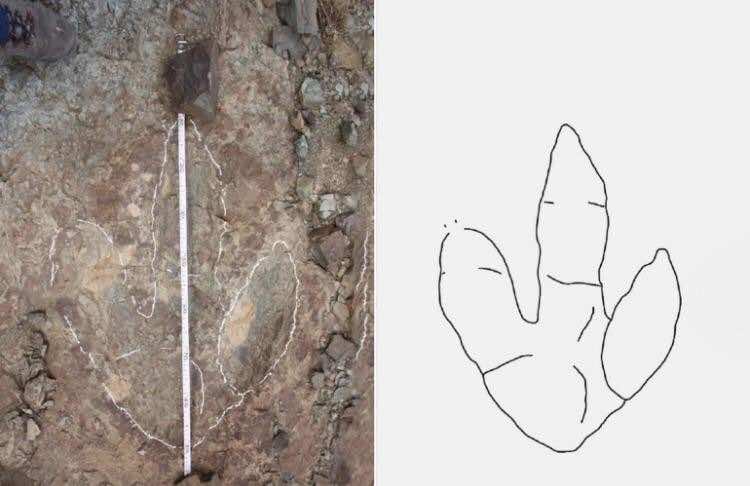
Fez – A group of archeologists in Morocco’s Imilchil in the High Atlas Mountains has recently discovered “colossal” dinosaur footprints dating back to about 176 million years ago, during the Middle Jurassic period.
According to the findings published in the Journal of African Earth Sciences, the footprints belong to a theropod, a flesh-eating species of dinosaurs. Theropods (literally means “beast foot”) are believed to have included some of the largest carnivores to have ever walked the Earth.
The authors of the study said that the footprints, found in the Taghighacht’s archeological site in the Imilchil region, are longer than 70 centimeters – a rarity in the international records.
As of today, the pair of the newly discovered footprints add up to only 26 colossal theropod footprints found worldwide, noted the authors.
Speaking to Al Jazeera, Moussa Masrour, a researcher at Agadir University and one of the authors of the paper, said that the new discovery is another milestone for Morocco’s rich archeological sites.
“The Imilchil region remains very rich with dinosaurs’ footprints as well as other animals who had lived during this period in the region. I think that it takes years of work to cover all these kinds of footprints,” he told Al Jazeera.
Masrour had embarked on a four-year journey to uncover the fascinating discovery alongside a multinational group of archeologists from Spain, the United States, and Morocco. Throughout the past years, the team regularly visited the archaeological site, conducting large-scale searches for dinosaur footprints.
Read also: The Most Fascinating Scientific Findings Within Morocco in 2021
Morocco has seen significant scientific findings in recent years, allowing archeologists to uncover some of the most fascinating secrets of ancient civilizations.
In 2021, scientists discovered a dinosaur fossil with “bizarre” spikes dating back to about 168 million years ago in Morocco’s Boulahfa in the Middle Atlas Mountains.
The fossil belongs to an Ankylosaurus, a type of herbivore species of dinosaurs that are known for their “ebony armpit that once covered their backs,” according to the Natural History Museum.
The discovery is unprecedented to scientists and archaeologists alike, as it is the first time a fossil of this type has been discovered in Africa.