 Join on WhatsApp
 Join on Telegram
Casablanca – Morocco’s current investments all have one overarching goal: to make sustainable development a critical social initiative and a new model for development.
Morocco first joined the international community in subscribing to the Sustainable Development Goals (SDGs) program in 2015.
It has since considered these goals to be one of the key pillars of its New Development Model (NDM), which focuses on the implementation of initiatives aimed at pollution avoidance, climate change mitigation, and preserving biodiversity and water resources.
Morocco’s commitment to the principles of sustainable development within the economy, society, and environment has resulted in a series of changes aimed at laying solid foundations for economic growth.
In fact, Morocco’s efforts to implement the SDGs are part of a massive investment campaign that began in the early 2000s.
As a result, a third of the country’s GDP has been allocated to economic and social infrastructure and reducing poverty and social inequities, with particular attention paid to the consequences of climate change.
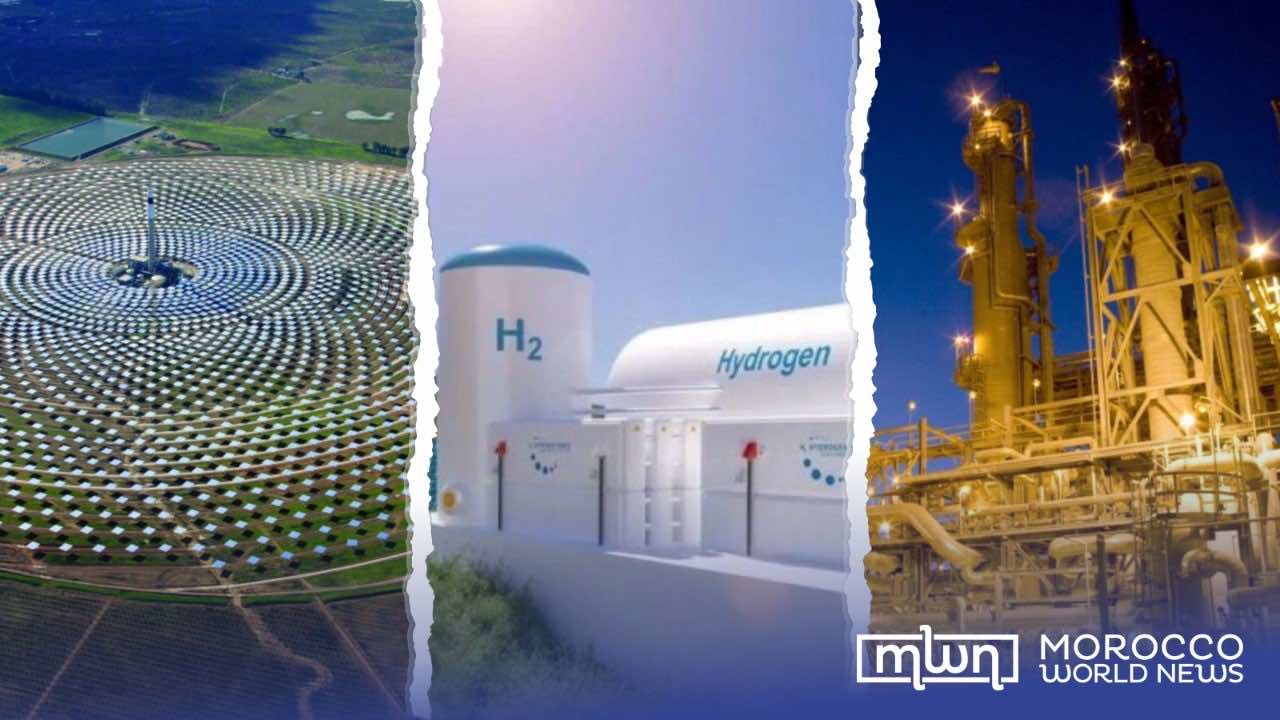
The Moroccan government’s most recent sustainability efforts may be seen in the country’s ambitious new projects, particularly the green energy and hydrogen endeavors.
Morocco’s breakthrough in green energy
Since 2009, Moroccan authorities have implemented a new energy policy that focuses on reducing energy dependence on foreign sources and expanding access to energy at competitive, ecologically friendly pricing.
As the Covid pandemic greatly restricted fuel imports, Morocco was forced to further prioritize sustainable energy independence by transitioning from a country that imports all of its oil and gas to one that generates renewable energy by utilizing wind, solar, and marine currents energy.
Morocco currently imports nearly all of its energy, and its gas output meets less than 20% of the country’s demands, particularly for power generation.
Spurred on by the limited fuel imports, the government is attempting to diversify its energy market by focusing on alternative energy projects to generate electricity while also building a number of oil and gas reserves to meet the rising energy demand.
In a report released in April 2021, the World Economic Forum ranked Morocco third in the Arab world and 66th globally in terms of accomplishing a successful energy transition by 2022.
The Moroccan strategy aims to boost the usage of power from the Noor plant in Ouarzazate in order to secure the country’s independence from foreign energy sources.
The Noor Ouarzazate Solar Complex, the world’s largest concentrated solar power plant, is a 580 MW power facility located 10 kilometers northeast of the Moroccan city of Ouarzazate.
The first phase of the Ouarzazate solar power station project involved the commissioning of Noor I, a 160 MW Concentrated Solar Power (CSP) facility, in 2016. During phase two, construction of the 200MW Noor II CSP plant and the 150MW Noor III CSP plant began in 2018. A 70 MW photovoltaic (PV) Noor IV CSP power plant was also commissioned in 2018 as a part of phase three.
This project is intended to meet half of the country’s electricity demands by the end of the current decade.
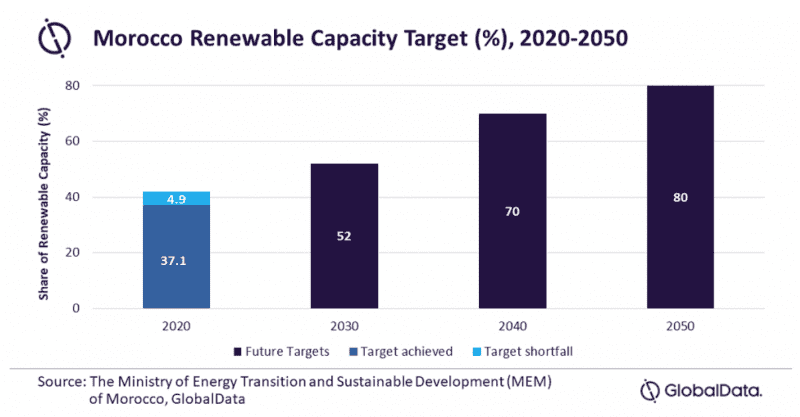
Since renewable energy accounts for more than 35% of Morocco’s current electricity-producing capacity, the country plans to cut greenhouse gas emissions by 13% and increase renewable energy production to 52% by 2030.
Morocco’s hydrogen ambitions
In addition to its enthusiasm for green energy projects, Morocco considers green hydrogen a key source of development in the national economy.
According to the International Renewable Energy Agency (IRENA) report, Morocco is striving to become a world leader in renewable energy and has begun implementing more sustainable policy projects that will place the country on the map of major green hydrogen producers by 2050.
As noted in the report, Morocco, with Namibia and Chile, is set to become a world leader in the export of green hydrogen.
It was listed as a country that might emerge as a worldwide leader in the green hydrogen race by 2050, alongside Chile, Australia, and Saudi Arabia.
Morocco was placed fourth worldwide among prospective countries to become a significant hydrogen producer, trailing only Australia, Chile, and Saudi Arabia.
It has surpassed numerous nations that currently dominate the oil and gas trade, including the United States, Algeria, Qatar, the Sultanate of Oman, the United Arab Emirates, and the United Kingdom.
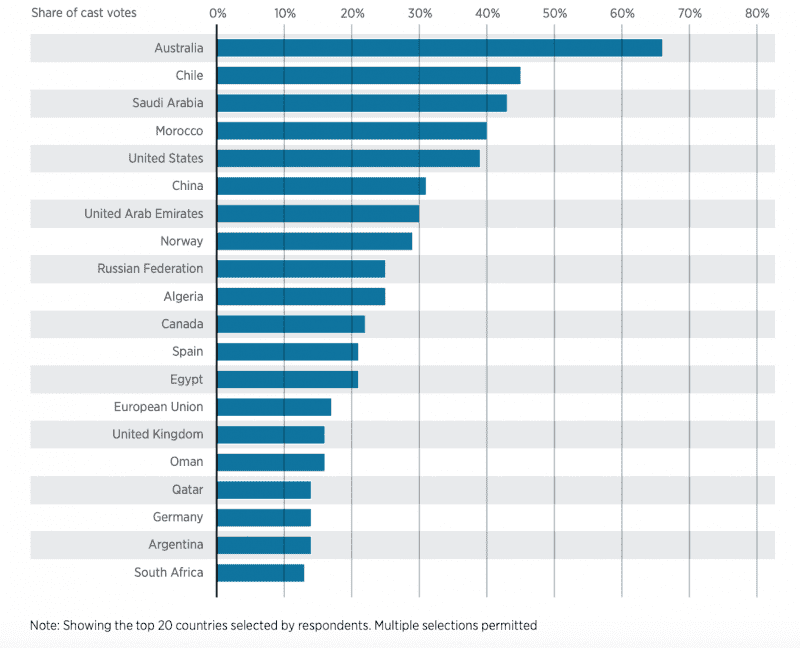
Source: IRENA Geopolitics Hydrogen Annex 2022
Although Morocco is not yet a supplier of hydrogen, IRENA analysts predict that it will earn substantial geostrategic relevance on the world map of clean hydrogen exporters.
According to the strategy of the Ministry of Sustainable Development, Morocco’s qualities will allow it to seize 2 to 4% of the worldwide market for green hydrogen and become an exporter by 2030.
With a keen interest in developing its hydrogen production capacity, Morocco established a National Hydrogen Committee in 2019, which adopted a green hydrogen roadmap two years later.
Last March, the North African Kingdom launched its first green hydrogen pool, an initiative aimed at developing and manufacturing green hydrogen while encouraging research and knowledge sharing.
On June 14, 2021, it also partnered with the International Renewable Energy Agency (IRENA) to switch to a green hydrogen economy.
This is in addition to Morocco’s green hydrogen-powered ammonia project, which is led by the French independent electricity production company Total Erin. The project is anticipated to generate 183,000 tonnes of green ammonia by 2026, with a yearly capacity of 31,000 tonnes of green hydrogen.
Morocco aims to supply the domestic market with 4 TWh and the international market with 10 TWh by 2030. To meet this target, Morocco is increasing investment in renewable infrastructure with a capacity of 6GW, as well as supporting the creation of more than 15,000 direct and indirect job opportunities.
Morocco’s growing global leadership in renewable energy
Given Morocco’s vast renewable energy potential (solar and wind), developing a diverse energy mix that benefits renewable energy has been one of the country’s main goals.
To meet rising electrical demand, protect the environment, and minimize reliance on foreign energy sources, Morocco has developed and invested in several big and important green energy projects.
Thus, Morocco has swiftly converted itself into an international leader in renewable energy during the last decade.
With the goal of increasing the contribution of renewable energies to the national electricity network, Morocco has been developing an ambitious renewable energy program since 2009.
The completion of these initiatives is a chance for Morocco to build and expand an industry centered on renewable energy and energy efficiency.
According to GlobalData, Morocco’s current goal is to expand the percentage of renewables in total electricity capacity to 52% by 2030, 70% by 2040, and 80% by 2050.
In addition to serving as a global leader in the creation of innovative renewable energy projects, Morocco has built a robust legal environment to attract renewable energy investments.
As Morocco has the third-highest Global Horizontal Irradiance (GHI) in North Africa, which is 20% greater than Spain’s and more than double that of the United Kingdom, its ability to complete these ambitious projects is undeniable.
The country’s great potential for sustainable energy, as well as its existing position as an international leader in green energy and green hydrogen, will undoubtedly allow it to successfully undertake such crucial and significant projects.
Read also: Gigantic Projects: Morocco’s Bet for a Brighter Economic Future