In July 1962, after a 132-year-long occupation by France and a fierce 8-year-long national liberation war against the French, Algeria obtained its independence and became a country, a new state on the world stage. It took the name of “The People’s Democratic Republic of Algeria,” before letting itself be more or less ruled by the military since then.
The country’s sixty years of existence have been erratic, alternating between militaristic presidents and recurring periods of power vacuums under the ever-tightening tutelage of the army.
An army with a State
Coup d’Etats, president assassinations; a “Black Decade” with 250,000 deaths; a president who was bedridden following a stroke, “re-elected” in 2014 and hardly a “candidate” in 2019, before a wave of unprecedented protests in the country’s history.
All of this has evidently resulted in an unstructured economy, in which industry is not founded on any strategy or perspective, the public sector is bloated, and which relies almost exclusively on manna from the energy sector.
Hydrocarbons still represent 95% of the country’s exports, and contribute more than 50% of the state budget. As for agriculture, tourism, and many other sectors, they never properly started, and the result is that the Algerian economy remained a cash economy where foreign currency served to buy social peace.
In reality, to borrow Mirabeau’s description of Prussia in the 18th century, “Algeria is an army which possesses a state.” Everything is good, everything is permitted, while nothing is good enough for the Algerian People’s National Army (ANP), whose generals have more or less taken the country’s political power hostage.
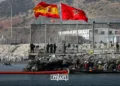
The ANP vigorously buys equipment, even if useless, such as the six diesel powered submarines it recently acquired from Russia. The army and its chiefs, in a permanent (mental) state of war, impose this mentality of the besieged on the entire country where their psychotic culture of secrecy leads to the opacity of the Algerian regime.
According to former French ambassador to Algeria Xavier Driencourt, a fine connoisseur of the country’s political mysteries and author of “The Algerian Enigma” (Editions de l’Observatoire, 2022), the Algerian regime lives permanently with two eternal enemies: France and Morocco.
To France, Algeria never forgave the 124 years of colonization and the 8 years of a bloody independence war; and to Morocco, Algeria does not forgive the simple fact that it exists. Algeria’s obsession with these two countries is the source of the siege mentality of the Algerian generals and the presidents they put in place.
Deep-seated Hatred of Morocco
And it is precisely this mentality that leads the Algerian regime to ludicrous, even kafkaesque diplomatic moves (on the Sahara dispute, for instance), and even sometimes to dangerous acts (the latest attack on Melilla by migrants from Algeria).
Behind the current situation of the country is the coming to power, at the end of 2019, of the Abdelmajid Tebboune-General Said Chengriha duo. Tebboune serves in a figurative role as the Head of State, where he is tightly controlled by General Chengriha, who himself is well-documented to have been responsible for a great many deaths in the country during the “Black Decade.” The duo replaced two much more prestigious figures, who were more aware of emerging international trends and challenges than their successors.
Tebboune and Chengriha are permanently engaged in unending rounds of upmanship against Paris and Rabat, and especially Rabat. Accusing Morocco of all Algeria’s ills, rupturing diplomatic relations, and even childish decisions and measures such as refusing to refer to the kingdom by its name, but by the amusing expression “North African country.” The very “North African country” that saw its map retracted and its national anthem butchered during the 2022 Mediterranean Games…
Read also: Amid Crisis, Algeria Considers Moroccan Development Policies
In the end, the Algerian people bears the biggest responsibility in the stagnation of a country that could have been great otherwise than by geography.
The reason is that, after initiating a promising Hirak in 2019, the Algerian people has interrupted its movement and seems to have gotten accustomed to the mediocrity of its leaders, who in turn drive the country to its doom — economically, politically, diplomatically, or geopolitically. And the generals of the country’s army maintain their hatred of “Marrok,” a hatred or at least a rejection which, despite denials, is found in a large section of the population.
Meanwhile, despite its problems and vicissitudes, its shortcomings and failures, Morocco is moving forward, ignoring its neighbor’s Moroccan obsession. All of which is really regrettable, because the Maghreb could have existed and been stronger together. And imagine what a changed place the Mediterranean region would have been with this unity!
We must wait then, for wisdom to enter the hearts and spirits of the Algerian leaders. In principle, celebrating the 60th anniversary is celebrating wisdom… let’s hope, but in the meantime, let’s groan!