 Join on WhatsApp
 Join on Telegram
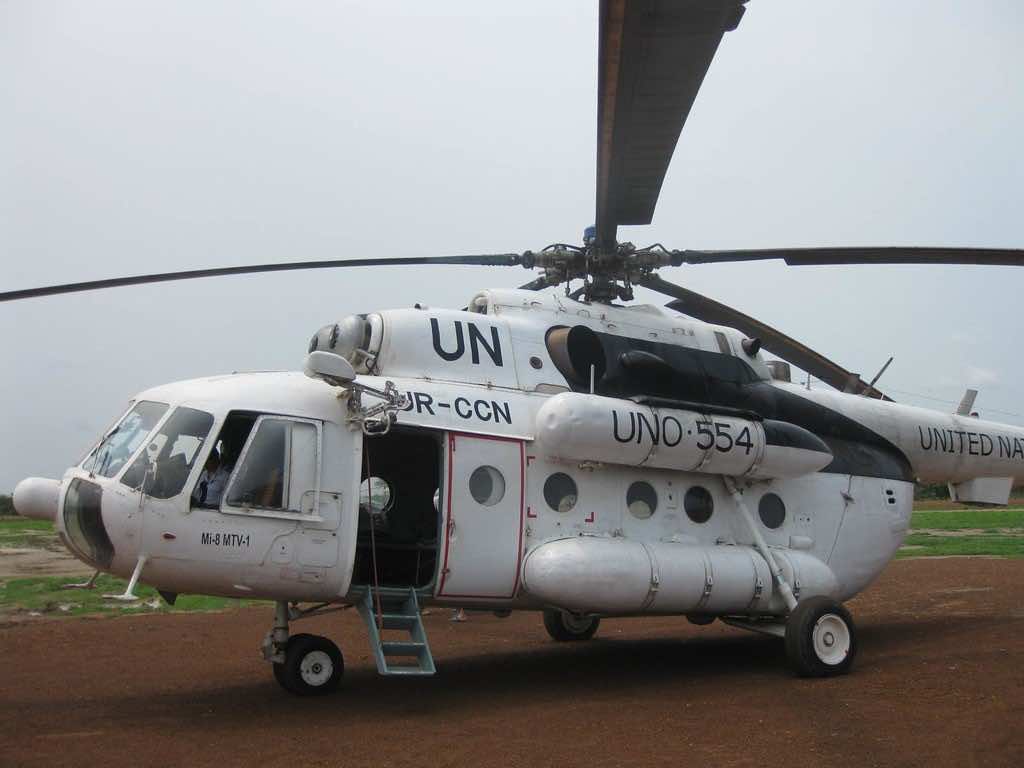
Rabat – Another UN helicopter has crashed in the Democratic Republic of the Congo, potentially heaping new pressure on the local UN peacekeeping mission. The crash of a UN helicopter, used by the World Food Programme (WFP), injured three crew members on Friday, September 2. The WFP told Reuters that no passengers were on board as the helicopter went down near the provincial capital Goma.
The crash is the second time a UN helicopter has gone down in North Kivu this year, after a UN Puma helicopter was downed in March, killing all eight people on board. Six Pakistani flight crew members, as well as a Russian and Serbian peacekeeper, died after the helicopter was shot down while on a reconnaissance mission to monitor fighting between M23 rebels and the DRC national army in Tshanzu, near the border with Uganda..
Pressure on MONUSCO
The new crash is likely to heap further pressure on the local UN mission, the UN Stabilization Mission in the Democratic Republic of the Congo (MONUSCO). The mission hosts roughly 12,400 UN peacekeepers, with Moroccan troops making up more than 10% of the total troops deployed in the region.
MONUSCO has faced strong local opposition in recent months, with many citizens decrying the mission’s inability to stop ongoing fighting between M23 rebels and DRC troops.
Prior to 2022, MONUSCO forces had managed to defeat the primarily Tutsi M23 uprising in 2013, with hostilities continuing for several years. In March 2022, the armed group suddenly launched a new offensive, using more advanced weaponry and tactics.
North Kivu has long been one of the most volatile areas in the world, due to its mineral riches which have supported both local militias and irregular troops crossing the borders from nearby Uganda and Rwanda.
Local armed groups have benefited from the ability to retreat into nearby Rwanda and Uganda whenever DRC or MONUSCO forces make significant advances. Similar to the strategy used by the Taliban during the US occupation of Afghanistan, and Polisario militias in southern Morocco, the rebel groups’ ability to retreat across international borders have led to indefinite hostilities in the region.
Widespread and Systematic Attacks
According to a recent UN report, these advances have been worsened by “widespread and systematic” attacks on the local population by another armed group, the Allied Democratic Forces (ADF) which the UN accuses of trying to wipe out the population of local villages.
“Entire families have been hacked to death,” the report highlighted, saying the ADF’s genocidal attacks could amount to crimes against humanity.
M23 rebels have made significant gains in the region in recent months, overtaking vast swaths of territory in the troubled region. Guinean Diplomat Bintou Keita, who serves as the UN’s top official in the DRC, has warned that in 2022, the M23 group has “conducted itself as a conventional army, rather than an armed group.”
Local opposition
On Friday, Keita pleaded with journalists to not sensationalize local opposition to MONUSCO. “Those who are against (MONUSCO) are the most vocal, they are the most heard. It feels like everyone is represented through those who are the most vocal, yet that’s not the case,” she emphasized.
Violent local demonstrations have often rocked the region’s main cities in recent months, particularly in Goma, where the UN mission is headquartered, as well as local trade hub Butembo.
Keita on Friday denied earlier reports by Reuters that MONUSCO had vacated Butembo, saying the UN had instead “temporarily suspended our activities until the situation improves.”
With recent clashes in and near the city having resulted in the deaths of civilians and several peacekeepers, including two Moroccan infantrymen, the MONUSCO chief stressed: “We cannot work in a hostile environment; we cannot expose the staff to a hostile environment.”