


Marrakech – Chinese tech giant Huawei is positioning itself to become a major player in the digitization of railways around the world, including in Morocco, by highlighting some of the advantages that new tech can bring to the field.
Already one of the major players in telecommunications and consumer electronics in the region, the firm is looking to establish itself in the transport industry, especially seeing as Morocco is planning to expand its high speed train lines in the coming years.
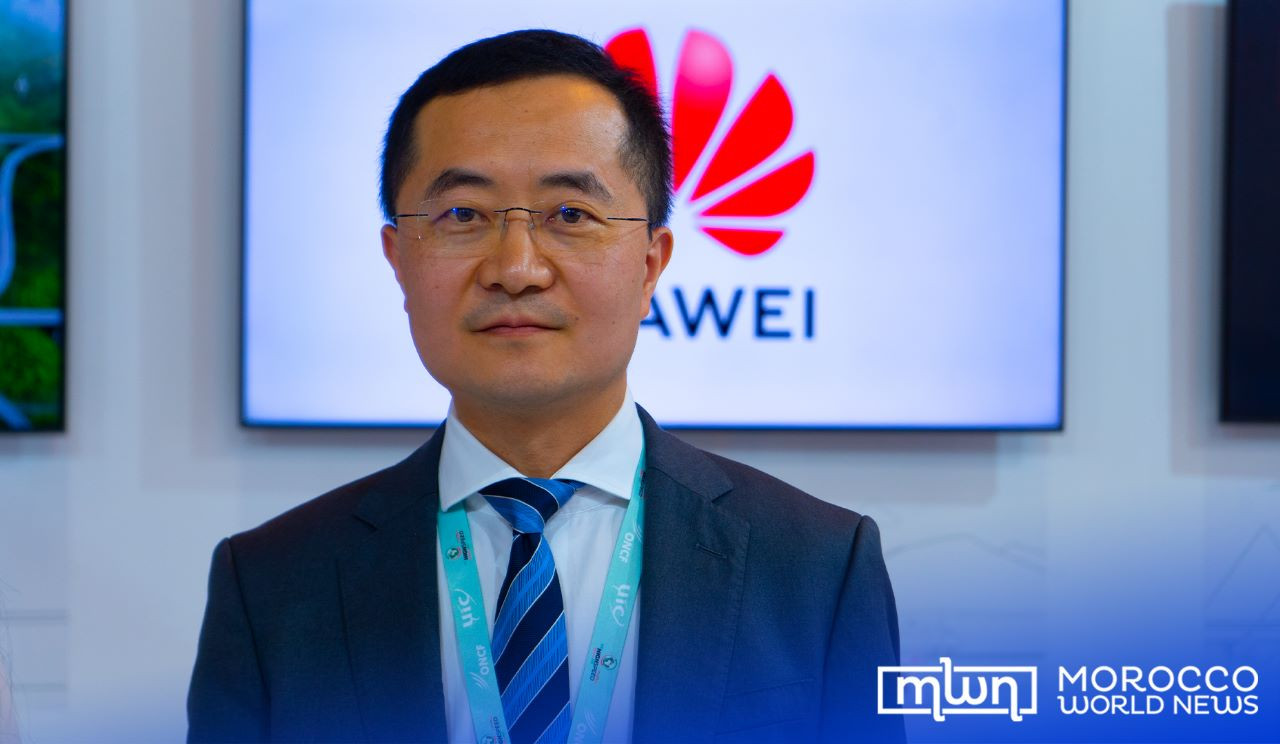
Vice President of Huawei’s Aviation & Rail Business Unit, Xiang Xi, explained some of the company’s strengths and what they could bring to the vital sector.
Safer railways
According to a 2022 safety report by the International Union of Railways (UIC), 83% of accidents were caused by a train’s collision with an obstacle or individual, a risk that grows higher with increasing speeds, as some of the fastest trains now reach 350 kilometers per hour.
“One thing that I think is important in some regions is people and animals crossing lines can cause some accidents, and also in some countries sometimes digging and trying to steal the copper cable,” Xiang Xi told Morocco World News (MWN) on the sidelines of the 11th UIC High-Speed Congress in Marrakech.
11th UIC High-Speed Congress in Marrakech.
Xiang Xi presented Huawei’s counter solution to the problem; an optic fiber that can detect vibrations from people and animals trying to cross the railway.
Huawei presented the solution during the congress, emphasizing that it includes a feature that can detect unnatural or unwanted movements along key locations in the track.
Improving efficiency
“In the physical world, we want to move people and goods more efficiently,” Xiang Xi said, detailing ways in which implementing cloud technologies and smart railways can improve the efficiency of railroads.
Enhanced connectivity and communication between different platforms and sections of the railway infrastructure, with the Chinese company introducing some of its own technologies to establish itself in the field.
Xiang Xi asserts that Huawei can provide solutions for all the stakeholders within the field as well, mentioning the company’s optical fiber technologies that can provide simpler and more efficient connections and data exchange for train stations.
The company’s plans also include a central cloud computing center that can manage all the lines in the country to make communication and data exchange more efficient.
That data and connectivity can also benefit maintenance partners and solution providers, who can use it to improve safety or efficiency over time by evaluating the data.
Digitization is inevitable
Like many industries and sectors around the world, transportation and specifically railways are witnessing rapid digitization, with cloud technologies, the internet of things, and AI leading the change.
Morocco, which is actively attempting to integrate digital technologies in several of its sectors and industries, finds itself uniquely situated in this regard, with its possession of Africa’s first and only high-speed railway line, Al Boraq.
“We are at a very critical moment. From now on we can introduce more digital transformation so we can bring more intelligence to the high-speed construction,” Xiang Xi said, emphasizing that the new technologies would benefit all stages of a high-speed line’s operation.
Despite that, digitization is expected to face some challenges, especially with the initial implementation. The Huawei official highlights coordination and management as two notable challenges.
“This kind of digitization must be a CEO-owned project, and CEO management should support not only in budget, but also in the decision of reshaping the business,” he said.
“Of course, digitization also needs the involvement of partners from the railway ecosystem, and it should be sustainably moving forward by the upgrade of technologies and algorithms,” Xiang Xi continued.
11th UIC High-Speed Congress in Marrakech.
Environmental sustainability
Another priority for the railway sector is sustainability, Xiang Xi affirms, detailing some of the ways in which Huawei can help digitize the sector while still maintaining a minimal effect on the environment.
“What Huawei can do for this part is, of course, using more green power and beyond that, we can have more of the latest ICT technology so we can have the real time of the power consumption we use for each train, each cooling stock,” he detailed.
Such information can help operators identify areas where inefficiencies in energy consumption exist and tweak them in ways that maintain a greener approach.
Huawei is also advocating for more future-proof and efficient technologies in the sector, to make it more sustainable over the long term, he added.




