


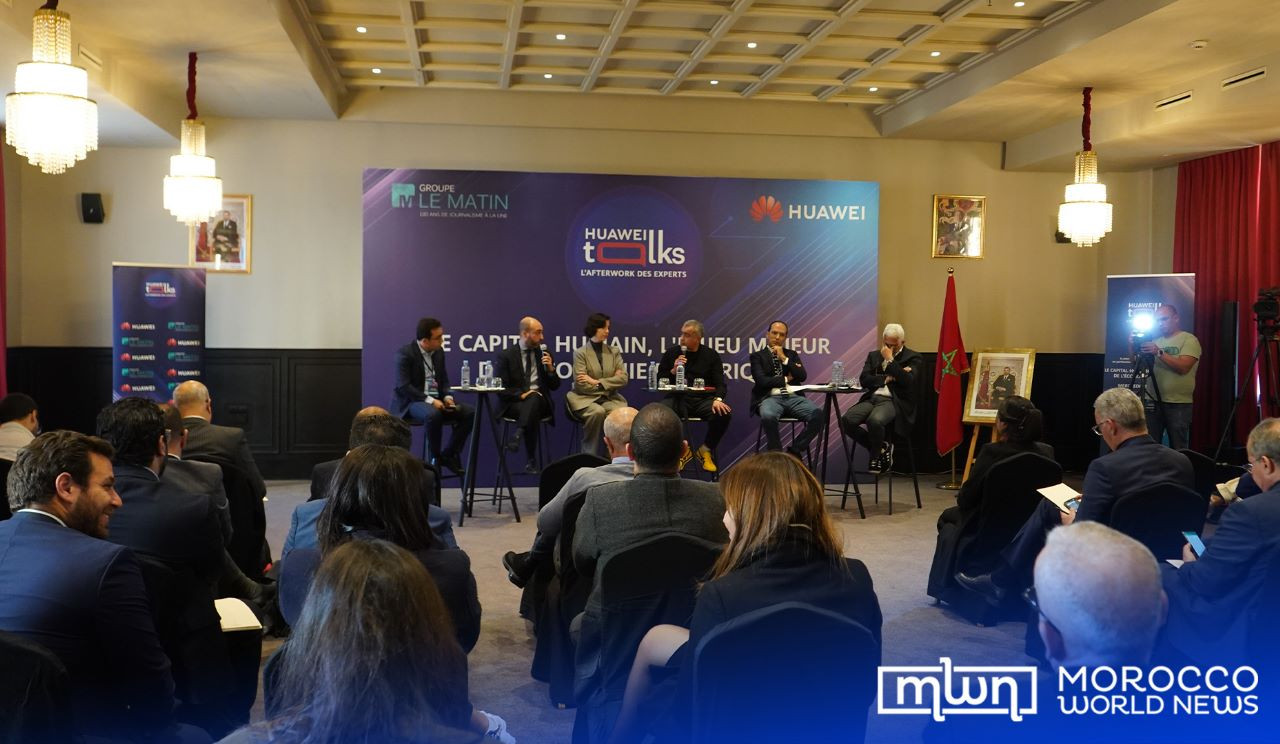
Rabat – Nabil Ouchagour, Huawei’s Chief Brand Officer, has argued that the lack of qualified labor is one of four challenges facing Morocco on its journey to becoming a digital nation.
While Morocco is currently on the run to become a regional tech hub, the country lags behind in terms of qualified labor, the Huawei executive told Morocco World News on Wednesday on the sidelines of Huawei Talks, an event that brings experts to deliberate on key issues facing Morocco’s transition to a digital economy.
This means Morocco’s digital-skill gap is emerging as a core challenge facing the country’s ambitions to host tech-related business activities.
“In many universities, the skills that are being taught will be obsolete soon,” Ouchagour noted, again suggesting that Morocco’s digital-skill gap is the core challenge facing the country’s ambitions to host tech-related business activities.
The senior Huawei official explained, however, that this issue is not Morocco-specific: fast-paced advances in tech make it difficult for education systems to keep up.
“Developing connectivity, data treatment capability, decarbonization” are equally crucial to support this transition, he detailed.
Citing research commissioned by Huawei in 2021, the executive argued that Morocco needs to focus on adapting its education system to the fast-moving digital world. The country should equally focus on training individuals capable of adapting and acquiring new skills as they enter the job market.
Ouchagour’s remarks are in line with an extensive body of research that suggests that the transformation into a digital economy will erode millions of jobs.
The idea is that the shift to a digital economy calls for a T-shaped labor force consisting of individuals with expertise in one field, but with the ability to pick up more skills to adapt to the new dynamic labor market.

Huawei’s Afterwork with Experts Talk in Casablanca
Digital skills and creating a start-up nation
Morocco’s economic ambitions largely hinge on the country’s ability to create the next generation of workers. The country is currently committing significant funds and pushing for policies to support the emergence of a startup ecosystem.
As several speakers at Huawei Talks pointed out, however, without the proper digital-savvy workforce, Morocco will fall short of its ambitions to become a hub for scientific innovation.
One of the speakers was Hicham Chiguer, President of the Association of Information Systems Users in Morocco.
Chiguer noted the state of Morocco’s labor market in his remarks, arguing that companies in Morocco “are suffering because there is a lack of IT-related talent.” He stressed: “Without human capital, digital transformation will not be possible.”
Also speaking at the Huawei event was Jamal Belahrach, CEO of DEO, a consultancy. According to Belahrach, “creating thousands of digital skills doesn’t necessarily mean that they have to find jobs in multinational companies, but they could also power our startup ecosystem.”
The state and the digital transformation
While discussing the role the state should play in supporting the next generation of tech-savvy workers, Belahrach pointed out that Morocco suffers a 15-year gap in digital strategy.
The country still does not have a digital observatory, he observed, stressing: “We need to understand the urgency. We have an eager generation waiting for the opportunity to learn.”
The state should only intervene to “create the necessary conditions for companies to do what they do best,” Belahrach added, recalling Huawei’s ICT Academy initiative dedicated to giving free courses to Moroccan workers in need of improving their digital skills.
Speaking at the Huawei event, Salma Karim, Head of Innovation and Human Resources Department at Morocco’s Digital Development Agency, made sure to emphasize the notable steps Morocco has taken to have a successful transition.
According to Karim, Morocco has responded to the rising need for digital skills to power its transition to a digital economy by making digitization an integral part of its 2021 New Development Model.
While pointing out the gap between offer and demand in the Moroccan labor market, Karim pointed out that at this stage “all stakeholders have a common vision and understand the need” to succeed in the digitization of Morocco’s administration and economy.
Read Also: Huawei Launches ICT Program in Morocco to Support Moroccan Talent




