 Join on WhatsApp
 Join on Telegram
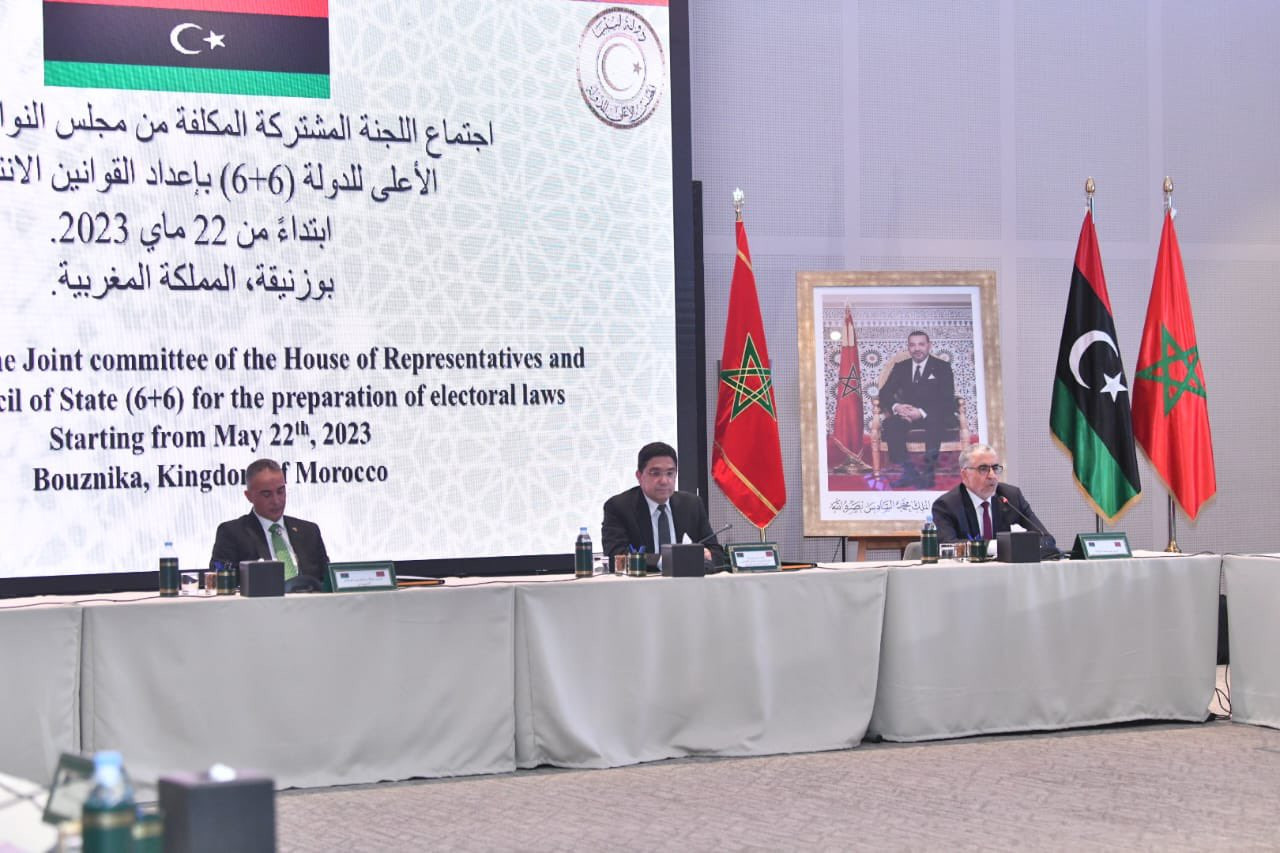
Rabat – Morocco’s Minister of Foreign Affairs has hailed the “6-6 mixed commission meeting” between Libya’s rival factions, stressing that the gathering constituted an important step in the process aimed at finding a political solution to the decade-long Libyan crisis.
“These discussions were marked by the examination of challenges related to the Libyan reality which requires innovation,” said Morocco’s chief diplomat Nasser Bourita, reiterating Morocco’s undying commitment to support all efforts seeking to find a definitive solution to the Libyan crisis.
Rival factions vying for control in Libya met on Tuesday in Morocco’s Bouznika, a coastal town near Rabat, to sign an agreement on Libya’s electoral laws. The meeting’s attendees included high-profile figures from both sides of Libya’s lingering political divide, namely the Tobruk-based House of Representatives and the Tripoli-based High Council of State.
During the meeting, the mixed commission announced that its members agreed on the law regulating the much-expected presidential and parliamentary elections in Libya.
Coming on the back of two weeks of intense debates hosted and facilitated by Morocco, the meeting’s final agreement will be approved in the coming days in the presence of speakers of the Libyan House of Representatives and Council of State, said Jalal Shwehdi , a member of the Tobruk-based House of Representatives.
Shwehdi also commended Morocco’s role in making inter-Libyan dialogue a success, stressing that the commission has “not suffered any pressure from abroad.”
For his part, Omar Boulifa, a member of the eastern Libyan-based High Council of State, stressed that the members of the commission reached a compromise on all points of divergence relating to the electoral laws.
“Two laws have been drawn up, the first of which concerns the election of parliament, while the second text concerns the election of the Head of State,” he said.
Read also: Morocco Renews Pledge to Support Libya’s Democratic Transition
Like Shwehdi, Boulifa emphasized that representatives of Libya’s rival factions agreed to a compromise on a number of essential issues without any foreign interference.
These laws “do not prohibit anyone from participating in the electoral process and do not provide for exclusion, nor that they offer political parties the opportunity to play a fundamental role in the electoral process,” he said.
He also expressed appreciation and gratitude toward Morocco, welcoming the country’s efforts to facilitate and support the commission’s mission.
Boulifa’s statement echoes remarks from the international community – particularly the UN, which has frequently stressed the importance of Morocco’s efforts in the Libyan affair.
In January this year, Abdoulaye Bathily, Special Representative of the UN for Libya, commended Morocco’s efforts by emphasizing that Rabat and the UN have a shared objective to contribute to helping Libya’s warring factions find a political solution to put an end to the decade-long plight of their country and fellow Libyans.
An oil-rich country, Libya has been facing several challenges for over a decade, including a deep-seated political unrest hampering the holding of a general election.
This latest inter-Libyan meeting in Bouznika is part of a series of gatherings Morocco hosted in the coastal town and the northern Moroccan city of Tangier to facilitate dialogue between Libyan factions.