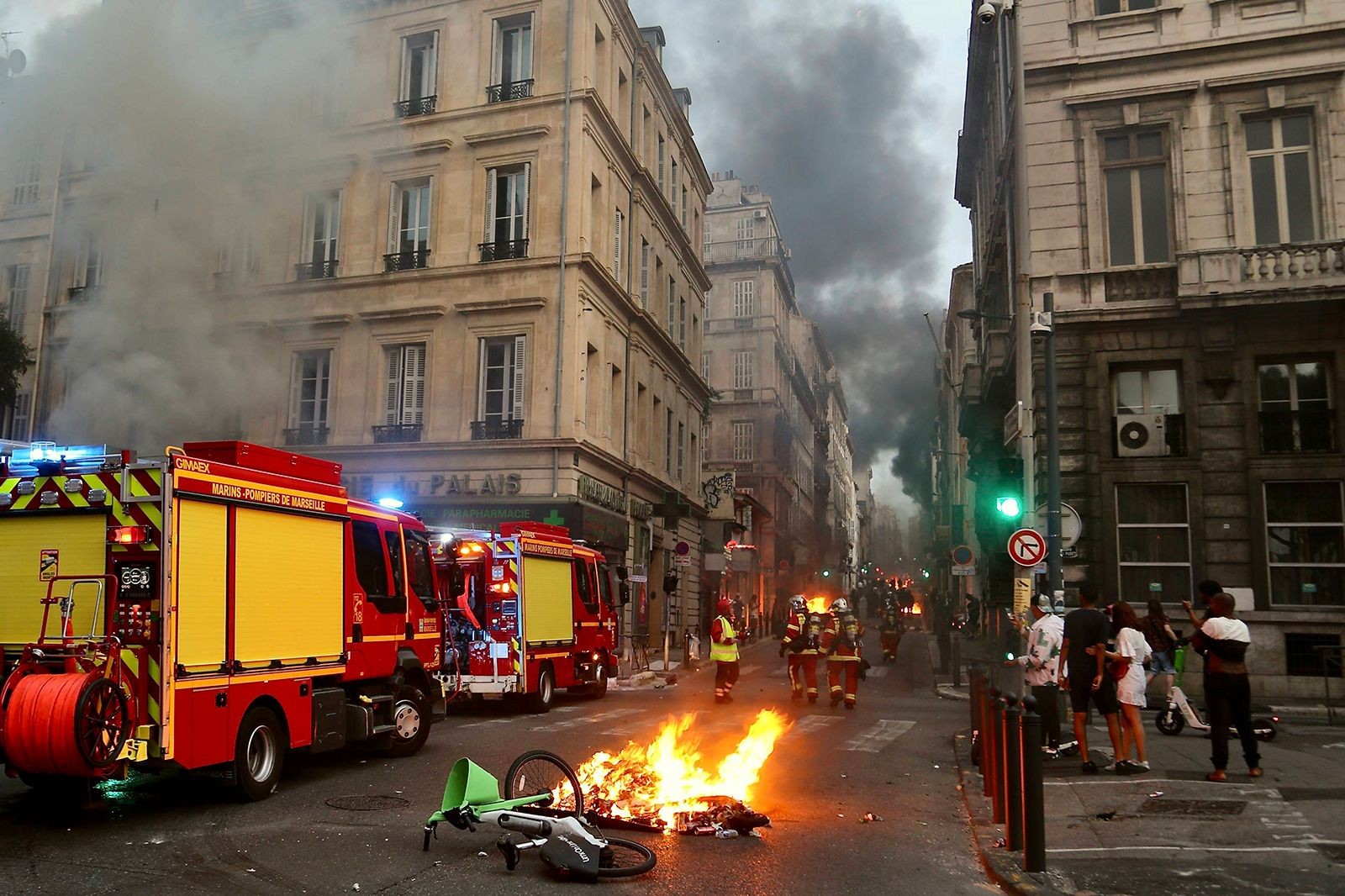
The events that shook France in recent weeks as much of the world watched shocked and helpless should give world leaders pause for thought. Indeed, the world experienced through France a double shock that could set many countries ablaze and exacerbate tensions that had until now been collectively internalized.
Needless to say, the difficult recovery from a pandemic that has turned economies and societies upside down, as well as the technological revolution that is networking societies have facilitated the convergence and contagion of anger.
In France today, the confrontation between a society suffering distress due to identity issues and economic decline, and an isolated, discriminating, and violent elite or government has ignited a firestorm that has led the most radical members of society to take extreme action. This has plunged the country into even greater uncertainty, after the Yellow Vests protests, the dubious management of the COVID crisis as well as the most recent tensions and clashes over the Macron government’s unpopular pension reform.
As he tried to make sense of these recent waves of unprecedented yet predictable riots that engulfed major French cities in clashes between hordes of angry marginalized youths and law enforcement officers, President Emmanuel Macron appeared to put much of the blame on social media. Eric Dupond-Moretti, France’s Minister of Justice, was quite content to confirm his president’s assessment.
Shortly after President Macron mentioned the role of social media platforms in the problematic socialization of increasingly violent youths, Moretti announced his decision to crack down on one of these supposedly troubled and troubling social media platforms. Ironically, France’s targeting of Snapchat is uncannily similar to rattled, cornered Arab governments’ approach to Facebook during the Arab Spring.
The message, in this sense, is that Whatsapp, Twitter, and TikTok are widely considered by leaders all across the world to be dangerous, existential threats to the survival of their regimes. In other words, social media’s role as a social equalizer and an effective tool for rallying masses to protest for or against a particular cause is bad news for world leaders.
Read also: Is Emmanuel Macron’s France Still a Democracy?
And because the technological revolution is on a fast-paced, inexorable march forward, leaders the world over, particularly those in the Mediterranean region, would do better to reflect on their fates and their societies. With the advent of state-of-the-art gadgets and the proliferation of social media platforms, social anger can very quickly turn into an irresistible and irrepressible popular discontent.
This discontent can then be expressed through the ballot box or, as has often been the case, directly in the streets. And if the recent events in France are any indication, it should be clear by now that the best security systems in the world cannot cope with an angry, connected, and organized society, which increasingly feels it no longer has time to wait for elections to take on its rulers.
All the countries in the Mediterranean region and beyond are facing the same difficulties in emerging from the fallout of the pandemic, as they work to repair the damage caused by nearly three years of turbulence of all kinds, and relaunch their productive systems.
All around the world, governments are reeling from the uncertainties caused or exacerbated by the war in Ukraine. And so, however one slices it, the fact remains that the confrontation between the Western bloc and Russia, and indeed the rest of the world, has made the globe more dangerous and global security more fragile.
While mainstream attention continues to go to the Ukraine war, many other countries in the Global South are confronted with the disastrous effects of global warming, including ever-increasing waves of domestic and cross-border migration.
Read also: Regional Security Complexes in a Transitional Stage of International Politics
Indeed, more alarming is that many of these countries do not even seem to remotely grasp the fallout of these lingering crises on the collective psychology of their societies and in what profound ways this era of increasing uncertainty and insecurity can and does impact the behavior of their populations in the face of the unending amalgamation of past, present, and future crises.
In countries around the Mediterranean, for example, popular anger has come from a variety of events: public or governmental decisions rejected by the population, individual events that turn into collective tragedies, or incompetence trials of governments incapable of thinking up the right action or reaction to the various challenges — current or emerging — they face.
The technological revolution and the extraordinary development of social networks have also created a new category of activists known as influencers. As Umberto Eco observed and foresaw, it is no longer necessary to have a solid training or a strong ideology to conquer a large audience and be followed by millions of people. Mediocrity threatens stability.
Read also: The Mostafa Terrab Scandal: Post-Truth and the Dilemma of the Privileged
World governments are thus up against an extremely explosive cocktail as they navigate global problems of a new, modern type: the demystification of political power thanks to disruptive means of mass communication that have exposed the limits and at times the utter inefficacy of once revered political institutions whose commitment to the old-fashioned way of doing things, while admirable at times, is inevitably irrelevant and blindsided in a constantly shifting, evolving world.
Betting on the five-year ballot box to deal with our era’s keyboard politics, where disillusioned youths permanently ask uncomfortable questions of those who govern them and only seem to value immediate responsiveness is a perilous, doomed business.
As what is currently happening in France combines more or less all these elements, it may create a form of emulation among other nations, based on the principle that the same causes produce the same effects, especially when the same means are available. Public opinion is as volatile as influencers are talkative, and today’s truths are no longer those set out and proposed by governments; people now have their own truths.
In this day and age, it is up to governments — including Morocco’s — to express themselves, to explain their motives, to listen to the public’s opinions and disillusions, to anticipate, and to innovate. Vertical policies no longer work, and legitimacy, the guarantor of stability, is no longer based solely on traditional institutional channels such as elections, but also on the mood of societies in perpetual motion, easily and explosively incandescent.
If there’s one lesson to be learned from the events in France, it’s this: We mustn’t wait until fire breaks out and people take to the streets, because the return to normal is always difficult, perhaps even impossible.