


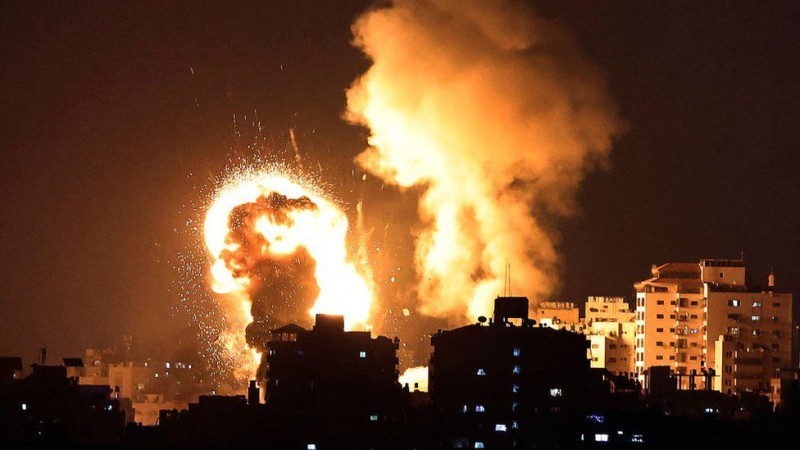
Fears of regional escalation in the Middle East are growing, fuelled by clashes between the Lebanese Hezbollah and the Israeli army, and by heavy suspicions of Iranian involvement in the October 7 attack.
Since the Hamas offensive on Israel on October 7, Hezbollah and Islamic Jihad in Lebanon have claimed responsibility for several strikes and incursions on Israeli soil. The risk of the conflict spreading to the northern front is compounded by the possibility of new fronts opening up in the West Bank, East Jerusalem and even Israel itself.
Potential regional conflagration
Concern about the risk of a regional conflagration extending beyond the borders of Israel and Gaza is growing in neighboring countries and among international leaders. “We will change the Middle East,” declared Benjamin Netanyahu on Sunday October 8, announcing that he was preparing for a “long war”. And even if neither side has the will or the interest to engage in a full-scale confrontation, any slippage could trigger an uncontrollable spiral.
The increasing number of clashes in recent days on the Lebanese-Israeli border between Hezbollah militiamen and other Palestinian groups and the Israeli army is being scrutinized from all sides. The opening of a second front to the north of Israel, should the Lebanese militia engage massively in battle, would lead to a deadly escalation for both belligerents.
The Lebanese, already in the throes of a colossal political and economic crisis, are anxious.
Eugene Daniels, Ryan Lizza and Rachael Bade argue in Politico that war in the Middle East threatens to spiral, saying that a bigger concern on the horizon is “the possibility of a broader conflict” after a brief exchange of strikes with Hezbollah in the north, reported by the AP.
“The flare-up on Israel’s northern border also threatened to draw into the battle Hezbollah, a fierce enemy of Israel’s which is backed by Iran and estimated to have tens of thousands of rockets at its disposal. Hezbollah fired dozens of rockets and shells on Sunday at three Israeli positions in a disputed area along the border and Israel’s military fired back using armed drones,” they added.
But Hezbollah is still taking a wait-and-see attitude, despite its rhetorical support for the Hamas attack. The United States and its allies are said to have issued warnings to the Lebanese movement against any escalation. According to information reported by CNN, the message was passed on by the Lebanese government and, in particular, by Parliament Speaker Nabih Berri, an ally of the Shiite militia.
“There is no indication at this time that other adversaries of Israel are preparing attacks,” a senior US military official said in Brussels on Wednesday, October 11.
What will Iran do?
Questions are focusing on the role and strategy of Iran and its allied forces in any escalation. At the heart of the debate is Teheran’s support for the Al-Qassam Brigades, the armed wing of Hamas, in the unprecedentedly large-scale offensive launched on Israeli territory on Saturday October 7.
“I have no comment to make on direct Iranian involvement, of which we have no formal trace,” said Emmanuel Macron on October 10 at a joint press conference with German Chancellor Olaf Scholz.
“It is likely that there was aid given to Hamas and cooperation. I will remain cautious on this point until we have stabilized completely secure intelligence elements,” he also maintained.
Similar comments had been made two days earlier by US Secretary of State Antony Blinken. Ayatollah Ali Khamenei, Iran’s highest authority, denied his country’s involvement on Tuesday, while reaffirming Iran’s “support for Palestine”.
The links between Hamas and Iran are not new. Quite the contrary, in fact. Although the relationship has had its ups and downs, the Palestinian cause is an integral part of the Islamic Republic of Iran.
Hamas is part of what Iran calls the “axis of resistance,” which links the Iranian regime, Iraq, the Syrian regime, Lebanon and the Palestinian territories. These are various armed militias, a kind of informal coalition led or supported by Iran.
Lately, all eyes have been on Saudi Arabia, an important player in the region, which until now had opened the way to negotiations with Israel, and which paradoxically has started relaxing its previously strained relations with Iran.
Saudi Arabia and Iran are two major players in the region. Rivals, moreover, and barely able to agree to relax their relations somewhat. On the other hand, Israel is the arch-enemy of the Islamic Republic of Iran. So, in the balance of power, a rapprochement between Israel and Saudi Arabia does nothing for Iran.
Since its inception in 1979, the Islamic Republic of Iran has been committed to the fight against Zionism and the State of Israel, whose existence it does not recognize. This has become an integral part of its DNA, and therefore of the mullahs’ regime. And it has never wavered. Without this cause, the republic has almost no reason to exist.
In this context, Iran has every interest in positioning itself as the main regional player in the defense of the Palestinian cause. All the more so as this is a subject that unites public opinion in the Arab-Muslim world.
It should not be forgotten that, despite the realignment of the diplomatic postures of certain Arab states, this resentment towards Israel in general is still very much in the majority on Arab streets. We’re surfing on a certain populism here. Iran has everything to gain from this, because if a conflict like the one now taking shape were to profoundly reshuffle the cards. It would not be the work of regular Arab armies, but the work of Iran, which would have achieved this objective through the militia network it has in some cases created and in others supported.
In this regard Alex Vatantka writes in Middle East Institute: “As the war rages on between Israel and Hamas in Gaza, the role of Iran will remain a central factor.”
Stressing that Tehran’s endgame in the war is still unclear, Vatantka clarifies “two basic realities.”
“Iran has no intention of directly engaging militarily in the war against Israel or the U.S. should Washington decide to get involved,” he explains. “Doing so would simply be too risky for the Islamic Republic and its 84-year-old supreme leader, Ayatollah Ali Khamenei, whose regime’s scaffolding has been shaky in recent years.”
He adds that Tehran sees this moment instead as an opportunity to vindicate its vision for the region based on the aforementioned “Axis of Resistance.”
“This in turn is a plain repudiation of Abraham Accords and the idea of Israel’s integration into the fabric of the Middle East,” he explains.
“The U.S., and the West in general, can do much to inadvertently advance Iran’s agenda if they fail to mediate the Israeli-Hamas conflict in a way that takes into account the demands of the Arab and Muslim publics,” Vatantka adds. “To put it mildly, the concept of Abraham Accords is on the line and no one wants to see its demise more than the Islamic Republic.’’
Iran has also been weakened internally on a societal level. For over a year now, following the death of the young Mahsa Amini, part of Iranian society has been in revolt against the regime. For the regime in power, this is also a way of diverting citizens’ attention to an external issue – the Palestinian cause – which has mobilized several generations.
Indeed, Iran has a wide network of proxies that can be used against Israel. Julien Barnes-Dacey, Ellie Geranmayeh, and Hugh Lovatt, writing for the European Council on Foreign Relations say that it “has carefully cultivated a network of state and non-state regional allies that now find themselves in the ascendancy.”
They cite the example of Iraq, where the political class aligns with Tehran, as well as Hezbollah in Lebanon, and the Assad regime in Syria.
“Iran’s Islamic Revolutionary Guard Corps (IRGC) is intertwined with the Iraqi security apparatus, particularly through the array of militia and paramilitary forces that arose in the fight against the Islamic State group (ISIS),” they explain.
They also add that Iran has engaged in social outreach to Iraq’s Shia community and encouraged millions of Iranian pilgrims to travel to the country, and draw attention to its investments in the Kurdistan region.
“In Lebanon, Iran’s close ally Hezbollah dominates both the political and military spheres, effectively holding veto power over state decision-making,” they explain. “For Iran, Hezbollah is a successful model of an allied non-state actor that can dominate the security sphere and eventually take centre stage in the political realm.”
In addition to its increased ties with the Syrian regime, the authors also point to Iran’s military aid to the Yemeni Houthi fighters, especially as Saudi Arabia continues its military engagement in the country.
The Arab world and the current escalation
Since the Hamas offensive on Israel on October 7, Hezbollah and Islamic Jihad in Lebanon have claimed responsibility for several strikes and incursions on Israeli soil. The risk of the conflict spreading to the northern front is compounded by the possibility of new fronts opening up in the West Bank, East Jerusalem and even Israel itself.
The United Arab Emirates, like Bahrain albeit in a more modest way, have established diplomatic relations with Israel through the Abraham Accords. This approach sets them apart from some of their neighbors.
Unlike Morocco, the United Arab Emirates has not had a significant Jewish population in recent history. However, their geographical position and regional power make them key players in the diplomatic crisis opened by the Sukkot War.
Whether or not the Abraham Accords hold depends in part on Israel’s reaction to certain situations. This may limit the UAE in their actions, while offering them an opportunity to play a mediating role in the region.
In terms of regional geopolitics, Qatar stands out for its role as a leading financial supporter of Hamas, creating a potential point of tension with the United Arab Emirates. Despite this rivalry, the two countries paradoxically remain among the most stable zones in the event of heightened regional tensions: Dubai, in particular, is seen as a bastion invested by all stakeholders in all regional and even international conflicts.
A crucial question is what would be the threshold, in terms of casualties in Gaza, the West Bank or Lebanon, that would prompt the United Arab Emirates, but also Morocco, to reconsider the Abraham Accords.
Although it is difficult to assess such a threshold, these agreements, which are difficult to conclude, would probably be maintained, except in the event of a catastrophe of unimaginable proportions.
In the long term, it is unlikely that these countries would completely sever their ties with Israel. These states could adopt a range of nuanced discourses to signal their concern and condemnation, while at the same time seeking to propose diplomatic solutions, in order to signal their new role as regional mediating powers.
Saudi Arabia occupies a very singular position today, and has been weakened by the Sukkot war. Under the leadership of Mohammed ben Salmane (MBS), it had embarked on a bold policy of rapprochement and normalization with Israel.
This could have been achieved this autumn or in 2024. But an escalation of the conflict could permanently suspend this momentum and, by extension, call into question a large part of the strategy followed until then by the Crown Prince, whose main argument to the international community has been that the region would be more stable and calmer under his leadership.
In reality, despite these promises, Iran continues to have the means to reach Israel indirectly via Hamas and Hezbollah, and thus to disrupt the plans of their Saudi rivals. The question of Saudi Arabia’s real capacity to curb the current situation is raised, and the answer to it will strongly determine trends in the new period that this crisis seems to be outlining.
In the immediate term, the position of an Iran weakened by the demonstrations and popular protests has been strengthened. But it is hard to see how Israel would not seek, at the same time as “destroying Hamas,” to also reduce Iran’s capacity to indirectly sow terror on Israeli soil.
In short, despite its financial and diplomatic assets, Saudi Arabia needs to think about how to manage this complex situation. For the time being, Saudi diplomacy’s statements calling for international intervention, after having wished to play the role of regional hegemon, could be seen as a sign of weakness.
A region in turmoil
Traditionally a region in turmoil, the Middle East has fallen into multifaceted chaos since the turn of the century. The Arab Springs that began in 2011, followed by the Hiraks, have affected most Middle Eastern countries, but their failure has often been accompanied by brutal repression.
The absence of united, credible opposition, the resilience of autocratic governments and limited support from Western countries all help to explain this failure. But the ingredients that provoked these uprisings are still there, and the leaders of these countries must take account of public opinion, which aspires to better governance and greater freedoms.
Other factors, such as the destabilizing military interventions of Western countries, including the United States, Great Britain and France, have led to the proliferation of failed states such as Iraq, Libya, Syria, Lebanon and Yemen.
This bankruptcy is characterized by the collapse of state powers, which are unable to assert their authority over a large part of the national territory, by their lack of legitimacy among the population, the disorganization of public services, the presence of numerous militias which often benefit from external support, and by stricken economies where shortages are further exacerbated by the poorly controlled coronavirus pandemic.
The situation in Syria is fuelling hotbeds of tension that are having an impact in Europe: the al-Hol camp, home to families of French jihadists, the town of Idlib where radical elements have gathered, and the 4 million refugees residing in Turkey are all sources of concern for European authorities.
This situation can only encourage the persistence of jihadist breeding grounds which, through the networks of al-Qaeda movements under its various names or the Islamic State, remain very present on the ground and even more so through the ideology they propagate.
Despite its retreat after the battles of Mosul and Rakka, the IS retains enclaves in Syria and Iraq, and underground networks just about everywhere, while al-Qaeda controls a large part of south-eastern Yemen.
Middle East: a dim future
The Middle East is no stranger to war. The region stretching from the Maghreb to the far reaches of Central Asia has seen regular, almost continuous armed conflicts over the past 70 years.
The founding of Israel, the Suez crisis, the Six-Day War, the Yom Kippur War, the Israeli-Palestinian conflict, the Lebanon War, the Iran-Iraq War … right up to the conflicts of the 21st century: the American invasion of Iraq, civil wars in Syria, Libya and Yemen, often following peaceful democratic uprisings that were quickly hijacked or radicalized.
There, civil wars almost inevitably become international conflicts with multiple strings attached. In the Syrian tragedy, as many as twelve countries have had a hand in it, or have been affected in one way or another.
This region of the world is relatively unintegrated from an economic point of view: heavy state models, trade limited to a few areas and a few partners, and little integration into the globalized economy.
The same applies to regional cooperation. If, in a fit of cynicism, you were looking for examples – for laughs or tears – of the weakness of interstate institutions in the 21st century, you could always point to the European Union, the Union of American States or the African Union… although in all three cases, it can also be proved that they have their uses, and have already demonstrated them.
No, if you want an example that stands out for its inanity and insignificance, the Arab League is the place to look. And yet, this is a region of the world where the causes of crisis – social, political, military – are similar and overlapping, and where there is a high degree of “integration” of issues.
Internally, it’s a fatal and eternal choice between two symmetrical calamities, Charybdis and Scylla. Military dictatorship or the invasion of religion into politics. Sometimes, some will have both at the same time!
In the Arab-Muslim world, these two political responses always (or almost always) end up crushing popular democratic movements, combined with secular demands. Periodically, as is the case today in Algeria, Lebanon, and Iraq, populations cry out their desire to escape this fate.
Internationally, everything still revolves around three axes: the old Arab-Israeli confrontation (and the Palestinian “sub-question”), the Iran-Saudi Arabia face-off (closely overlapping the Shiite-Sunni confrontation, extending to Iraq, Syria and Lebanon) and finally, intra-Sunni rivalries.
Today, the first cleavage is tending to fade behind the other two, even if the Palestinian question – with its Israeli antagonism – remains an important theme for many Arab populations.
The Iranian question, the designation of Shiite Iran as “absolute evil”, is gaining in power: it tends, for example, to transform Israel and Saudi Arabia into allies, which is unprecedented and weakens the Palestinians.
The – for once clear – positioning of Biden’s United States reinforces the antagonism here, while elsewhere in the region, the United States is fading to the benefit of Russia, and perhaps tomorrow of China.
Among the Sunnis (and here, we must include Turkey), the Syrian and Libyan theatres have given rise to clashes with, on the one hand, Qatar and Turkey pulling strings and, on the other, Egypt and Saudi Arabia – a duo of allies that perfectly embodies the two facets of Arab-Muslim dictatorship in the 21st century.
This close interweaving means that any domestic political issue, any internal tendency, is automatically judged and assessed by the yardstick of foreign influences (which was fatal for Syrian democrats, for example). Conversely, geopolitical balances of power determine internal struggles and the influence of players such as the Houthi rebels in Yemen (allied to, but not affiliated with, Iran), or the Sunnis in Lebanon.
While the Middle East is a region of endless conflict, it is not one of generalized war, which is what an open conflict between Iran and Saudi Arabia would probably become. The main players don’t want it at the moment. But with all these tangled strings and myriad secondary players pulling the strings, things could get out of hand.
Never likely, but always possible.




