


 Join on WhatsApp
  Join on Telegram
 Rabat – The World Bank and International Monetary Fund’s (IMF) annual meetings kicked off today in the Moroccan city of Marrakech, with the launch of a book prepared by the IMF on “Morocco’s quest for stronger and Inclusive Growth.”
The launch event was opened by Morocco’s Head of Government Aziz Akhannouch, who praised the partnership between Morocco and the international financial institutions and highlighted the progress that the North African country has made over recent decades.
Head of Government Aziz Akhannouch
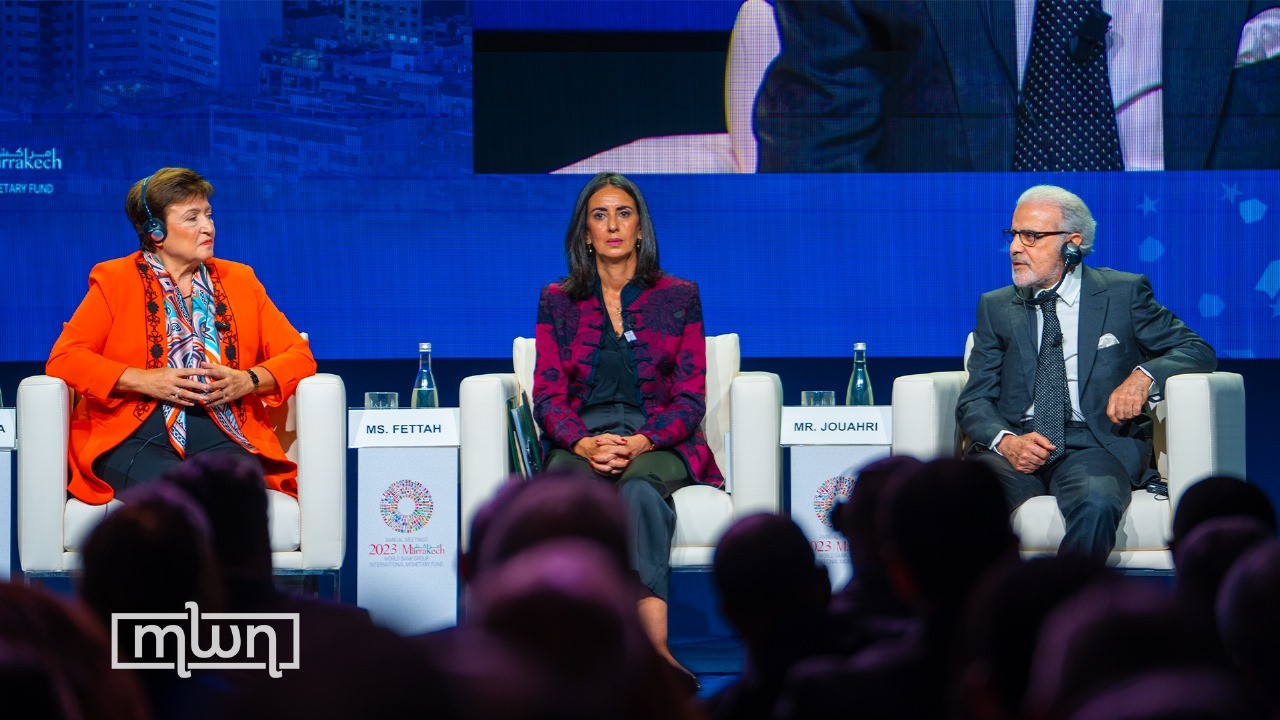
Several high-profile Moroccan and international figures were also in attendance, including Moroccan Minister of Economy and Finance Nadia Fettah Alaoui, Bank Al-Maghrib Governor Abdellatif Jouahri, and IMF Managing Director Kristalina Georgieva.
Earthquake recovery
The topic of Morocco’s recovery from the September 8 earthquake took up a large portion of the discussions during the opening of the event, as Akhannouch opened his speech by thanking the two international organizations as well as other nations for the solidarity shown following the disaster.
He particularly highlighted the decision to maintain the annual meetings in the city, with the same starting dates, thanking the IMF for its recent $1.3 billion resilience loan to the country to help it recover from the quake.
The Head of Government also asserted that Morocco took humanitarian and economic measures “very swiftly” following the event.
“Today, Morocco is at a historic crossroad,” Akhannouch declared, emphasizing that “we would like to have a strategic vision” to push the country forward.
This idea of Morocco being a crossroad was highlighted by the other attendees, with Fettah Alaoui pointing out that the earthquake should serve as an opportunity for the country to rebuild stronger.
“When we are facing crises, we also reinvent ourselves for a better future, especially for the youngest,” she said.
The minister stressed that all stakeholders and leaders in the country are having constant meetings to not only recover the direct damages but also to build a comprehensive, ambitious plan for a solution for the “invisible” disparities in the region.
The earthquake wrought most of its destruction on rural secluded villages, highlighting the continued existence of pockets of poverty and inequality in Morocco.
“We are determined to have a fair society based on solidarity,” Akkanouch also said, pointing to reforms concerned with health, education, and innovation and research.
The sentiment was also echoed by Kristalina Georgieva, who recounted how her recent visits to some of the affected communities in the Marrakech region highlighted the country’s resilience and recovery efforts.
“I saw a glimpse of how the country is thinking of building forwards, rather than just restoring what was there,” Georgiva said, recalling how she visited students from affected villages who are already back to school in different institutions.
“The best memorial Morocco can build for those who have died is to build better,” she added.
IMF Managing Director Kristalina Georgieva
For his part, Abdellatif Jouahri, the governor of Morocco’s Central Bank, Bank Al-Maghrib (BAM), detailed some of Morocco’s plans to recover from the unexpected September 8 tragedy.
He recalled how stakeholders have conducted comparisons with other countries that expressed similar disasters to chart concrete recovery plans. To this end, Morocco has dedicated a MAD 120 billion ($11.5 billion) budget over the next five years, equivalent to 20% of GDP, which is consistent with what other countries put in place to properly recover.
“You cannot imagine the extent of the solidarity fund when you are negotiating with international organizations,” he added, stating that the solidarity fund set up by BAM reached MAD 12 billion ($1.1 billion) in donations.
Morocco’s path for growth
The panel discussed Morocco’s reforms over the past few decades in some detail, with Fettah-Alaoui especially highlighting how the country has worked to improve social conditions and public services for all citizens.
Bringing a spotlight on the country’s social security system, she highlighted how the country recorded over 20 million beneficiaries at the end of 2022, compared to less than 10 million towards the end of the 20th century.
“People now see that they can go to public or private institutions and have effective services,” she explained, pointing out how social security has rendered medical services, for example, accessible to all people.

Morocco’s Minister of Economy Nadia Fettah Alaoui with IMF Managing Director Kristalina Georgieva
Education was another area of focus, with the minister saying that the aim is to double the number of students who benefit from soft skill instruction in public schools to 50%.
“In public schools, we guarantee that there will be social equality in our country,” she declared.
Other areas of focus included sustainability and green energy, with Akhannouch highlighting the country’s progress in the field.
“Water scarcity and climate change are some of the strategic priorities for Morocco, which is why the country has introduced some projects for water desalination and to benefit water-scarce regions in the country,” he said.
He also highlighted the country’s solar and wind energy projects, which are projected to not only help fulfill the country’s own energy supply, but also to export energy to other countries.
Africa’s needs
For members of the panel, Africa’s growth and development is necessary for global sustainability and success.
“A prosperous 21st century is only possible with a prospering Africa,” Georgiva declared, voicing support for paying greater attention to the continent, especially in the face of the consecutive economic and social shocks seen recently.
The IMF Managing Director highlighted that Morocco is for now the only country in Africa that is eligible for flexible credit, expressing hopes that more countries can join it.
Fettah Alaoui also said that international leaders need to look at the specific needs for Africa.
“Many countries in Africa have not defaulted on loans, but they are defaulting their youth and the future of their infrastructure,” she said
According to the Moroccan minister, Africa needs comprehensive help, in the fields of food, climate financing, infrastructure, and much more.
Morocco hopes to play a central role in the continent’s development, in this regard, with Minister Delegate in Charge of the Budget Fouzi Lekjaa highlighting that “Morocco has played the role of a bridge to Africa for centuries through Marrakech.”
Minister Delegate in Charge of the Budget Fouzi Lekjaa
Leveraging Morocco’s strategic position and Marrakech’s regional and international appeal, the panel hoped that the country can play a role in facilitating investment and aid in order to help the continent avoid any setbacks in its development.
The World Bank and IMF annual meetings will take place until 15 October, with the participation of more than 14,000 members from across the world.
While they serve as an occasion for WB and IMF officials, as well as international leaders and central bank governors to discuss economic issues and challenges, there are also many side events highlighting topics such as climate change and equitable growth.


