


 Join on WhatsApp
 Join on Telegram
Rabat – Morocco’s central bank, Bank Al-Maghrib (BAM) on Monday announced buying €200 million of sustainable development bonds from the World Bank. The investment underscores the development of Morocco’s climate financing work.
BAM made the announcement at the start of the World Bank and International Monetary Fund annual meetings in Marrakech.
In a statement, Bank Al-Maghrib said that the purchase is split evenly between three- and five-year bonds, and would be held in its reserves management portfolio.
Climate bonds are financial instruments used to raise funds for green investments, including climate mitigation or adaptation-related projects. Similar to usual bonds, the holder of the climate bonds receives a fixed income.
The bonds mature – reach the time when the bond’s issuer must repay the original value of the bond to the holder – on October 6, 2026, and October 6, 2028, BAM explained in the statement.
“The transactions are an opportunity for Morocco, as the first host of the Annual Meetings on the African continent in 50 years, to raise awareness for the urgency of mainstreaming climate action in the region and across the continent,” the central bank said in its statement.
According to the statement, the World Bank uses the funds raised from the bonds to finance efforts including developing “resilient food systems, clean and renewable energy, and environmental and water security throughout its global portfolio, including African countries.”
The World Bank is also financing projects to proactively support countries to manage climate shocks while implementing urgently needed adaptation measures.
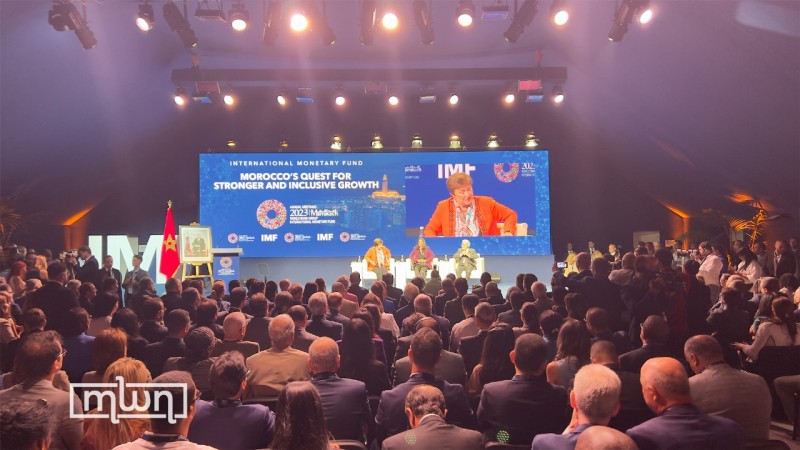
Panel discussion at the IMF, WB annual meetings in Marrakech
BAM further explains in the statement that the WB is taking a “holistic approach” to integrate climate change across its operations in more than 75 countries, with over 90% of new projects incorporating climate components.
In North Africa, where climate change is worsening water scarcity, the World Bank is accelerating investments to increase the resilience of drinking water supply and irrigation which serves as a model for other water-constrained countries.
Meanwhile, in sub-Saharan Africa, the World Bank is engaging in the climate fight by supporting countries to increase the resilience of their agri-food systems.
Throughout the continent, the World Bank is advancing a sustainable path towards universal access to electricity through investments in renewable energy.
The decision to buy climate bonds is the latest in Morocco’s efforts to boost climate financing in the country.
In January of this year, a report by the Green For South, a Torant-based consultancy, shed light on Morocco’s climate financing sector. Morocco, the report suggested, is emerging as a regional leader in establishing channels to finance climate action.
It also noted that Morocco is the first country in North Africa to adopt “appropriate regulations and guidelines” to support climate finance.
In July 2022, Morocco adopted a climate mitigation plan (NDC) under a budget of $78 billion. Of these, $38 million went into funding mitigation measures while $40 billion went into setting up climate catastrophe warning systems.
In terms of green financial activity, Morocco ranks alongside Egypt, Lebanon, and Turkiye in the group of leading countries mobilizing resources from both global green funds and green bonds.
Read Also: IMF-World Bank Meetings: Morocco’s Earthquake Special Fund Reaches $1.15 Billion


