 Join on WhatsApp
 Join on Telegram
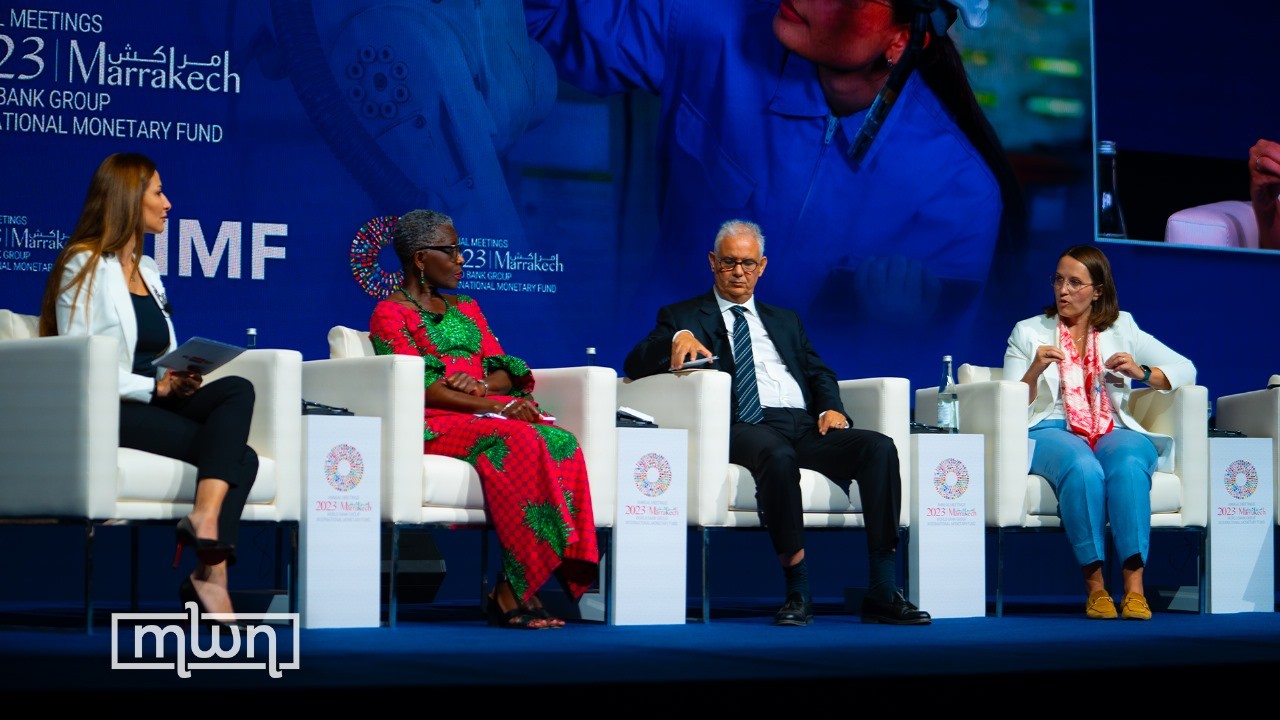
Marrakech – An International Monetary Fund (IMF) panel held in Marrakech during the IMF and World Bank annual meetings has discussed the need for reforms and new policies to address the world’s current economic difficulties.
The panel gathered IMF Deputy Managing Director Antoinette M. Sayeh, Moroccan Minister of Water and Equipment Nizar Baraka, Polish Minister of Finance Magdalena Rzeczowska, and BlackRock Global Head of Emerging Markets Fixed Income Amer Bisat.
The panelists focused on ways to revive growth and sustain development policies in developing countries, which have suffered dire consequences from recent crises such as the COVID pandemic and climate change.
Crises and droughts
Nizar Baraka, Morocco’s Minister of Water and Equipment, drew special attention to consecutive crises that Morocco has endured in recent years.
In addition to the ever-looming threat of climate change, as well as the unexpected shocks of COVID-19, the war in Ukraine, and the recent earthquake, the minister particularly pointed to the droughts the country experienced in recent years.
In recent years, Morocco has experienced the worst drought in the last three decades of the country’s history. This has heavily impacted the country’s agriculture, a pillar of the national economy.
In addition, the drought also affected drinking water resources as well as industrial applications, with some regions having to ration their drinking water after certain hours.
Baraka detailed how the Moroccan government had to come up with creative solutions to fulfill its biggest cities’ water needs, citing the example of Casablanca.
“Casablanca needs 290 million cubic meters. To find a solution, we did a water pipeline of 67 kilometers in eight months to take water from Sebou,” he explained, detailing that the pipeline is set to transport 400 million cubic meters a year to regions such as Rabat and Casablanca.
The project would guarantee 12 million people a consistent supply of drinking water. In addition, he highlighted an upcoming water desalination plant that would fulfill the drinking water needs of even more people.
“We will begin at the end of this year a very important desalination plant for 300 million cubic meters, and we will use renewable energy,” he said.
Need for structural reforms
In response to these crises, IMF Deputy Managing Director Antoinette M. Sayeh emphasized the need for “first-generation” structural reforms.
First-generation reforms are ones which aim to revitalize markets through opening them up through revising regulations that can make it harder to implement new businesses and reducing trade restrictions to open up markets to foreign capital.
“When those reforms are implemented in [economies that don’t have them] and if they are prioritized appropriately, sequenced appropriately, bundled together, they can over a two-year period make for an increase in growth of 4%,” she detailed.
Reforms on both the local and international levels have been a key point of discussion at the 2023 annual meetings, with some financial donors decrying the fact that monetary contributions can often get caught in bureaucratic red tape and other obstacles.
Sayeh cited the case of Senegal from 2014 to 2019, where the pursuit of first-generation reforms saw an average growth of 6.2%.
Citing “a world of constrained resources and limited policy space,” the IMF official said the fact that such reforms can ease tensions in policy choices is “huge.”
These reforms could also facilitate green transitions, especially in developing countries, by ensuring that additional growth goes towards green investments and transitioning workers in the fossil fuel sector.
The annual meetings of the World Bank Group and International Monetary Fund are currently taking place in Marrakech until Sunday, October 15, with the attendance of thousands of participants from the member countries of the two global financial institutions.