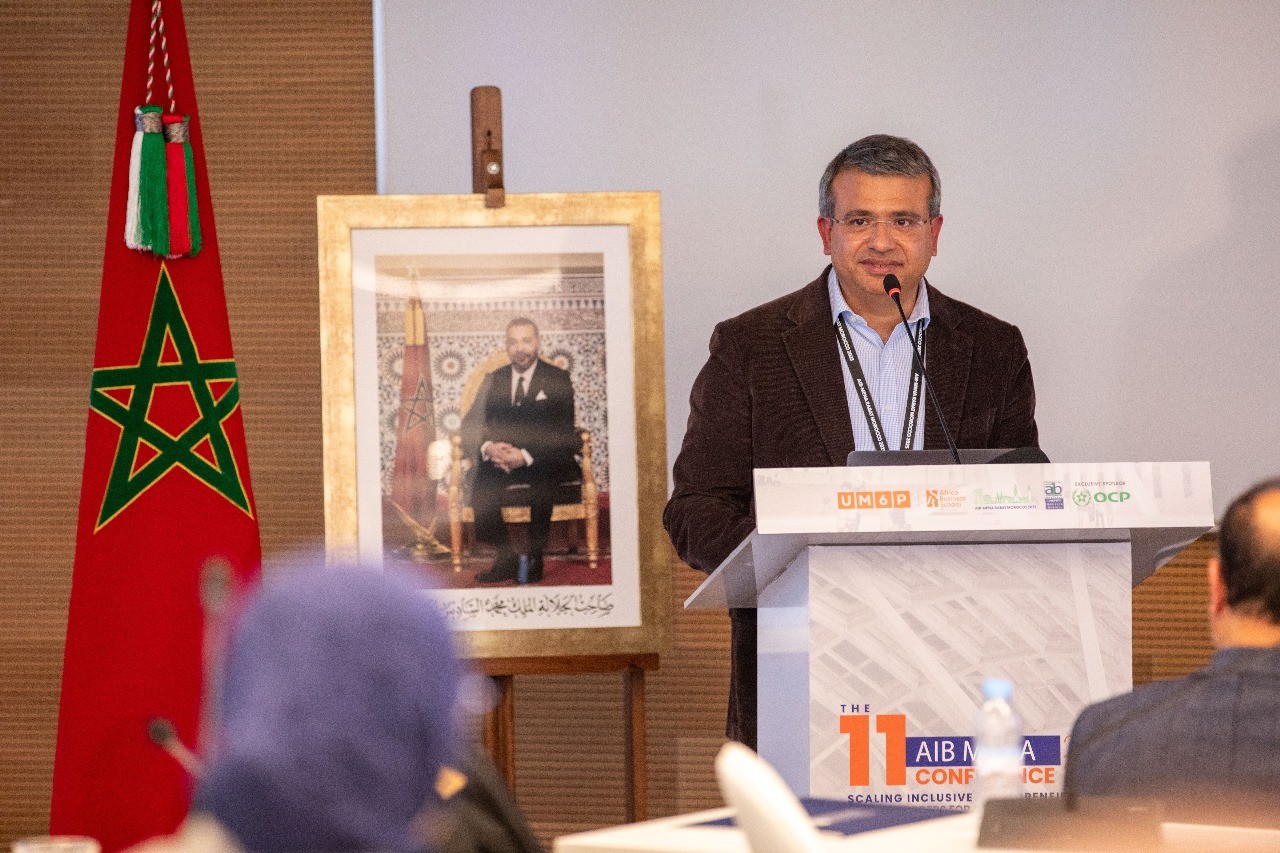
In the ever evolving narrative of international business and globalization, the Academy of International Business MENA Chapter’s (AIB-MENA) recent 11th Annual Conference, hosted by Africa Business School (ABS) in Rabat, stands as a reflective point. As the conference co-chair, I saw it as a deep dive into the complexities and possibilities of international business.
Our conference theme, “Scaling Inclusive Entrepreneurship Across Borders for a Sustainable Future,” was more than a guiding principle. It pushed us to look beyond traditional business theories and delve into how businesses can evolve sustainably and inclusively in the dynamic landscapes of the MENA region.
As I reflect on what we achieved, we investigated globalization’s uneven trajectories and its impact on diverse societies. A central insight from the conference was the challenge of “wicked problems” like economic inequality, environmental degradation, and social imbalance. These are not just regional issues but global challenges that require innovative, locally rooted, and globally applicable solutions.
We were also reminded that management science has a vital obligation to provide them. The discussion around inclusive growth emerged as a critical element for robust and sustainable international business practices.
This concept extends beyond ethical considerations, encompassing a practical approach to internationalization that seeks to uplift all sectors of society. It’s about crafting a business agenda where progress is measured not just in economic terms but in broadening opportunities and capabilities across all communities.
Sustainability, often relegated to corporate social responsibility agendas and buzzwords, emerged at the conference as a strategic core, not an afterthought, in business planning. This perspective aligns with Africa Business School’s commitment to transform business and society sustainably.
The conference also underscored the power of collaborative innovation, highlighting the synergy achievable when academia, industry, and governments unite to address the MENA Region’s challenges.
What resonated most deeply was the shared commitment to transform scholarly research into tangible societal impact. This event was not just about academic discourse; it was about enacting change.
At Africa Business School, we spearhead research that extends beyond theoretical discussions, addressing societal issues with actionable insight. Our aim is not just to contribute to scholarly conversations but to deliver management solutions that resonate from Africa to the rest of the world.
I feel energized and hopeful. Institutions like AIB-MENA and Africa Business School have the potential and the duty to tackle pressing problems and deliver societal impact. We stand as changemakers committed to a future where business is a force for good.
As we continue to make sense of the complexities of international business, the insights gained from this conference will shape our actions for sustainable and inclusive business practices that resonate globally.