Rabat – President of Morocco’s Human Rights Council (CNDH) Amina Bouayach has outlined Morocco’s strategic vision for boosting fundamental rights, including human rights and democracy.
Bouayach made her remarks during a one-hour interview with Medi1TV on Sunday.
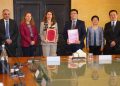
The CNDH President started the interview by commenting on the award she received recently, in recognition of her efforts in promoting human rights as well as gender equality.
Earlier this month, Bouayach was awarded the North-South award by the North-South Centre of the Council of Europe.
Commenting on the award, Bouayach recalled that two Moroccans received the award before her, including King Mohammed VI advisor Andre Azoulay and late Head of Government Abderrahmane Youssoufi (1998-2002).
“I was present when Youssoufi was awarded the same prize, I was working with him. I never thought I would also receive the same award” Bouayach said, noting that the prize reflects Morocco’s position in boosting human rights.
“It reflects Morocco’s achievements, strategic choices, sovereign democracy, and human rights,” she said, stressing her confidence that more Moroccans will receive the award.
Bouach also commented on Morocco’s historic election to the presidency of the UN Human Rights Council for 2024.
Morocco was elected to the presidency of the UN body on January 10, reflecting the country’s wave of reforms seeking to consolidate democracy, gender equality, social and territorial justice, in addition to youth empowerment.
For Bouayach, this election reflects Morocco’s gains in the human rights sector, noting that this role requires a country that can manage all member countries and is open to listening to all challenges presented.
Citing the kingdom’s qualities in the sector, Bouayach said that Morocco does not politicize human rights.
This quality and transparency gave the voting countries a comfort to give a note to Morocco’s candidacy.
Clear Moudawana
The CNDH President also discussed the much-anticipated Moudawana or family code reforms, recalling the consultations and meetings held by a special committee tasked with exchanging ideas and opinions about reforms needed to tackle family-related issues.
Speaking about the process, Bouayach said that the consultations and negotiations that took place were centered on addressing challenges by the family institution as a whole, transcending a focus solely on women.
The goal is to comprehensively tackle challenges at their core through a negotiation process, involving all stakeholders, including NGOs and legal experts.
The emphasis has been on developing recommendations that encompass different facets, including religions, social, and cultural considerations, Bouayach said, noting that these recommendations are intended to serve as a framework for finding solutions to diverse family issues.
The CNDH President notably acknowledged the persistence of critical issues in Morocco’s society, including child marriage, violence against women, and child sexual abuse.
The challenges are often compounded by the escape of perpetrators from due punishment, she added, noting that the new family code aims to provide unequivocal responses to the challenges that persist within the familial landscape.
The special committee tasked with reviewing the family code conducted 130 hearings as of December 27, 2023.
The consultations were held with different stakeholders, including NGOs, political parties, and experts in family law, among others.
The consultations came after King Mohammed VI called on the government to revise the family code in September last year
The request came as NGOs and human rights activists have been demanding reforms in the family law, encompassing, the abolition of underage marriage, the prohibition of polygamy, and equal inheritance rights.
Read Also: The Moudawana: A Look into Previous Reforms