Fez – The history of the traditional tannery is linked to the ancient medina in Fez, Morocco where it has been a real source of wealth, thus came the Arabic proverb “Dar Dbagh, Dar Edheb” (A house of tannery is a house of gold).
Tanning and currying is an art that has been practiced for centuries using ancestral techniques, making Morocco famous worldwide. It reached its peak in the Kingdom under the Almohad dynasty in the 12th century.
Around the year 1325, there were around 86 tannery houses in the old city of Fez, of which currently only 3 houses remain; Chouara, Sidi Moussa and Ain Azliten.
As part of the rehabilitation program, these three tannery houses have also benefited from a set of programs and support measures, such as restoration and rehabilitation operations, the collective quality mark of “real leather”, and the acquisition of technical equipment.
Tanning hides and skins is an industry that stimulates all senses. The sharp smell tickles the nostrils, and the finished material is warm to the touch.
In the Chouara tannery in Fez, there are more than 500 master craftsmen working every day in the city’s 1,200 basins.
Nearly 900 years old, Chouara is considered to be the oldest tannery in the world. It is also the most famous Moroccan tannery and a trademark of local leather products. It is a very important craft for the country’s economy.
In Chouara, the tanning of sheep, cow, goat and camel skins are processed using the same techniques for a thousand years, dating back to the 12th century. The entire process lasts around thirty days.
Made up of numerous stone basins filled with a wide range of dyes and various liquids, some tanneries still attract craftsmen, whose often tense faces hide all the joy and dynamism that mark their profession.
To get a rawhide ready for use, tanners follow three major steps. The first consists of immersing the skins for several days in basins filled with lime, pigeon droppings and ammonia.
During the dying phase, the numerous vats are transformed into natural palettes of colors; poppy flower for red, indigo for blue, henna for orange, or even mint for green.
Finally, the skins are rinsed, then dried in the sun for three days.
The view is impressive. Under a blazing sun, dozens of artisans work barefoot to immerse their large leather skins in hundreds of vats of all colors.
Tannery as a business model is deeply rooted in tradition but has been able to evolve and survive the passage of time, and currently employs more than 300 families. This may seem somewhat surprising since tanning is neither a pleasant nor a particularly well-paid profession – a tanner earns the same as any unskilled worker in Morocco, approximately 2500 dirhams per month.
But passing down the tradition is deeply important to families in the business.
Most tanners start in the trade because their fathers are also tanners. This makes it possible for them to get started in a trade where one usually needs a fellow tradesman’s recommendation.
A visit to Chouara
Thanks to recent rehabilitation programs, the leather crafts of Fez attract nearly a million tourists each year.
Visitors gather around terraces above the Chouara tannery with cups of tea in their hands to observe the whole process, despite the particularly unpleasant odors.
Once in the tannery, visitors are provided with a sprig of mint, which they should keep for the whole tour since it’ll protect them from the odor.
When your visit comes to an end, if you’re not going to buy anything, it’s customary to tip the shopkeeper for the tour and the sites from their terrace to admire the most traditional and colorful show in Fez.
Of the nearly 90,000 inhabitants of the old medina, around 30,000 are artisans, 500 of whom work as master craftsmen in the 1,200 tanning vats and workshops of Chouara.
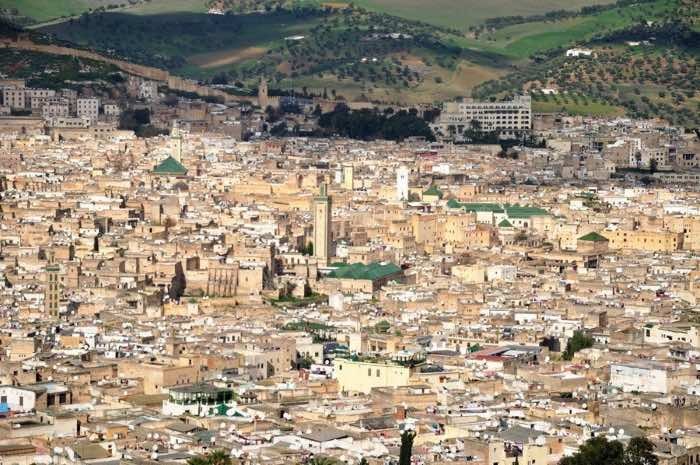
The tanners’ district in Fez, or Chouara, is full of shops offering leather items, most often of very good quality. It is located in the heart of the medina of Fez el Bali, along the canalized Oued Fez, an ideal location as skin treatment requires lots of water.
Like in the rest of the city, there is a lively bargaining culture, where you will have to negotiate with shopkeepers if you want them to knock down their prices. If the seller is a professional, you can also get a highly instructive chat about how each of their products are made.
Tourists always have to haggle their way to the best deals the tanning areas have to offer, as most prices get usually knocked down to half or less of the initial fee.
In 1981, the ancient city of Fez was named a UNESCO World Heritage Site, joining nine other Moroccan locations, including the old city in Marrakech, and the Ait Ben Haddou fortress in Ouarzazate.
Read also: 4 Must-See Sites in Fez, Morocco’s ‘Cultural Capital’