 Join on WhatsApp
 Join on Telegram
Madrid: Arab origin of its name
The history of Madrid began in the ninth century, when the Umayyads decided to build a line of fortifications in the center of the Iberian Peninsula to defend the borders of Al-Andalus.
Around the year 865, Muhammad I, son of Abderraman II, ordered the construction of fortifications around the village of Magerit مجريط, formerly known as Matrice, a name that referred to the water in the area and the stream that ran through the street of Segovia.
Madrid was founded as a hisn حصن (fort), but soon historical sources began to refer to it as a madina sagira (a small city) or al-mudeyna. It became a center of attraction for the civilian population, as well as the capital of a small region. On its account, the Moroccan geographer al-Idrissi wrote in the twelfth century:
“Among the cities with minbars at the foot of these mountains is Madjrit, a small town and a powerful and prosperous fortress. It had, in the Islamic era, a large mosque where sermons were regularly given. “
The only Christian source that made a mention of Madrid before the Castilian conquest in the 11th century is a chronicle by Bishop Sampiro de León in which he tells how King Ramiro II of Asturias, in one of his expeditions against the land of the “Chaldeans” (a way of referring to the Muslims), attacked and destroyed the walls of “the city they call Magerit. ” Magerit was the medieval Latin and Castilian way of transcribing the Arabic “Majrit” مجريط, origin of the current name of the city.
Recovered history and identity
Nevertheless, this stage of Madrid’s life is not well known by tourists and even by many locals who do not know that their city was, at one time in history, one of the fortresses of al-Andalus. To remedy this situation, the Madrid City Council has recently published a guide to inform about those two centuries when the capital was part of al-Andalus and to highlight its Arab origins.
“Madrid islámico: La historia recuperada” (Muslim Madrid: Recovered History) is the title of this book published by the City Council of Madrid, in collaboration with the Center for Studies on Muslim Madrid (CEMI).
Although few remains of the al-Andalus period have been spared in Madrid, the City Council wanted to shed light on this heritage and this part of the city’s ancient history, which until now has been little known and, above all, little revealed for subjective reasons.
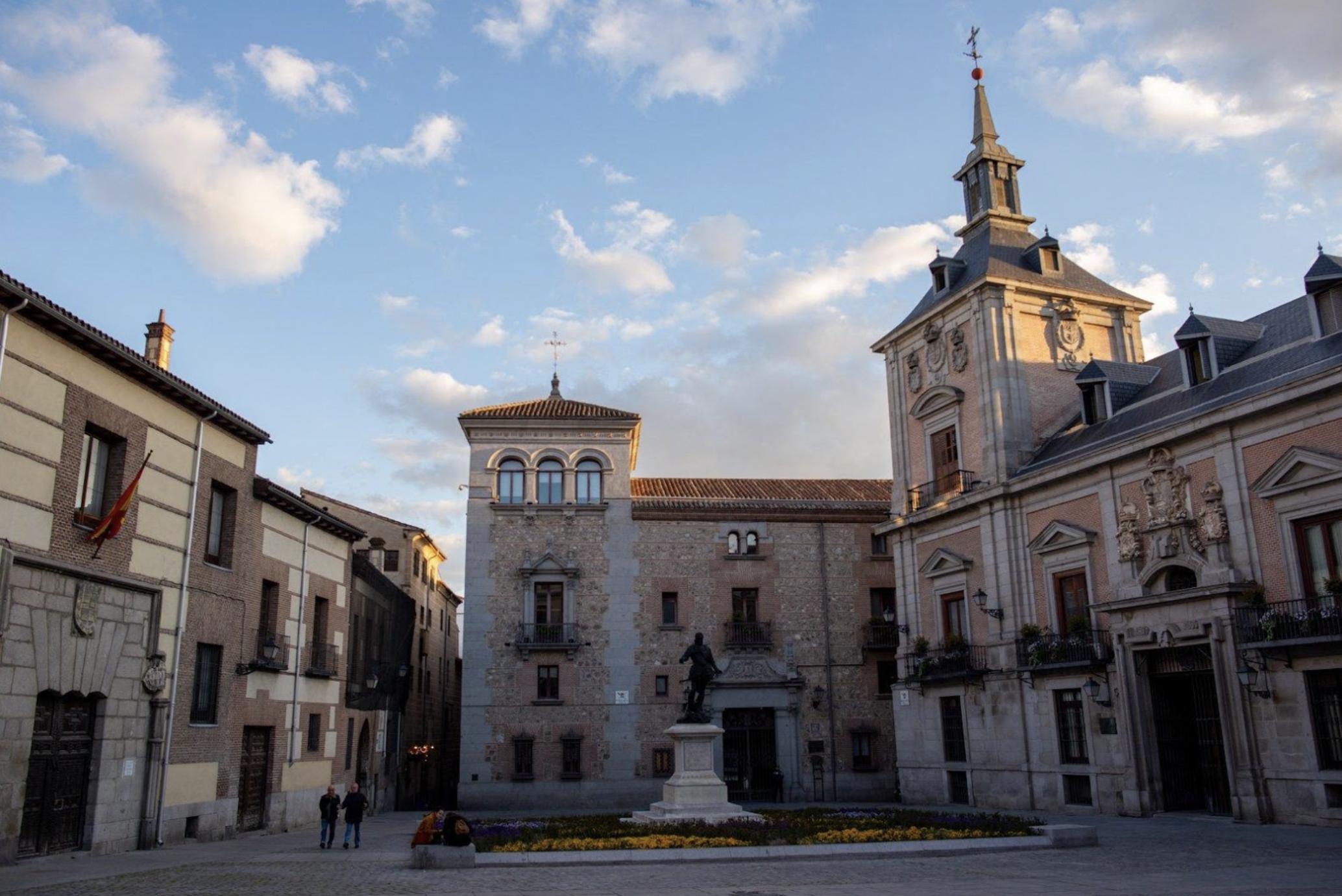
Among the ruins reminiscent of this period are part of the Arab wall in the park of the emir Muhammad I, as well as a portion of another Arab wall now located under a building in a street in the center of the capital, an Arab watchtower from the 10th century now located in an underground public parking lot in Plaza Oriente or a silo from the Arab-Muslim period in Plaza de Ramales.
Several of Madrid’s disappeared Arab monuments are also mentioned in the guide, as well as the objects used in that era, a large number of which are on display at the San Isidro Museum, which now has an entire room dedicated to Arab archaeology.
Several objects and archaeological remains from the al-Andalus era, discovered during excavations for urban projects in the heart of Madrid or during archaeological digs, are on display in this museum. These remains allow visitors to imagine what social, economic and political life was like in Mayrit.
Madrid Today
The Madrid headquarters of Casa Árabe on Calle Alcalá, near the northern entrance to the Retiro, is a neo-Mudejar building constructed in 1886 that housed the Aguirre schools at the end of the 19th century.
This building was designed by the architect Emilio Rodríguez Ayuso, who conceived it as a two-story building capable of housing educational spaces that were particularly innovative for the time, including a gymnasium, a library, a school museum, a playground, a music room, and even a weather observatory located in the tower.
Casa Árabe, which is based in Córdoba and Madrid, is supported by various public institutions such as the Spanish Ministry of Foreign Affairs and the Spanish Agency for International Cooperation, the Autonomous Communities of Madrid and Andalusia, and the City Councils of Madrid and Córdoba.
This tour of Medieval Madrid can be continued at the National Archaeological Museum, which includes an interesting collection of sumptuary arts from the Visigothic Kingdom of Toledo to the Late Middle Ages. The Medieval and Renaissance art rooms of the Museo Lázaro Galdiano and the Museo del Prado are also worth a visit. It is also worth mentioning the Christian Wall of Madrid which began to be built after the fall of Toledo during the reign of Alfonso VI of León and Castile (1040-1109) and continued its construction coinciding with the instability of borders and domains during the twelfth century and the first third of the thirteenth until 1212.
Among the luxury villas of a residential area in the north of Madrid is a small square with the mysterious name of Maslama. In fact, it is the only memorial in the city to one of its most famous sons: Abu Al-Qassim Maslama “Al-Majriti”, otherwise known as “the Madrilenian”.
Sons of Madrid: Abu Al-Qassim Maslama “Al-Majriti”
Abû-l-Qâsim Maslama ibn Ahmad al-Faradi al-Hasib al-Qurtubi al-Majritî (Arabic: أبو القاسم مسلمة بن أحمد المجريطي), Arab mathematician, chemist, and astronomer from al-Andalus, born in Madrid in 950, died in 1007 in Cordoba, known as the master of mathematicians of al-Andalus. He lived mainly in Cordoba.
He is quoted by Ibn Khaldun in his Muqaddima. He affirmed the law of conservation of matter. In astronomy, he translated and commented on the work of Ptolemy. He revised the Astronomical Tables of Al-Khwârizmî. He was strongly inspired by the sciences in the civilizations of the ancient Greco-Roman world.
He published several works that have come down to us, including commentaries on al-Khwârizmî and books on geometry and arithmetic based on Greek and Hindu books.
He is credited with a treatise on astral magic, Ghâyat al-Hakîm (The End of the Sage) translated into Latin (by Gerard of Cremona?) under Alfonso X, king of Castile known as the Wise, (1221-1284) under the name of Picatrix, and dating from the middle of the eleventh century.
In today’s Madrid, he is a complete stranger, even to the inhabitants of the square that bears his name. In fact, it is difficult to find a list of illustrious Madrileños who predate the city’s Christian patron saint, San Isidro (Isidore the Ploughman), who according to legend was born at the end of the 11th century.
Conclusion
The presence of the Arabs/Moors in Spain for 8 centuries is no doubt a painful history of colonization and Islamization of Christian land by force, but having said that it seems that this reality recedes when reflecting on this part of human history and, instead, several positive facts come to mind:
-
Al-Andalus permitted the advent of the only instance of coexistence of the three monotheisms in the history of humanity, referred to in Hispanic literature as convivencia. Obviously many intellectuals reject this as a pure myth but the fact is that many others defend the veracity of this concept of vivre ensemble with as much strength for the simple reason that if this did not exist al-Andalus would not have been the cradle of fantastic development of human knowledge and wisdom;
-
Human experience in al-Andalus would not have been successful if it were not for the generosity of both the Spanish land, known as al-firdaws (among Arabs), and that of the Spanish people during Muslim rule;
-
This extraordinary development in thought and technology fed, undoubtedly, the European renaissance and led to the apogee of Western culture and way of life worldwide; and
-
Today with the revival of doubtful nationalisms and religious fundamentalisms reactivating sentiments of racism, xenophobia, hate, violence and intolerance, one wonders if it is not high time to go back to the spirit of forgiveness and conviviality of al-Andalus to root out the present atmosphere of dislike and anger directed at the other and his otherness.
Madrid, majra, majrit is about many sources and streams of wisdom and harmony much needed today. Madrid was a small town in the edge of al-Andalus in Spain. It is fully Spanish even in its Arab past and should be celebrated as such and must be fully recuperated for Spain and for humanity, especially at a time when hope for humanity, been humane and compassionate, is fading dangerously.
Yesterday, Madrid was a fortified edge of al-Andalus, today Islamic Madrid, with its many streams of consciousness, can surely become a world center of faith dialogue and intercultural dialogue. Amen.
You can follow Professor Mohamed Chtatou on Twitter/X :@Ayurinu