

Doha – As the holy month of Ramadan approaches each year, Moroccans eagerly seek out a special delicacy – the Mejhoul date, known as the “king of dates”.
Hailing from the oases of Tafilalet in southeastern Morocco, this large, soft and exceptionally sweet fruit has gained renown far beyond the country’s borders.
Despite its high price, the Mejhoul date remains a staple for many Moroccan families during Ramadan, prized for its nutritional benefits and ability to provide sustained energy during long days of fasting.
Nutritional benefits and utilization:
According to Maria Benjelloun, a nutrition specialist, the Mejhoul date shares many of the same nutritional properties as other date varieties. In an interview with SkyNews on the Ramadan food staple, she adds that because the date is rich in fast-acting sugars, it provides a significant energy boost while being low in fat and high in fiber. The dates are particularly beneficial for those with high blood pressure due to their potassium content, and can aid digestion and prevent constipation.
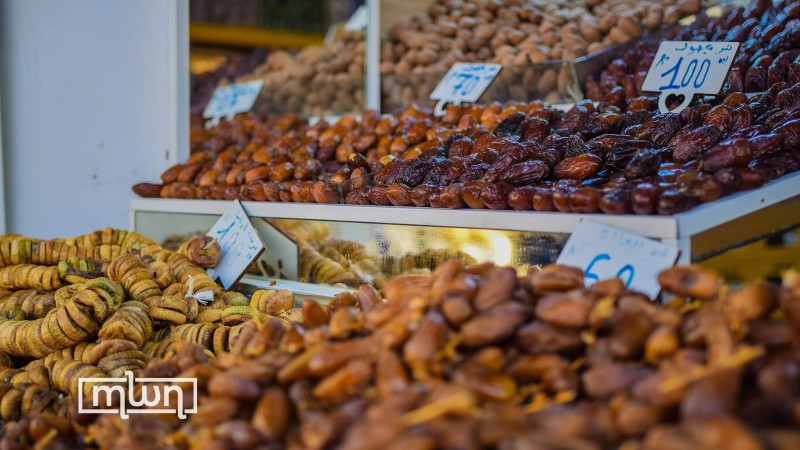
Dates on sale at a store in Medina Rabat
Benjelloun also notes that Mejhoul dates are an excellent source of minerals, particularly iron and zinc, making them valuable for those with anemia. They contain phosphorus, manganese, calcium and vitamins that support brain and heart health. The dates’ nutrient profile helps combat fatigue and exhaustion during fasting.
What sets Mejhoul dates apart is their large size, equivalent to about three regular dates, and their slightly lighter color. They are also exceptionally sweet, with a flavor reminiscent of honey. Benjelloun recommends breaking the fast with a glass of water and a single Mejhoul date, waiting about ten minutes before consuming other foods or performing the Maghrib prayer.
The Mejhoul date is dried, not dehydrated, and therefore sold soft and sticky. It is a highly versatile fruit that can be used in various ways, including being consumed as a snack with dried or fresh fruits, or as an ingredient in sweet or savory recipes.
It is also used to prepare traditional cakes (notably the Maqrout), to sweeten biscuits, or to stuff certain pastries. It can also be used in juices and smoothies, or to prepare beverages such as date milk.
Additionally, the date can be consumed in paste form to replace spreads saturated with white sugar and palm oil. As nutritionist Benjelloun cites, it is considered a superfood due to being rich in nutrients and antioxidants. For this reason, it can be used in certain health products such as dietary supplements and energy bars.
An internationally renowned Moroccan delicacy:
According to a 2006 study by Mohammed Aziz Elhoumaizi, professor of biology at Mohamed Premier University in Oujda (eastern Morocco), the Mejhoul date is classified as a rare date variety grown in North Africa. It is cultivated specifically in the Errachidia region of Tafilalet. Similar date varieties are grown in Algeria, Tunisia, Egypt and Jordan.

Different types of dates on sale in Medina Rabat
According to the book “Variety Mejhoul: The Jewel of Dates,” co-edited by Professor Abdelouahhab Zaid and Professor Abdallah Oihabi, the Mejhoul date has a long history of being recognized as a premium date variety. In the 17th century, it commanded higher prices than other dates in the markets of England and Spain, with most of the dates imported to Europe at the time originating from Tafilalet.
However, the Bayoud disease, caused by a soil-borne fungus and first scientifically described in 1919, devastated Moroccan date plantations. The Mejhoul cultivar was particularly susceptible to the disease, leading to a significant decrease in production and its disappearance from the European market.
The Mejhoul date is among the most expensive, with a single date sometimes costing over a dollar. This is attributed to the complex and labor-intensive cultivation process, as well as the palm trees being pollinated naturally.
The first journey to the US
In 1927, the French colonial authorities formed a scientific commission to study the Bayoud disease, which included American scientist Walter Swingle and several French experts.
During their investigations in the Boudnib oasis, home to around 9,000 date palms primarily of the Mejhoul variety, Swingle was impressed by the exceptional quality of the Mejhoul dates. He acquired eleven offshoots and brought them back to the United States.
The offshoots were quarantined in Nevada for nine years, from 1927 to 1936, to ensure they were disease-free. The surviving offshoots, along with the additional ones they produced, were then transferred to a USDA research station in California.
In 1944, the station began distributing offshoots to growers in California and Arizona. The Bard Company of California acquired 24 offshoots from the USDA, and today, 99% of the date palms grown in Yuma and the Bard Valley are of the Mejhoul variety.
The name was distorted while crossing the Atlantic, becoming known as “Medjool” in America. The U.S. now exports these Medjool dates to many parts of the world, including Saudi Arabia, North African countries and Israel.
How did the Mejhoul date reach Israel?
Mejhoul date cultivation extends to Israeli settlements in the Jordan Valley along the Syrian-African Rift. The variety, originally popular in Morocco, was affected by the mysterious Bayoud disease in 1927. Despite efforts by scientists from around the world summoned by the French colonial authorities, they were unable to save the affected palm trees.
However, an American scientist, Walter Swingle, was permitted to take eleven Mejhoul date offshoots. Following the quarantine period in Nevada to ensure the saplings were disease-free, they were transferred to California.
From California, the Mejhoul date made its way to Israel in the 1960s, where it was planted in settlements in the Arava Valley. The Mejhoul date revolution in Israel began in the 1990s, and the country now holds 30% of the world’s Mejhoul dates, exporting over 50% to the global market.
Expansion and investment
According to Le360, a significant investment agreement of approximately 7.47 billion dirhams has been concluded for a period of 10 years, with 3.6 billion dirhams financed by Maroc Dattes and 3.87 billion dirhams coming from the state. The overall objective is to reach a production of 300,000 tons of dates, which will require significant improvements.
By 2030, a total of 3 million date palm plants will be planted to rehabilitate the traditional palm grove. Specifically, some 2.63 million plants will be planted in the Drâa-Tafilalet region, while the Oriental will benefit from 142,000 plants, Souss-Massa from 193,000 plants, and Guelmim-Oued Noun from 35,000 plants.
An extension of plantations outside the traditional zones is also planned. Some 2 million vitro plants will be planted on an area of 14,000 hectares in the regions of Drâa-Tafilalet, Souss-Massa, Oriental, and Guelmim-Oued Noun, for a total targeted area of 21,000 hectares. This diversification of cultivation zones will contribute to increasing date production and reducing dependence on traditional palm groves.
This sector provides an average of 3.6 million working days annually and secures 50% of agricultural income for over 2 million Moroccans, according to official data. It covers 471,000 square kilometers of date palm cultivation areas.
As Ramadan begins, Moroccans will once again turn to the beloved Mejhoul date to break their fasts and savor its unparalleled sweetness.
While the dates remain a seasonal delicacy for many, the expanding cultivation and investment in the sector point to a bright future for this “king of dates”.
With its exceptional flavor and nutritional benefits, the Mejhoul date is sure to remain a cherished part of Moroccan culinary heritage for generations to come.
Read also: Ramadan Countdown: What’s the Moroccan Way to Welcome the Holy Month?