
 Join on WhatsApp
 Join on Telegram
Rabat – As the devastating Israeli genocide on Gaza shows no signs of abating, the enclave continues to bear the brunt of occupation’s merciless attacks. Since October 7, at least 41,020 people have been killed, and 94,925 others wounded in Israeli strikes, Gaza’s Health Ministry reported on Tuesday.
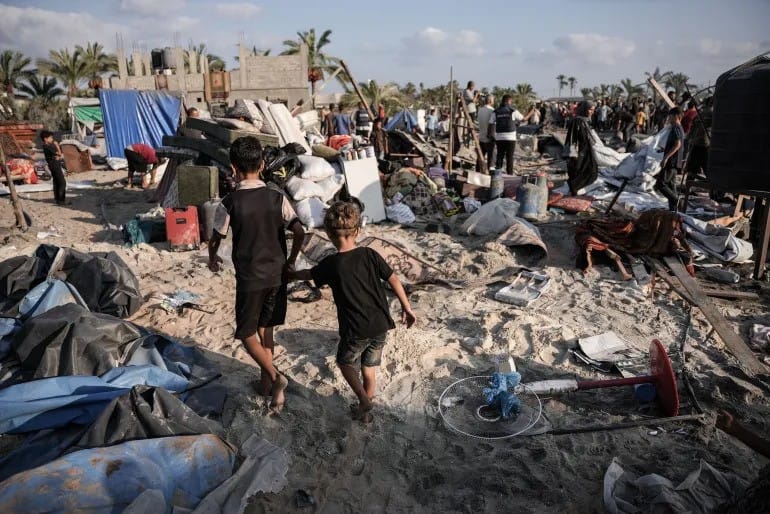
In the latest 24-hour period, 32 Palestinians were killed, and 100 more were wounded. Israeli airstrikes have completely pounded various areas across Gaza, including the al-Mawasi “humanitarian zone,” where at least 40 people were killed and 60 injured early Tuesday morning.
Four missiles struck the overcrowded coastal area, causing widespread devastation and leaving craters as deep as nine meters. Hundreds of thousands of displaced civilians, forced to relocate by Israeli forces, were currently sheltering in Mawasi under dire conditions when the horrific attack occurred.
The strikes have drawn sharp criticism as they target areas designated as supposed “safe zones” for civilians. However, with the humanitarian situation worsening and no ceasefire in sight, the violence by the Israeli Occupation Forces (IOF) rages on.
Meanwhile, efforts by mediators US, Qatar, and Egypt to broker a ceasefire and facilitate the release of Israeli hostages have hit significant obstacles. A proposed deal aimed at halting the violence and securing the hostages appears to be faltering.
US officials, who originally said they were preparing a “take it or leave it” proposal for both sides, are now reassessing their next steps, the Washington Post reported last week.
Senator Chris Murphy, a senior member of the Senate Foreign Relations Committee, remarked on the challenges the Biden administration faced during truce talks. “Most days, it’s pretty clear the Americans are working much harder than the Israeli government is working at this,” Murphy remarked, attributing the stalemate to “political calculations” by both Israeli Prime Minister Benjamin Netanyahu and Hamas.
Despite the criticism, the long-standing Israeli ally continues to send billions of dollars to Israel in military aid to bolster the IOF who continue to commit genocidal acts.
Following the recent round of ceasefire talks mid-August, mediators presented a “bridging proposal” that the US said Israel had accepted. Yet, Hamas strongly rejected the proposal for deviating from the terms of the ceasefire deal Biden presented in May and the UN Security Council later endorsed.
The Palestinian group also criticized the US for succumbing to Israeli pressure. The original deal includes Israeli forces’ full withdrawal from Gaza, a term that Netanyahu strongly opposes.
Israeli Defence Minister Yoav Gallant, however, on Tuesday signaled support for an agreement to release captives as part of a phased Gaza truce, seeing it as a “strategic opportunity” for Israel to address broader security concerns.
Gallant emphasized the importance of prioritizing the release of the captives, an issue that has become a point of contention within Israel’s government. He has criticized Netanyahu’s stance on the matter, accusing him of delaying an agreement to maintain control over the Philadelphi Corridor, a move that he suggests is jeopardizing the lives of the hostages.