
 Join on WhatsApp
 Join on Telegram
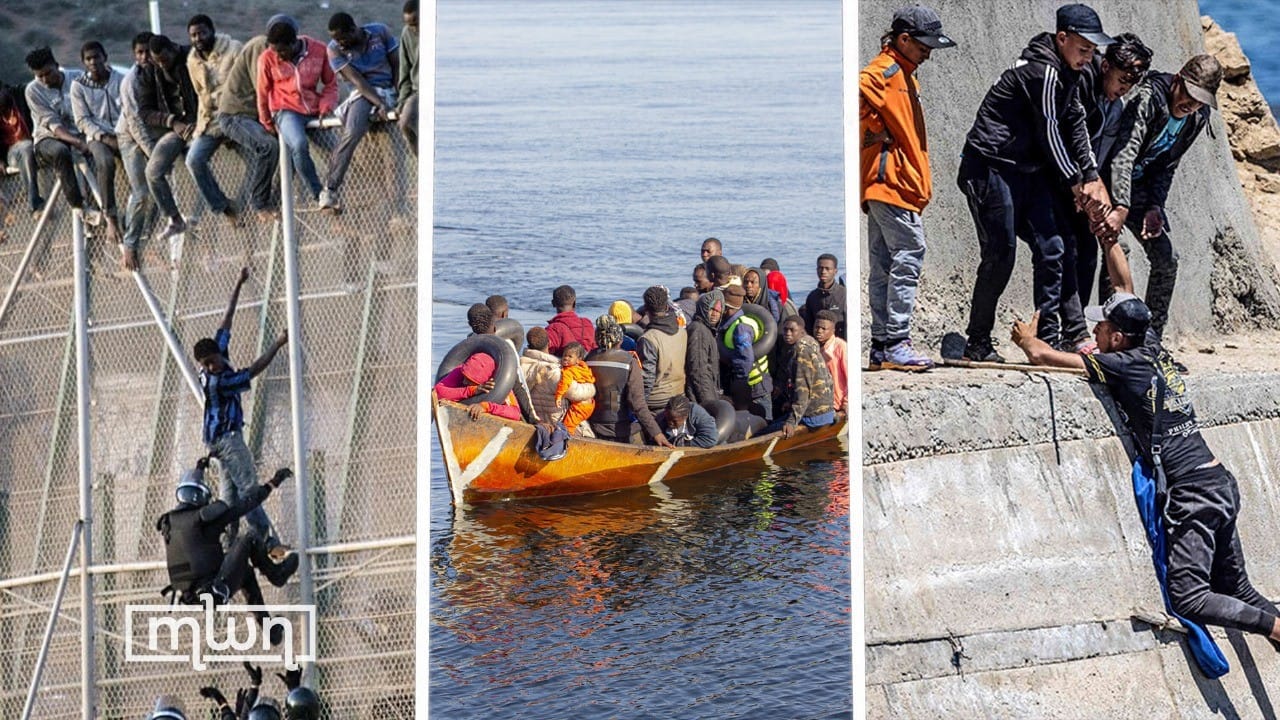
Rabat – The rubber boat, jam-packed with stick-figure people screaming and praying, was leaking. Freezing waves smashed over the floor, where 30 irregular immigrants – seven of them unaccompanied children – were crammed. As darkness fell and hopes of making it to the other side faded, a Guardia Civil ship finally caught up with them.
“We spent 26 hours in the sea. Without Satellite Navigator we’d have been lost and nobody would have found us,” Ayoub, not his real name, told me on the condition of anonymity.
“Many thought we were going to die. We took turns emptying the floor and plugging the holes. Everyone was praying and reciting verses from the Quran. Children clung to each other. Nobody was wearing a life vest. We all thought that’s it, It is the end of us.”
The self-appointed captain of the rubber boat was himself an irregular migrant. He was trained by people smugglers to drive the inflatable boat and navigate the GPS. Once close to the Tenerife borders, they were instructed to “call Helen” on 112. Helen is not a real person; it’s a codename for any operator who picks up the distress call and dispatches the Guardia Civil to the rescue of migrant boats.
‘Nobody wants to hire me’
“One of the agents screamed instructions, ‘wahed wahed, wahed wahed’ [One by one, one by one]. The immigrants boarded the vessel and they took them to a refugees’ center. On arrival, assistants handed each a bag with dry clothes, shoes, a sandwich, an orange juice, and a bottle of water. “I was so famished I swallowed the whole sandwich and gobbled the orange juice on one go. I felt my organs running again,” Ayoub recalled.
Irregular immigrants are required to spend a maximum of 90 days in a reception center before being transferred to a community in Spain, but the authorities are overstretched, so they are often kept much longer. Ayoub was in a reception center for four months, during which time other boys left, moving to cities to try to earn money.
“I am a barber. So I wake up every morning hoping my luck is by my side. I managed to find a stint in many barbershops but nobody wants to hire me full time. I need a Spanish residency.”
Upon landing in Malaga, Spain, Ayoub took the bus to Tomelloso, a village 200 kilometers south of Madrid, to join his friends from the neighborhood in a shared house. Tomelloso is one of Spain’s leading melon- and wine-producing communities so most of his friends work in the fields all day for a meager pay.
“I would rather do sweat jobs here than in Morocco. The pay is higher in Spain but the cost of living is pretty much similar. I could save more money and wire some to my mother back home. She is the reason I am doing all this,” he added.
Defying death for a brighter future
Over 17,200 undocumented migrants and asylum seekers arrived in Spain via the Mediterranean route in 2023, nearly 7% more than the 16,000 in 2022, according to ACAPS, an analytics firm. But those services – rides in rubber boats that may or may not sink – usually cost north of MAD 20,000 ($2,000). Most immigrants, like 19-year-old Ayoub, remember every penny they squirreled away to pay the smuggler.
Irregular immigrants will go to desperate lengths as they risk their lives in a life-or-death bid to cross the seas in hopes of a bright future. Smugglers defy foggy conditions to attempt the dangerous crossing, some take advantage of the calm seas to make the trip swimming to the Spanish enclaves of Ceuta and Melilla.
As risky as it is, many are willing to take on the challenge. Videos abound online of migrant groups making their way towards the Spanish coasts. Some are smirking and giving thumbs ups to the camera. Others wearing swimsuits lip-syncing songs on tiktok dedicating their triumphant crossing to “L’Walida” – their mothers.
But it’s not all rosy, between January and May this year, a total of 5,504 migrants – almost 33 deaths a day, or one migrant every 45 minutes – died trying to reach Spain by making the treacherous sea crossing, according to Spanish NGO Walking Borders citing US and EU data.
Several factors drive young people to migrate. Poverty, unemployment and a failing educational system remain determinants that control the increase and decrease of the rate of migration. Lately, peer pressure has entered the fold.
Moroccan police arrested over 60 people for promoting content on social media inciting for irregular crossing. Still, offers of illegal immigration by jet skis continue to invade pages and active groups on Facebook. The Moroccan authorities have in recent years banned the use of jet skis in most cities in the north of the country, such as the Tangier-Tetouan-Al Hoceima region, to avoid their use in illegal immigration, human trafficking, and drug trafficking.
While the majority of Europe-fascinated irregular migrants choose to ride the “death boats,” there is an increasing shift toward the use of jet skis. Those who choose the second option either pay a huge sum of money to the smugglers — as much as 60,000 MAD ($6,000) — or go to virtual intermediaries who help them cross the Moroccan coastline in a short time and without risk.
Exploited in Europe
In most cases, however, their hopes for a better life are dashed as soon as they reach their once idealized destination. Moroccan men, women and children are exploited in forced-labor and sex-trafficking markets abroad.
Last year, the Spanish police shared footage of operations in which local security officers rescued 20 women who were forced into prostitution by drug gangs in Marbella. The victims were mostly irregular immigrants who had been promised well-paid jobs. Worse still, other migrants end up in the hands of pedophiles. There are even claims of boys being taken or killed for their organs.
Europe’s fruit and vegetable farms depend on the work of migrant day laborers. Global inflation has driven up prices everywhere, including Spain, where much of Europe’s fruit and vegetables are grown. As a result, Spanish farmers have increasingly resorted to recruiting cheap labor to keep the price down. Many farm hands are paid as little as $5 an hour.
Ayoub managed to find a job at a barbershop owned by a Moroccan. He is grateful he’s found a community that received him with open arms. His integration was “seamless,” he says. He is surrounded by Moroccans and eats Moroccan food but he can barely speak a full sentence in Spanish.
His next objective is to earn Spanish residency to improve his salary so he can go back to visit his family back home. I asked him what Spanish words he’s learned so far. “Ocho,” he said. “Number eight. It’s my registration number at the reception center.”
Read also: African Countries Need to Address Youth Fascination with Migration