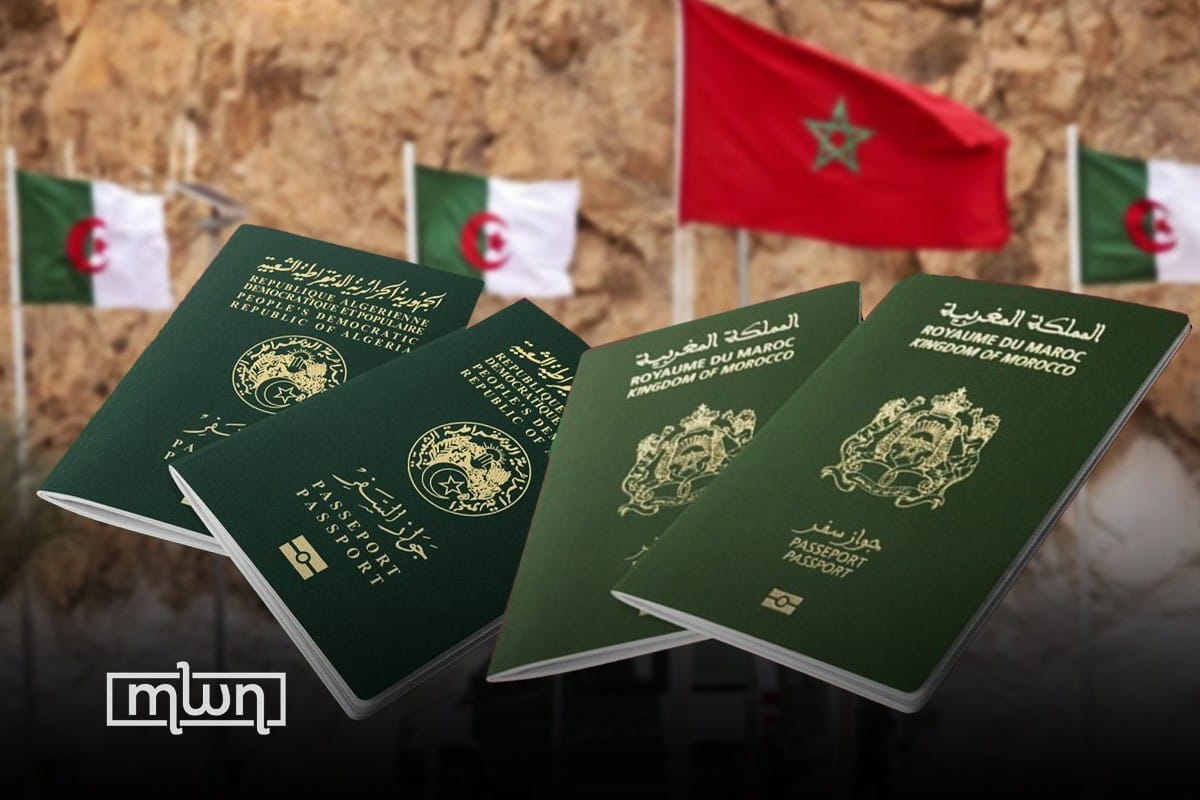
Doha – On Tuesday, Algeria reimposed visa requirements for Moroccan citizens wishing to enter the country, in a move seen as the latest attempt by Algerian authorities to undermine Morocco’s growing regional influence and success.
The Algerian Foreign Ministry claimed in a statement that Morocco had been “abusing the visa-free system to organize large-scale networks of organized crime, drug and human trafficking, as well as illegal immigration and acts of espionage.”
Serious accusations, but little to no proof
It further accused Morocco of sending “‘Zionist’” spies holding Moroccan passports to Algerian territory,” but provided no evidence to support these serious allegations. Morocco has not yet officially responded to Algeria’s provocative decision.
Algerian newspaper El Khabar reported that the visa decision was the “logical result of a crisis that extends for five years, and historically for decades.” The outlet claimed that Morocco’s alleged actions “led and pushed the Algerian side to take the decision, and accelerated the pace of deterioration of relations between the two countries.”
Similarly, El Moujahid, another Algerian newspaper, published an article titled “The depths of a hostility without limits: Morocco, a toxic neighbor,” accusing Morocco of various misdeeds. The piece accused the Moroccan regime, which it refers to as the “Makhzen,” of “selling its soul to the devil to satisfy insidious designs.”
It also claimed that Morocco’s normalization of relations with Israel poses a threat to the entire region and accused the kingdom of repeatedly violating international law in pursuit of expansionist aims.
Escalation as diversionary cover
These are just some examples of how Algerian media outlets have seized this opportunity to launch scathing verbal attacks against Morocco, often making baseless accusations and perpetuating a narrative of “bottomless hostility.”
According to the Spanish news outlet Atalayar, Algeria’s visa decision comes as the country’s leadership struggles to prevent Algerians from visiting Morocco during the upcoming African Cup of Nations (CAN) in 2025, which the North African kingdom is set to host.
“The number one problem of the Algerian regime is how to prevent Algerians from visiting Morocco and discovering the achievements of a kingdom whose resources are ten times lower than those of Algeria, but which has advanced considerably compared to its rich oil neighbor,” Atalayar reported.
The Spanish outlet noted that Morocco’s progress “can be measured concretely by road infrastructure, the rail network, which includes Africa’s only high-speed train, and sports infrastructure that have placed the kingdom among the most prestigious countries, to the point of entrusting it with the organization of the 2030 Football World Cup with two European countries, Spain and Portugal.”
Will Morocco reciprocate?
In an interview with Morocco World News (MWN), Algerian political analyst Oualid Kebir said he believes Morocco will not reciprocate Algeria’s visa decision. “Morocco will not deal in kind with the Algerian regime’s decision to impose visas on Moroccan citizens. I do not think it will take this step and apply it to Algerians,” Kebir said.
He accused the Algerian regime of “continuing to show its hostility to Morocco, not to its system of government, but to Morocco as a state, as a nation and to the Moroccan people, in the face of the defeats it has suffered at the diplomatic, military and political levels in the Sahara issue.”
Kebir added that through the visa decision, Algeria is “insulting the Moroccan citizen,” noting that most Moroccans traveling to Algeria “have families in Algeria and some are skilled craftsmen and manufacturers.” He argued that “with this decision, Algeria will deprive itself of Moroccan creativity in terms of traditional industry and in terms of construction.”
In previous comments to MWN, Kebir highlighted how even the caftan, the traditional Moroccan garment, was introduced to Algeria by Moroccan artisans.
“The caftan is Moroccan by virtue of the fact that those who excel in sewing and marketing it are basically Moroccans,” he said. “The caftan comes from Morocco, meaning there is no Algerian caftan.”
This is not the first time Algeria has imposed visa requirements on Moroccans. In 1994, Algeria decided to reciprocate after Morocco imposed visas on Algerians following a hotel bombing in Marrakech. Morocco then unilaterally lifted the visa requirement for Algerians in 2004, with Algeria doing the same for Moroccans in 2005.
Algeria’s latest hostile move comes amid a long-running dispute over the Western Sahara issue, which has seen a severe deterioration in bilateral ties in recent years.
In August 2021, Algeria cut diplomatic relations with Morocco, accusing it of “hostile acts.” Algiers subsequently closed its airspace to Moroccan flights, stopped supplying gas to Spain via a pipeline running through Morocco, and boycotted Moroccan ports.
As Algeria’s political and military establishment continues to lash out at its neighbor’s achievements, it appears to be struggling to undermine the kingdom’s growing stature on the regional and international stage – a trend likely to be further highlighted when Morocco successfully hosts CAN 2025.
Read also: Failed Lobbying and Diplomatic Decline: The Algerian Experience in the US