



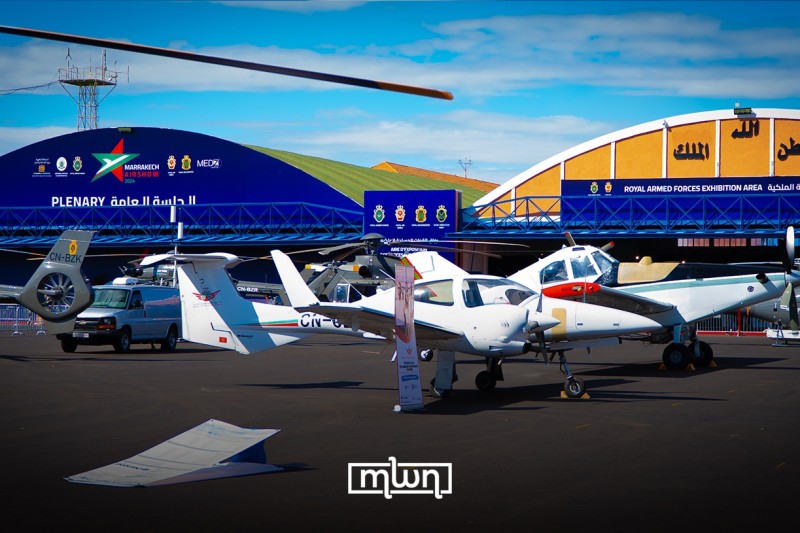
Marrakech – The 7th edition of the Marrakech Air Show 2024 launched on Wednesday at the Royal Aero Club in Marrakech, Morocco’s coveted Red City, highlighting the North African kingdom’s increasingly significant role in the aeronautics industry.

This year’s show features an impressive lineup, including 12,500 meter square of exhibition space, 300 exhibitors, over 75 official delegations, thrilling aerial displays, a dynamic exhibition area, and a packed program of high-level conferences addressing emerging trends and current and future challenges in the field.
A special focus this year is on innovation and new technologies, with dedicated spaces for start-ups and research projects. Topics like energy transition and sustainable mobility will also be central to discussions throughout the event.
“The king has given great attention to the aviation industry, as the royal vision has turned this sector into a success story through which our country has transformed into a leading international platform in the aviation industry in partnership with global companies,” Head of Government Aziz Akhennouch said at the event.

A new milestone
Akhannouch highlighted Morocco’s early steps in the aeronautics industry, recalling that the North African country first embraced the field in the late 1990s when Royal Air Maroc (RAM) launched an engine repair project, strengthening the country’s capacities and competence.
He also referenced Morocco’s role back in 2000 in producing electronic wiring.
Crucially, Morocco’s Head of Government celebrated a new milestone in Moroccan-French collaboration, announcing a new milestone for the burgeoning Moroccan aeronautical sector.
As part of French President Emmanuel Macron’s just concluded three-day state visit to Rabat, he said, Safran Aircraft Engines and the Moroccan government signed a Memorandum of Understanding (MoU) to establish a LEAP engine maintenance, repair, and overhaul (MRO) facility. This transformational project is expected to begin operations by 2026, stressed an upbeat-sounding Akhnnouch.
The sector has to date established six high-performance aerospace systems in Morocco, including assembly, engineering, maintenance, electrical wiring systems, converters, and component manufacturing.
Earlier this year, on February 27, Ryad Mezzour unveiled an ambitious initiative aimed at elevating the country’s growing aerospace industry, announcing Morocco’s commitment to producing its first entirely Moroccan-made aircraft within six years.
He characterized the performance of the Moroccan aeronautical sector as “fairly acceptable,” with the North African country ranking 20th Worldwide.
Mezzour further emphasized the country’s capacity to manufacture aircraft parts, particularly highlighting the recent opening of a production facility for a highly sensitive engine component, which is made in only five countries worldwide.
Becoming an aviation hub
According to the latest data compiled by the Moroccan Exchange Office, Morocco’s aerospace sector reported revenues of MAD 10.68 billion ($1 billion) during the first five months of this year. This reflects a 17.6% increase compared to the same period last year, the data indicated, adding that such remarkable growth is driven by increased sales in the assembly segment.
Morocco has heavily invested in developing its aviation sector over the past decade, with the goal of becoming a global aviation powerhouse. The country has actively sought partnerships with major manufacturers to enhance its multi-billion dollar aerospace market.
A recent report by the International Civil Aviation Organization highlights Morocco’s emergence as a key industrial hub for the aerospace industry over the past ten years.
It identifies several reasons to invest in the North African country, including its growing number of aerospace companies, the concentration of firms in various regions, and the fact that this sector is one of the country’s five priority areas.
Morocco boasts today more than 147 companies in the aerospace sector, creating over 20,000 jobs and achieving a 40% integration rate—one of the highest worldwide.
The Marrakech Air Show is a premier biennial event in the aerospace and defense industry, taking place in the heart of Morocco’s world-renowned hospitality industry.
The launch of this year’s show was attended by Head of Government Aziz Akhennouch, Minister of Industry and Commerce Ryad Mezzour, and Abdeltif Loudyi, Minister Delegate to the Head of Government and Head of the National Defence Administration.
Launched in 2008 and organized as part of a partnership between the Ministry of Industry and Trade, the National Defence Administration, and MEDZ, a subsidiary of the Caisse de Dépôt et de Gestion (CDCG), the event has become a distinctive platform for collaboration and exchange among leading figures in the global aeronautics industry.
Over the last five years, the show has become a vital platform for displaying cutting-edge technological innovations and promoting international collaborations. It draws a wide array of attendees, including industry leaders, government representatives, innovators, and aviation enthusiasts from across the globe.
Read also: Morocco’s Aerospace Sector Reaches $1 Billion in Revenues as of May
As it eyes cementing its regional leadership and emerging as a global hub, Morocco’s ever-evolving aeronautical sector signaled a newfound ambition and strategy of moving from building aeronautical parts into engine parts.
While the government’s efforts have played a significant role in putting Morocco’s rapidly developing aerospace industry on the global map, partnerships with global leaders like Airbus, Bombardier, Boeing, Safran, and Thales, among many others, have provided the finishing touches for the realization of Morocco’s aeronautical ambitions.
As Times AeroSpace reported this past June, many Western aeronautical giants are particularly attracted by Morocco’s “relative stability,” skilled workforce, and profitable servicing facilities given the country’s highly strategic location.
These civil aviation partnerships have borne considerable fruit over the past 10 years, both in terms of investments to expand manufacturing facilities and provide the local workforce with quality training.
Yet some of the discussions and agreements highlighted at Wednesday’s launch suggest that Morocco’s aerospace industry is now looking to focus significantly on the production of both wholly Moroccan aircraft and defense technologies.


