 Join on WhatsApp
 Join on Telegram
Doha – The Sahara Desert in southeastern Morocco experienced its first major flooding in nearly half a century.
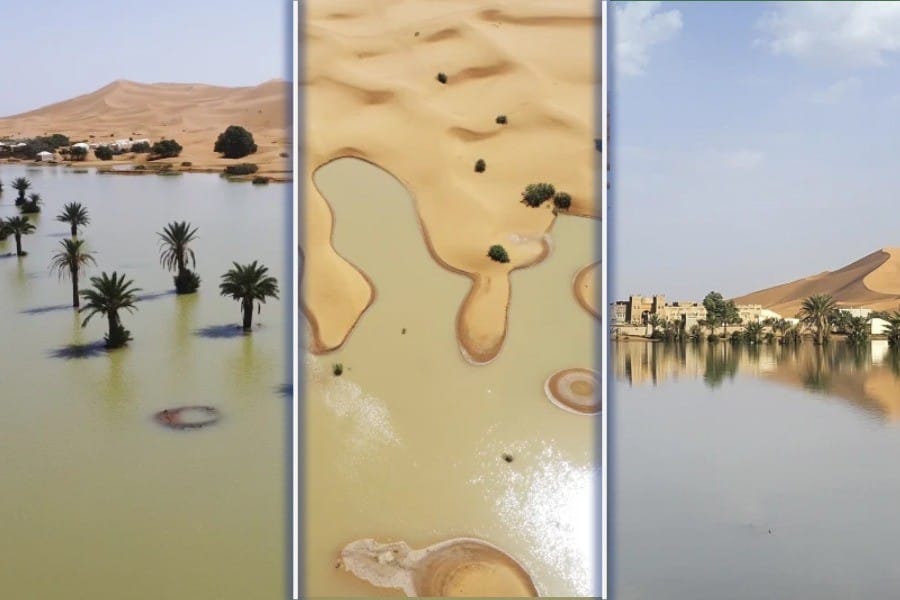
Intense rainfall in September exceeded yearly averages in several areas, causing dry lake beds to fill with water and transforming sand dunes into temporary lagoons.
According to El Houssaine Youabed from Morocco’s General Directorate of Meteorology, “It’s been 30 to 50 years since we’ve had this much rain in such a short space of time.”
In an interview with the Associated Press, Youabed explained that in Tagounite, a village about 450 km south of the capital city Rabat, more than 10 mm of rain was recorded in just 24 hours.
This equates to more than half a year’s worth of rainfall for the area, as reported by CNN.
NASA satellite imagery revealed the dramatic impact of the storms, showing the formerly dry Lake Iriqui in Iriqui National Park filling with water.
The famous lake bed, situated between the towns of Zagora and Tata, had been dry for 50 years prior to the September deluges.
‘An entire ecosystem is being resurrected’
The lake, which has a surface area of approximately 80 km2, has a long history in the region but dried up around 50 years ago due to changing climate conditions and precipitation patterns.
According to Adil Moumane, a researcher from the Ibn Tofail University of Kenitra cited by the Spanish news agency EFE, Lake Iriqui last held water in 1968. The lake now measures 13 km long by 11 km wide.
“An entire ecosystem is being resurrected,” Moumane celebrated, awaiting the return of migratory birds and the reappearance of crustaceans like the triops, considered one of the oldest living species on the planet, whose eggs can survive for decades in dry environments.
The heavy rains, described by meteorologists as an extratropical storm, carved new lakes into the desert landscape.
Images from the town of Merzouga showed palm trees reflected in newly formed lagoons, framed by steep sand dunes.
As reported by the Associated Press, in desert communities frequented by tourists, 4x4s motored through the puddles and residents surveyed the scene in awe.
A Spanish traveler who shared some of the first images of the desert lagoons published by National Geographic in late September remarked, “In my head, I wonder if it was all one of the classic mirages that occur in desert areas.”
While the rainfall brought a temporary transformation to the arid region, it also resulted in deadly flooding.
According to the Associated Press, more than 20 people lost their lives due to the storms in Morocco and Algeria, and farmers’ harvests were damaged.
The Moroccan government allocated emergency relief funds to assist affected areas, including some still recovering from last year’s earthquake.
Looking ahead, experts suggest that such extreme weather events could become more common in the region.
Youabed explained to the Associated Press that as the air retains more moisture due to the recent rains, it may promote further evaporation and draw in additional storms in the coming months and years.
Celeste Saulo, the secretary general of the World Meteorological Organization, told The Guardian that “as a result of rising temperatures, the hydrological cycle has accelerated. It has also become more erratic and unpredictable, and we are facing growing problems of either too much or too little water.”
The September rainfall is expected to help replenish groundwater aquifers that serve as critical water sources for desert communities.
Sources reported that dammed reservoirs in southeastern Morocco also recorded refill rates throughout the month.
However, it remains uncertain whether these rains will significantly alleviate the challenges posed by the seven consecutive years of drought that have impacted much of Morocco.
The storms have had a devastating effect. Oases and the water table act as natural regulators of water reserves, but the construction of dams and the massive pumping of water from wells to supply extensive agriculture seem to have upset the balance after a long period without rain, according to the Moroccan Association for the Fight against Erosion, Drought, and Desertification.
Many houses have been built near the banks of rivers whose beds almost always remain dry, in the belief that water would never flow through them again. Several towns have also been erected in narrow gorges.
The regions of Al Haouz and Taroudant, located in the Atlas Mountains and which suffered an earthquake last year that caused nearly 3,000 deaths, have also been affected by the recent floods.
Tens of thousands of people continue to live there in tents after the destruction of some 60,000 homes by the earthquake.
As climate change continues to influence weather patterns worldwide, the rare Saharan floods underscore the increasing frequency and intensity of extreme meteorological events.
The reappearance of Lake Iriqui after a 50-year absence, as documented by satellites Copernicus and Sentinel-2 and shared by ADAM Platform on X, shows the profound and often unpredictable ways in which the planet’s landscapes are being reshaped in the face of a changing climate.