 Join on WhatsApp
 Join on Telegram
Rabat — Recent rainfall across Morocco has brought a welcome surge in dam reserves, which reached a volume of 5 billion cubic meters on October 31, according to Morocco’s Ministry of Equipment and Water.
This boost raises the national reservoir fill rate to 29.7%, an improvement of nearly 5 percentage points over last year’s figure of 24.8% at the same time.
Several key basins benefited from the rainfall, including the Guir-Ziz-Rheris, Draa-Oued Noun, Moulouya, and Oum Er-Rbia basins.
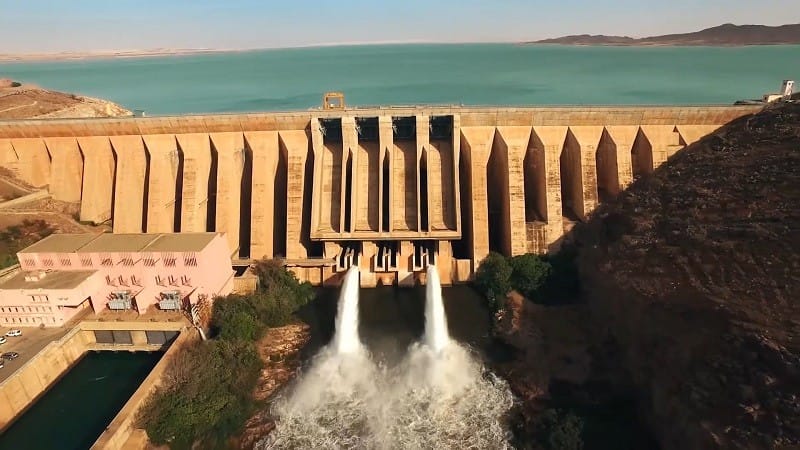
Notably, the Hassan Eddakhil dam saw an inflow of 22.88 million cubic meters, raising its capacity to 69% with a reserve volume of 216 million cubic meters.
In the eastern region, the Timkit dam reported a full capacity for the first time in months, now storing over 14 million cubic meters.
Amid ongoing climate pressures, Morocco’s urban centers are contending with steadily rising water demands. A new report by “Maa Dialna” highlights the annual drinking water needs of Morocco’s largest cities, driven higher by population growth and urban expansion.
Casablanca, the largest consumer, requires over 207 million cubic meters each year, followed by Tangier at 71.3 million cubic meters and Marrakech at 70 million cubic meters, each dependent on specific basin regions.
To support Rabat and Sale, which collectively demand around 87 million cubic meters, a recent royal project interlinking the Sebou and Bouregreg basins was completed in record time, ensuring a consistent water supply.
In the arid south, Agadir now relies on a large desalination plant to supplement its annual demand of 50 million cubic meters amid severe drought.
As the demand intensifies, authorities are implementing emergency measures to secure future water availability. Fez, for example, has seen an expansion of the Idris I dam, with a new reservoir supplying up to 2,000 liters per second.
Similarly, Meknes and El Jadida have launched projects to guarantee stable supplies through 2030.