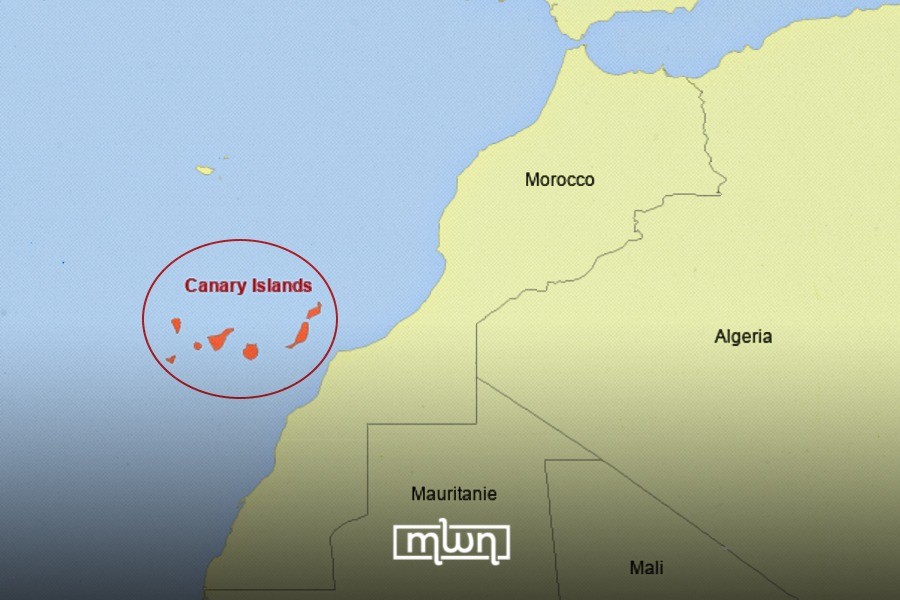
Doha – A former Spanish magistrate and international consultant, Ángel Llorente Fernández de la Reguera, has stated that the maritime border demarcation between Morocco and the Canary Islands will remain unresolved until the Western Sahara dispute reaches a conclusion.
Speaking at UNED in Las Palmas de Gran Canaria, Llorente, who served six years at the Spanish embassy in Morocco and was part of a support team for maritime border negotiations, explained the complexities of the current situation.
“For the delimitation of Canary waters, agreements would need to be reached with two adjacent territories: Morocco and Western Sahara. And this is not possible,” Llorente stated.
He noted that the Canary Islands is the only autonomous community that has water within its territorial scope, adding that the archipelago’s total territory – including its maritime spaces – exceeds that of historic autonomous communities like Catalonia, Galicia, or the Basque Country.
Llorente also recalled that previous negotiations with Morocco reached an impasse when Spain attempted to establish the median line as a definitive decision, while Morocco, adhering to the principle of equity rather than equidistance, sought a larger maritime space.
In 2020, Morocco’s parliament voted to establish two laws defining its territorial waters (12 nautical miles), its contiguous zone (24 nautical miles), as well as an exclusive economic zone extending 200 nautical miles. These laws were defined in accordance with the United Nations Convention on the Law of the Sea, signed in Montego Bay, Jamaica, on December 10, 1982.
The expert spoke about the significant maritime territory at stake, revealing that the Canary Islands’ maritime jurisdiction encompasses nearly half a million square kilometers.
Llorente also pointed out the strategic importance of submarine deposits in the Tropic seamount region, where Spain has requested a 150-mile extension beyond its 200-mile Exclusive Economic Zone to the UN.
Canary Islands President Fernando Clavijo demonstrated alignment with Spain’s position during his visit to Morocco in October.
In discussions with Moroccan Foreign Minister Nasser Bourita, Clavijo explicitly stated, “The government of the Canary Islands fully assumes the Spanish government’s policy, as it could not be otherwise,” noting that this support has fostered a climate of trust and collaboration between the parties.
Adding to these developments, Spanish media reports indicate that Madrid is planning to transfer the management of Western Sahara’s airspace – currently overseen by ENAIRE from the Canary Islands’ air traffic control center – to Morocco.
This planned transfer aligns with the seventh point of the Joint Moroccan-Spanish Declaration of April 2022, reflecting the new dynamics in bilateral relations following Spain’s support for Morocco’s autonomy initiative over its southern provinces.
Read also: Spanish Analyst: Morocco, Spain May Share Sovereignty over Ceuta and Melilla by 2030