


 Join on WhatsApp
 Join on Telegram
Rabat – In Morocco, the promotion of LGBTQ+ agenda remains deeply controversial and illegal, reflecting a clash between entrenched cultural and religious traditions and a small but vocal group of advocates pushing for change.
Public opinion overwhelmingly rejects LGBTQ+ agenda, with the prevailing societal stance firmly aligned with the country’s laws and religious identity.
Recent events, including one controversial incident at the Marrakech International Film Festival (FIFM), have sparked renewed debates on this sensitive and more often than not taboo topic.
The Marrakech International Film Festival walkout
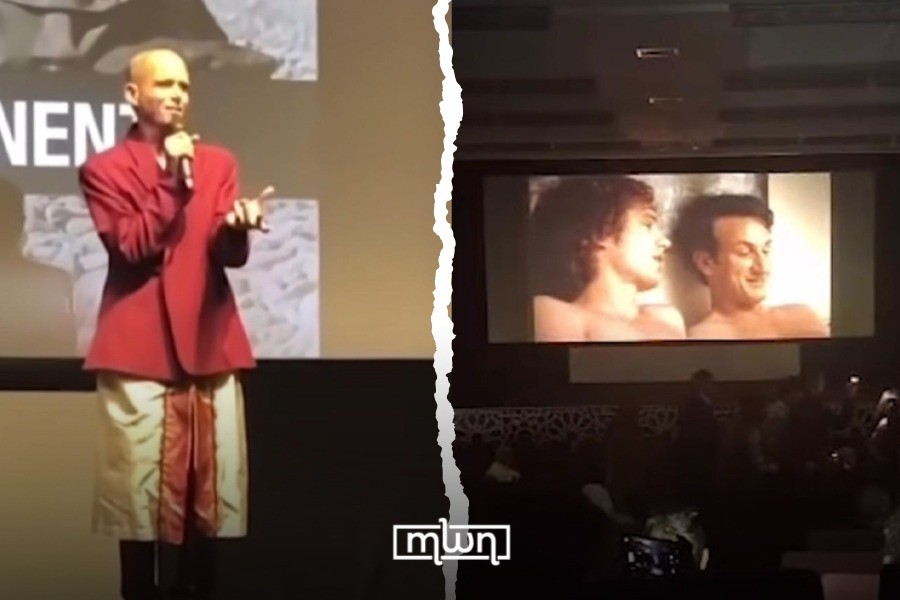
The Marrakech International Film Festival (FIFM) became the center of a national debate when a screening of a film depicting an intimate relationship between two men led to a walkout by several audience members. Videos of the incident circulated widely on social media, sparking both criticism and support for the reaction.
For some, the scene conflicted with their understanding of Moroccan values, prompting statements such as, “It’s reassuring to see people standing by their principles.”
Many others condemned the walkout, arguing that such actions reflect intolerance and a reluctance to engage with differing perspectives.
Adding to the discourse’s ambivalence was the participation of Moroccan writer and filmmaker Abdellah Taia, an openly gay artist who has been a prominent voice in LGBTQ+ agenda.
At the FIFM, Taia introduced his short film “Cabo Negro”, which explores themes of queer love and solitude.
During a post-screening discussion, he remarked, “When I was young, in the 70s, 80s, and 90s, I was completely alone. There was no one to turn to, no one to love, no one who could understand what I was going through. This movie, Cabo Negro, is my way of creating the love and support I didn’t find. I don’t want today’s young Moroccan gays to go through the same loneliness I experienced. The love I never received, I put it into this film.”
Taia’s comments were met with mixed reactions, with some applauding after his speech in support of LGBTQ+ agenda, while most Moroccans viewed his statements as a sin and as a bold challenge to Morocco’s cultural and religious framework.
Public and social media outrage
Social media platforms have amplified the debate, with reactions to the FIFM incident ranging from strong condemnation to calls for greater inclusivity.
Platforms like Facebook, Instagram, and X have hosted heated exchanges, reflecting the deep polarization within Moroccan society.
Some users expressed anger and frustration, viewing the audience walkout as a necessary stand against what they perceived as an affront to cultural and religious values. One user wrote, “Is this really being shown in our country, or am I dreaming?”
Another stated, “These issues, which are hidden in our society, are the poison that will destroy us if we allow them to spread. Boycotting these ‘artistic’ events is a religious, moral, and social duty.”
These comments reflect the intense opposition to LGBTQ+ agenda in Morocco’s media and public sphere.
The controversy at the FIFM is not an isolated event. In 2020, a witch hunt targeting gay men through the dating app Grindr led to widespread public outings, with many individuals facing eviction, family rejection, and, in some cases, suicide.
Legal framework and social norms
Homosexuality in Morocco is criminalized under Article 489 of the Penal Code, which prescribes imprisonment of six months to three years and fines ranging from MAD 200 ($20) to MAD 1,000 ($100) for engaging in same-sex acts.
The law is deeply enshrined within traditional interpretations of Islamic principles (Sharia law), which hold significant influence over Morocco’s legal and social structures.
These values are omnipresent in public attitudes and Moroccan daily life spheres, where homosexuality is seen as utterly incompatible with cultural and religious norms.
While there is some advocacy for reform among younger Moroccans and a few advocacy groups, the criminalization of homosexuality remains radically illegal, and religious precepts are strictly opposed to any change.
These calls for reform are met with fierce resistance from traditionalist segments of society, who uphold the country’s strict laws and religious values, making the issue deeply contentious and unlikely to shift in the near future.
Political reactions
Prominent political figures have weighed in on the issue. In August 2023, Justice Minister Abdellatif Ouahbi expressed concerns about the influence of LGBTQ+ movements, warning of potential cultural and societal repercussions.
He noted what he viewed as the growing presence of LGBTQ+ individuals in global decision-making circles and their influence on public opinion, particularly in Western nations.
In December 2021, Abdelilah Benkirane, leader of the Islamist Justice and Development Party (PJD) and former head of government, also described homosexuality as contrary to Moroccan values.
He said that under his leadership, the party would firmly resist any efforts to decriminalize same-sex relationships. Benkirane stated, “We will not strive for homosexuals to publicly declare the disobedience of God,” reinforcing the PJD’s commitment to preserving what it sees as Morocco’s cultural and religious identity.
Both figures underline their stance as a defense of Morocco’s traditional values and Islamic principles.
While conservative perspectives remain dominant, Morocco also has an advocacy community working to address LGBTQ+ issues.
Some leftist movements focus on broader reforms, such as repealing Article 490 of the Penal Code, which criminalizes sex outside of marriage. These groups argue that such laws perpetuate stigma and hinder personal freedoms.
Morocco stands unyielding on LGBTQ+ debate
Morocco remains firmly rooted in its cultural and religious principles, with little to non-existent indication that its stance on LGBTQ+ issues will shift.
As a religiously conservative country, it views the preservation of these values as non-negotiable, leaving limited room for change in the legal and social treatment of LGBTQ+ agenda.
While some advocates for LGBTQ+ agenda continue to call for recognition and inclusion, their efforts face caustic resistance from both societal norms and political leadership.
For many in Morocco, these issues are seen as incompatible with the country’s identity, and discussions around them often reinforce, rather than challenge, the prevailing status quo.
Read Also: Audience Exits Theater After Gay Scene at Marrakech Film Festival


