The role of the sacred in society is a subject that has been approached in many ways for a long time. The use of superstition, charlatanism and miracles has been a convenient way for individuals and communities to reassure themselves or become too enthusiastic, depending on the context and time.
However, the sacred takes on an even more important dimension when it is associated with power and its use through various forms of hierarchy that represent the relationship between the political and the social in a given society.
The literature on the sacred and politics, the sacred and power, and the sacred and community is easy to find and read. As far as the developing world is concerned, such literature is likely to have flourished during the various pre-colonial and post-colonial conquests. It has generally been associated with military ethnology and the study of social stratification, especially in countries where relations between social groups were very complex.
This literature was skilfully used in the Arab-Islamic world during the 1960s and 1990s as a shield and bulwark against political and intellectual upheavals related to unfinished processes of power alternation or the maintenance of one-sided dependence on former colonial powers.
One might be tempted to say that such an assumption sounds like a cliché that wouldn’t feed a worm. But clichés are never drawn for the sake of humour. If they are revisited, it is for good or bad reasons. In any case, this is not the main purpose of this paper.
Read also: Libya: Weak Core, Strong Core, for the end of Disorder in the Maghreb
The aim of this article is, on the one hand, to discuss the relationship between the lyrics of certain cult songs and the public’s perception of them. In this respect, we find the same techniques of socialisation, contestation and manipulation. We also find a perception that is influenced by a kind of passivity and complicit indifference on the part of the public, regardless of their social class or political and ideological beliefs.
On the other hand, there is the attempt to draw a parallel between the song with religious connotations and what has been happening in the Middle East in recent weeks. A risky venture, no doubt, but one worth the detour, as the saying goes.
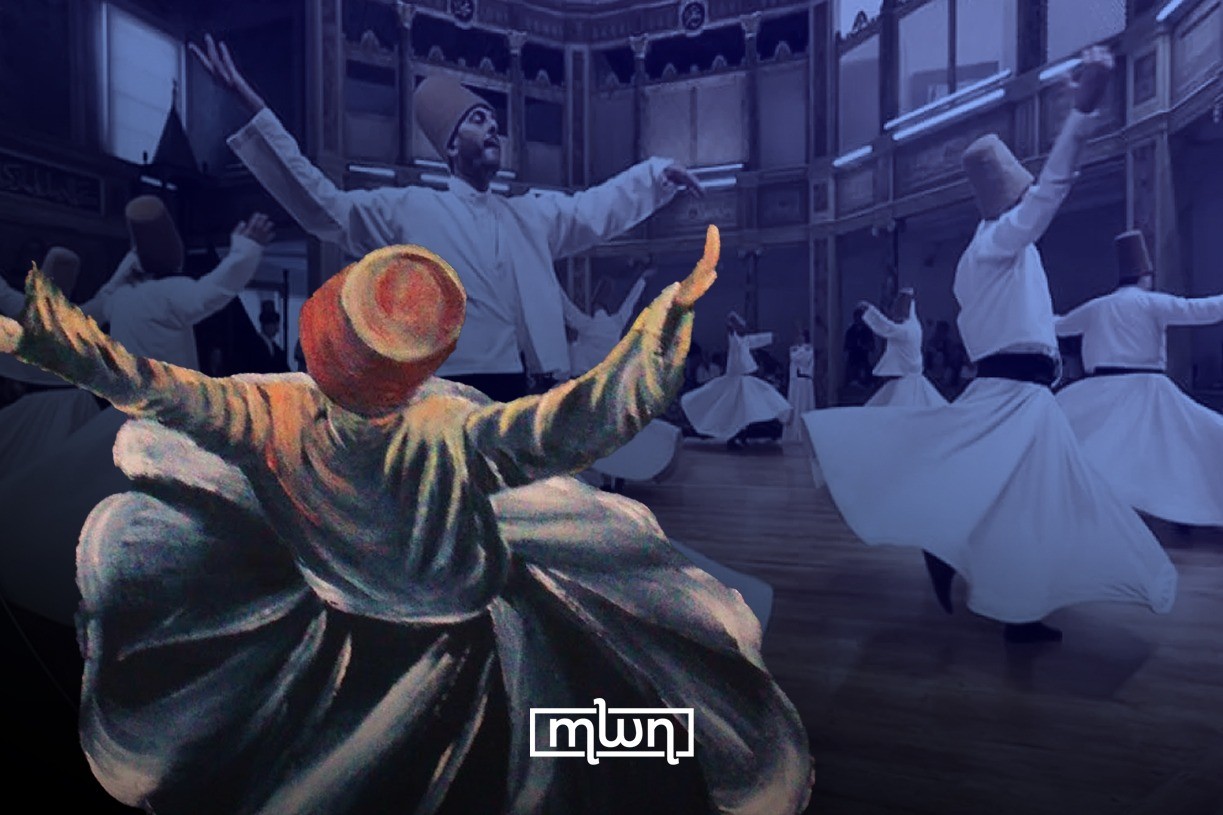
What is it about? Yesterday, for the third time during the day, I received a video clip of a song that has been enjoying astonishing success in recent months: شويخ من أرض مكناس (a gipsy sheikh from the land of Meknes). A beautiful song from 1982, composed by the Bahraini composer Khaled Cheikh and sung by Ahmed al-Jamiri to a text of the same name by Abul-hassan Chachtiri (1084-1131), an Andalusian poet and Sufi who lived for a long time in Morocco before moving to Egypt.
Nothing special, except that in the shared video we see people dancing to the rhythm, repeating the text without knowing its exact meaning, the context of its writing and even less that of its composition.
The same phenomenon was detected decades ago—and even today—with رباعيات الخيام (Rubaiyat al-Khayyâm), sung in a beautiful way by Oum Kalthoum in 1968 on the basis of the poem by Omar al-Khayyâm translated from Farsi to French, formatted in Arabic by Ahmed Rami and composed by Riad al-Sunbati.
The two previous examples show that listeners and viewers do not properly perceive the philosophical meaning of the lyrics and concentrate on the melody. Both songs have a Sufi spiritual depth that few people realise – or if they do, they don’t give it the exact meaning it deserves.
Context and historical landmarks
This perceptual behaviour isn’t unique. It can also be observed in Western societies. Fetish songs such as King Crimson’s Epitaph (1969), the Eagles’ Hotel California (1977) or Bob Dylan’s Blowin’ in the Wind (1962) record almost the same reception. People dance or repeat the choruses, apparently unaware of the philosophical and existential dimension of the songs and lyrics.
It is a phenomenon that creates a kind of dissonance and distorted perception, rooted in the listener’s tendency to surf on the same wave. We are not talking about manipulation here, but about an unconscious journey towards a momentary evacuation of the worries that the unbearable daily life causes them.
Manipulation occurs a posteriori, however, when the fetish song is used for purposes that the manipulative professionals did not initially foresee. They focus on the context and inject the ingredients of confusion in such a way that every listener can find something that pleases them.
In Morocco, for example, the iconic songs of Nass El Ghiwane and Jil Jilala in the 1970s and 1980s were diverted from their original purpose to serve other cultural, philosophical and political ends in the midst of political and social overheating.
The same thing happened in Egypt after the Arab defeat of 1967. Indeed, the iconic songs of Oum Kalthoum were exploited for intranational political purposes, allowing President Gamal Abdenasser to temporarily regain the hair of the beast.
Some chroniclers even say that it was at his instigation that Oum Kalthoum and Mohamed Abdelouahab were brought together to perform the song Inta Oumri, indirectly praising the Egyptian Zaïm. Unable to comfort the Egyptians whose dignity had been violated, the Raïs forced the diva and the maestro to reconcile their fellow citizens in another way.
Read also: International Law and Diplomacy at Their Highest Scale of Absurdity
In France too, towards the end of the 1970s, a song became a hit: Ça ira mieux demain. It was used by the singer, Annie Cordy (1976), to restore the image of President Valery Giscard-D’estaing. He used it to boost his election campaign.
This song contrasted with another that went almost unnoticed. Jacques Brel’s La ville s’endormait, from his last album, Les Marquises, released in 1978. We discover an existential breath that sounds the death knell of a life turned upside down by illness and despair. But also a thinly veiled call to repentance. The author uses the elements of nature as witnesses, in particular the river which is said to have inspired all the lyrics.
Then there is Fadel Chaker, a Lebanese singer who has been in the spotlight for two weeks. His story is astonishing. At the height of his fame, he decided to join the jihadist movements in Lebanon. He joined the preacher Ahmed al-Asir in the fight against Hezbollah. People remember the scene in which Chaker asked the audience to scream “Down with Bashar al-Assad” during his participation in the Mawazine festival in Rabat in 2012.
Fadel Chaker joined the Islamist movement challenging Hezbollah’s stranglehold on Lebanese government and society. He was sentenced in absentia to twenty-two years in prison. He decided to go underground. He declared that he had retired from art. A decision he reconsidered and resumed his artistic activity in 2016, while remaining in hiding. So he’s back, as if nothing had happened. The link between song and politics is once again crystal clear.
It goes without saying that context and historical hindsight are very important to understand and admire cult songs, to soothe one’s soul and ease one’s mind. But context and hindsight are even more crucial in political analysis. Nevertheless, a dose of restraint is necessary in order to make an overall judgement.
Today, thanks to information technology, the exchange of media outfits is so rapid that, with a few exceptions, no one bothers to think about the context, take a step back or exercise restraint before making a decision.
The common denominator of the lyrics and songs mentioned above is that they fulfil a multi-layered mission: social, cultural, philosophical and political. But it is the spiritual and mystical breath that is their engine par excellence. Let’s take a look at some lines from شَوَيخْ مِن أرْضِ مِكْناس (Chiouekh from the land of Meknes):
وأشْ على النَّاسِ منِّي شْ عَلَيَّا مِن النَّاس أ وسْطَ الأسْواق يُغَنِّي شَوَيخْ مِن أرْضِ مِكْناس
بالنَّبي قَد سألتُكْ والكرامِ الأحِبه جُدْ عَلَيَّا بِتَوْبَه يا إِلهِي رَجَوْتُك
In the text, the gypsy sheikh of Meknes walks through the souks and preaches advice without paying attention to comments of passersby who take him for a madman, a heretic, or an idle invertebrate. But in fact, he picks up the narrative of his life in Andalusia and advises people that life would not be worth making regrets but rather doing good to be comfortable in one’s own skin to be admitted in good company in the next life. In reality, he is looking for a way, a light, that of perfection and infinite satisfaction.
The spiritual breath and the political tune
The same spiritual and mystical breath can be witnessed in Epitaph. The quest for light and absolute truth: ”The wall on which the prophets wrote/ Is cracking at the seams/ Upon the instruments of death/ The sunlight brightly gleams/ When every man is torn apart/ With nightmares and with dreams /Will no one lay the laurel wreath/ The silence drowns the screams/Confusion will be my epitaph.”
The quest for truth, perfection, and fulfillment is an aspiration that we also meet in Hotel California: ”On a dark desert highway cool wind in my hair/ Warm smell of colitas rising up through the air/Up ahead in the distance, I saw a shimmering light/ My head grew heavy and my sight grew dim, I had to stop for the night/There she stood in the doorway, I heard the mission bell/ And I was thinkin’ to myself, this could be heaven or could be hell.”
In “Blowin’s in the Wind,” we feel the same breath: “How many roads must a man walk down/ Before you call him a man? / How many seas must a white dove sail/ Before she sleeps in the sand?/ The answer, my friend, is blowin’in the wind/ The answer is blowin’in the wind.”
This observation can also be noted in Khayyam’s Rubaiyat. Ahmed Rami excelled in the selection of verses and their translation. A mystical breath emanates from it in a beautiful way:
سمعتُ صوتاً هاتفاً في السحر نادى من الغيب غفاة البشر هبوا املأوا كأس المنى قبل أن تملأ كأسَ العمر كفُّ الَقَدر
Then he ends the text with a prayer-supplication:
لبست ثوب العيش لم استشــر وحــرت فيه بين شتى الفكر وسوف أنــــضو الثوب عني ولم أدرك لمـاذا جئت وأين المفر يا من يحـار الفهم فى قدرتك وتطلب النفس حمى طاعـــتك أسـكرنى الاثـم ولكننى صـــحوت بالآمال فى رحمتك
The secret lies in hope and redemption. This can be done regardless of space and time, the impact of which depends on our state of mind. Let us find out through Annie Cordy lyrics:
Il faut profiter du jour qui vient/ Quand je vois certains de mes bons copains/ Qui pour trois fois rien n’ont plus le moral/ Je leur tends la main, je leur dis c’est rien/ Tant que ton cœur bat ça n’est pas si mal.
This is an optimistic breath that hardly rhymes with Jacques Brel’s song “La ville s’endormait”: “La ville s’endormait / Et j’en oublie le nom / Sur le fleuve en amont / Un coin de ciel brûlait.”A text whose pessimism is garish, but which describes the end of a life and questions about life and death.
Read also: Middle East: State and Non-State Actors Who Have Lost it All
The text juxtaposes these two realities by challenging them in a way. But in the end, the obvious prevails: “On m´attend quelque part / Comme on attend le roi / Mais on ne m’attend point / Je sais depuis déjà / Que l’on meurt de hasard / En allongeant le pas.”
The song sounded like a premonition, as in قارئة الفنجان, reluctantly sung by Abdelhalim Hafez on lyrics by Nizar Qabbani. The two singers passed away, respectively, in 1977 and 1978.
Let us not be mistaken, however! I differentiate the songs mentioned above from the spiritual songs one can enjoy in Gospel or in mystical incantations related to religious brotherhoods. However, I cannot but remember the controversial example of Rachid Gholam, who is presumed to be very close to the Al-Adl wal-Ihsane Movement, of which he would have been the incantator par excellence. After years in the service of this movement, he decided to take a little more liberty and began to appear with famous Arab singers to reward the public with covers of Oum Kalthoum, etc. This would not have pleased his strict admirers.
In most of the texts referred to above, there is an expression of the idea of the quest for light, that is, absolute truth. Singing allows the travelling from the stage of attention to that of enjoyment. It is at this level that the message is injected and the guard is lowered. Listeners and spectators have already been conditioned for the message to be accepted, no question asked.
Suffice it to say that some songs with religious connotations have been programmed in election campaigns in the United States, for example. In this regard, we can mention the iconic song We Shall Overcome, sung by Joan Baez. The lyrics were first composed in 1901 by the Reverend Charles Tindley of Philadelphia. He called for overcoming the racial injustice Black populations had been suffering.
Within the Arab-Islamic world, the literature of religious songs spreading a political message has flourished, particularly in Egypt and Syria, thanks to the Islamic movement represented by the Muslim Brotherhood and twinning movements.
Without going into details that may cause confusion in people’s minds, I would say that this experience was found in North Africa, especially in Morocco, where it was merged with the local tradition in vogue among religious brotherhoods. A tradition that goes back centuries. The Chachtiri’s lyrics quoted above are a perfect illustration of it.
Read also: Non-Religious Moroccans Challenge Social Norms Through Subtle Activism
Yet, one might argue that all that has just been mentioned does not clearly highlight the link between the spiritual and the political. For this would not be the first intention of poets, composers, and singers. There is some sense in these arguments, but there is also what I earlier have called a manipulative post-intervention.
However, I could go even further by taking up the idea about the return of Fadel Chaker to put forward the following argument in relation to the evolution of the perception of political Islam. Assuming that religious brotherhoods have often promoted reformist discourse with undeniable political overtones, I would argue that the situation in Syria, for example, is not a matter of human rights and regime change for the sake of the Samaritans, but rather a projection of what political and strategic planners in the West expect to see happen in the Middle East.
Now, between so-called Sunni Islam and so-called Shiite Islam, there is a third variant that is inspired by religious movements that are not really related to one or the other. These movements differ from radical Islam, such as Al-Qaeda, the Islamic State, or the Muslim Brotherhood movement, or the reformist tendencies within the Salafiya. This raises questions about moves to co-opt and promote formerly radical movements and ultimately to integrate them into a clear political project that is part of ongoing geopolitical transformations on a global level.
Because, in the end, these same Western political planners and their relays or co-sponsors within the Arab periphery are aware that multi-confessional Arab societies remain attached to their cultural and civilizational values and roots.
Despite all the plastering and aesthetic scaffolding, these societies will never accept being second-hand civilizational peripheries. They have participated in the civilization of the universal, and they intend, regardless of the accidents along the way, to continue to do so. Above all, they are aware that when the geopolitical significance of the Middle East is reduced, they will be shut down.
The quest for light that we have noted in the model of songs mentioned in this article highlights the conscious or unconscious political underpinnings of their initiators. Because all those who wear the armband of reforms are, in one way or another, political activists. They can also be à la carte in the case of Arab artists. Context and historical hindsight can be interesting instruments for edifying those who would be tempted by the debate on art and politics, knowledge and power, and society and power.