
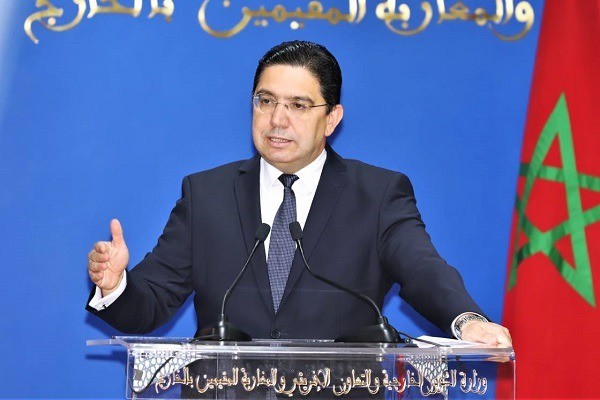
Rabat – Morocco has welcomed the recent announcement of a ceasefire between Hamas and Israel, set to begin on Sunday, and expressed hope that the agreement will be effectively implemented and lead to tangible results on the ground.
Moroccan Foreign Minister Nasser Bourita stressed today the significance of this development which he said aligns with King Mohammed VI’s vision for peace. He reiterated Morocco’s consistent position on the urgent need to end violence and prioritize civilian protection.
“In numerous speeches since the outbreak of the crisis, His Majesty has emphasized that the urgent priority is to establish a ceasefire. His Majesty has also specified in multiple statements that this ceasefire must be permanent, monitorable, and lead to a sustainable pathway,” Bourita said.
He noted that the ceasefire could bring several critical benefits, including halting the killing and destruction and safeguarding lives. He added that it would facilitate a greater flow of humanitarian aid, which the Palestinian people are in dire need of.
The need to rebuild Gaza
Bourita added that the agreement would result in the protection of civilians, including through the release of prisoners and hostages, and ensuring that civilians do not “bear the cost of these aggressions.”
“The Kingdom of Morocco can only welcome this agreement. However, at the same time, under the leadership of His Majesty King Mohammed VI, Chairman of the Al-Quds Committee, Morocco hopes, firstly, that this agreement will be implemented and respected by all parties,” the foreign minister stated.
He added that Morocco hopes the ceasefire agreement will lead to the rebuilding of Gaza and support displaced families, describing it as a “key element to granting credibility to this agreement.”
Bourita also expressed Rabat’s hope that the ceasefire will pave the way for a lasting peace process in the Middle East. He reiterated King Mohammed VI’s call for a two-state solution, which includes establishing an independent Palestinian state with East Jerusalem as its capital.
“His Majesty King Mohammed VI has reiterated on multiple occasions that it is no longer viable to continue managing crises in the Middle East without addressing their root causes. It is not about ceasing fire to end one crisis, only to wait for the next,” Bourita stressed.
He explained that there is an opportunity today to build on this agreement and launch a political process for a permanent and comprehensive peace in the Middle East within the framework of a two-state solution.
Beyond crisis management
“This solution would involve establishing a Palestinian state along the borders of June 1967, with East Jerusalem as its capital, living side by side with the State of Israel,” Bourita said.
This would have the region move from “crisis management to seizing this new opportunity to lay the foundations for regional peace, ensuring the legitimate rights of the Palestinian people while also considering the interests of neighboring countries that have also directly suffered from the recent crisis,” he argued.
The ceasefire deal was brokered by Qatar and the US and announced by US President Joe Biden on Wednesday. The first phase of the deal involves a temporary ceasefire and the release of 33 hostages held by Hamas over the next six weeks. In exchange, Israel would release hundreds of Palestinian prisoners and withdraw from parts of Gaza.
It will also include steps to allow displaced Palestinians to return to their homes and receive much-needed aid.
Specific details of the second and third phases of the ceasefire remain unclear and are set to be negotiated during the first phase. Biden said the ceasefire will continue even if negotiations on the coming phases go beyond the six-week mark.
Hamas officially announced on Thursday that it is “committed to the ceasefire agreement” as outlined by the mediators.
Meanwhile, the Israeli Prime Minister’s office announced today that the security cabinet has accepted the ceasefire deal with Hamas.