
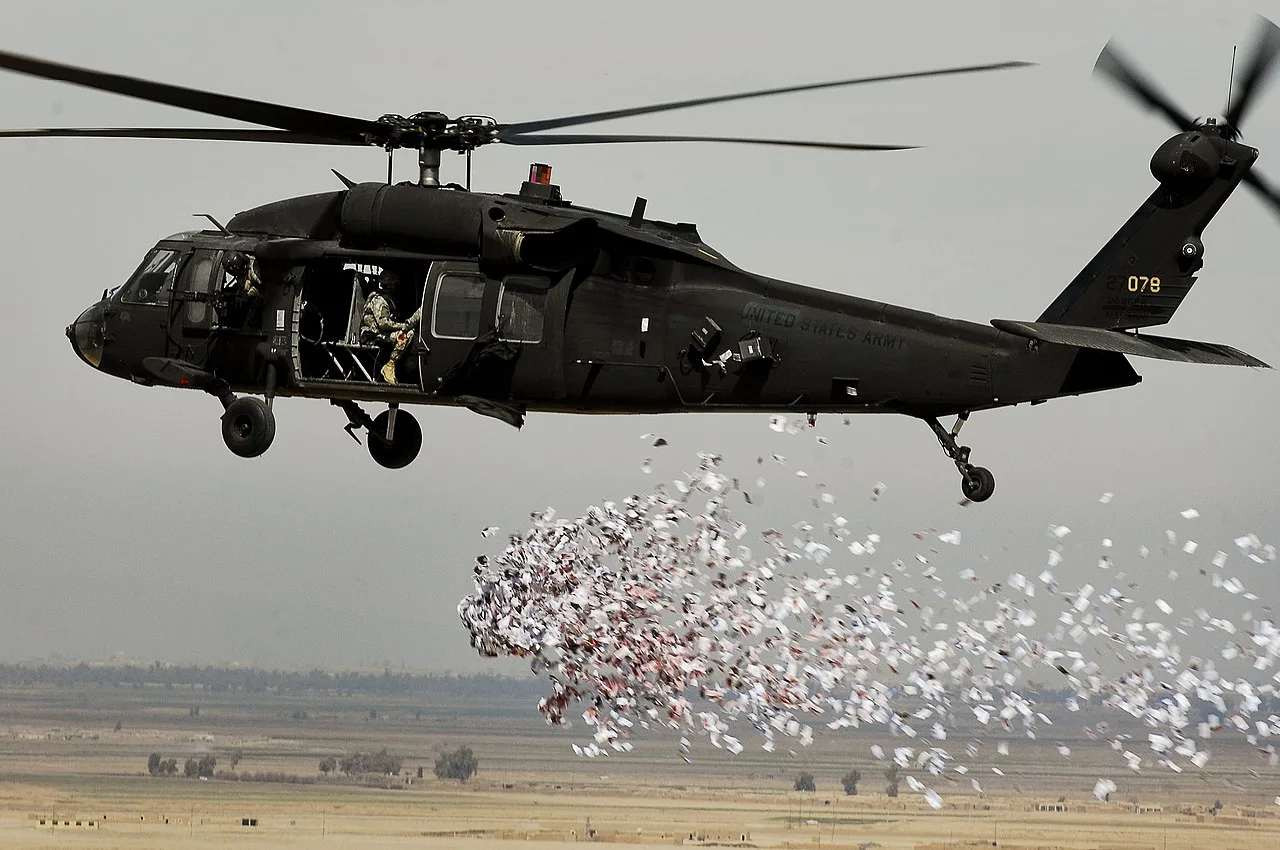
Rabat — On Wednesday, Israel dropped a round of leaflets onto Gaza civilians fearing for their lives, in their latest act of psychological warfare.
However, this is not nearly the first time. One month into the January 19 ceasefire, Israel dropped leaflets on genocide-torn Gaza, urging the population to comply with Trump’s plan to forcibly displace them, “whether [they] accept it or not
Under a photo of United States president Donald Trump and Israeli Prime Minister Benjamin Netanyahu, the power-crazed forces placed a verse of the Qur’an, addressing the people of Gaza as if Israel was their God:
“And certainly, we shall test you with something of fear, hunger, loss of wealth, lives and fruits, but give glad tidings to the patient ones.” Surah al-Baqara (155)
The leaflet, like many before it, was written in classical Arabic and contained genocidal statements such as “the world map will not change if the people of Gaza cease to exist.”
“Even your Arab countries, which are now our allies, provide us with money and weapons while sending you only shrouds,” read the leaflet.
While the document addressed Gazans under the guise of making “one final appeal to those who wish to receive aid in exchange of cooperating” with Israel, the tactic is a well tried and tested strategy under “psychological operation” (PSYOP).
The US, Israel’s closest ally, has repeatedly dropped leaflets on civilians throughout its long history of warfare: the Korean war, Vietnam war, Gulf war, as well as the wars in Afghanistan and Iraq.
In August 1945, the US even dropped leaflets warning Japanese civilians about the devastating raids — as if there was any way for them to avoid nuclear bombs.
While many people became familiar with their use in Gaza after October 7, when the crimes and terror campaign against Palestinians became widely broadcasted, the reality is that Israel has a long history of using leaflets to instill feelings of fear, isolation and capitulation.
A history of psychological terror
- The First Intifada (1987–1993): an uprising against Israeli occupation that started in Jabalia refugee camp, in Gaza, after an Israeli truck driver crashed into parked vehicles, causing the death of four Palestinian workers.
- The Israeli Occupation Forces (IOF) dropped leaflets warning against participation in peaceful protests, or engaging in any forms of resistance such as rock-throwing; often accompanied with threats of arrest, curfews and house demolitions.
- The Second Intifada (2000-2005): An uprising that was triggered by the IOF’s violent response to frustrated Palestinians protesting the storming of Al-Aqsa mosque by, then, opposition leader Ariel Sharon.
- Israel used leaflets as tools of psychological warfare, dropping them over Palestinian cities and refugee camps, conveying warnings against aiding armed-resistance groups, such as Hamas and Fatah, and threatened retribution for attacks against Israel settlers and IOF soldiers.
- Operation Cast Lead (2008-2009): mostly known as the “Gaza War”, the “Gaza Massacre” and the “Battle of al-Furqan.” One of the most deadly aggressions against Gaza until 2023, where almost 14,000 Palestinians, including 333 children were killed by Israel.
- The IOF dropped leaflets warning civilians to evacuate before airstrikes and attempted to instill distrust in civilians towards Hamas.
- Operation Pillar of Defense (2012): Began with an airstrike that killed Hamas leader Ahmed Jabari, followed by eight days killing 150 Palestinians, including 30 children and displacing 350 to 700 families.
- Leaflets warned Gaza residents of impending airstrikes and urged them to leave certain areas. Some warned against cooperating with Hamas and other militant factions.
- Operation Protective Edge (2014):Israel responded to an attack on a military vehicle by killing four Palestinian teenagers while they played football in Gaza sports stadium. Hamas and Israel fired rockets for days, ultimately resulting in Israel launching an official offensive, wreaking havoc on Gaza’s besieged population, of whom 2,000, were killed, including 500 children,while 10,000 people were injured.
- Israel dropped leaflets warning residents in specific neighborhoods, such as Shujaiya and Beit Hanoun, to evacuate ahead of airstrikes. Some leaflets provided hotline numbers and websites for civilians to report militant activities. The IOF also sent SMS messages and phone calls alongside leaflet drops.
- Operation Guardian of the Walls (2021): also known as the “Unity Intifada.” triggered by the Israeli supreme court’s decision to evict six Palestinians families from the Sheikh Jarrah neighborhood, in East Jerusalem. The IOF then stormed the holy Al-Aqsa mosque using tear gas, rubber bullets and stun grenades. Hamas retaliated by firing rockets at Israel, and the latter launched an 11 day assault that killed 256 Palestinians, including 66 children, and left 2000 injured.
- Leaflets warned residents to evacuate buildings suspected of being used by Hamas. Some were used to demoralize Hamas fighters by claiming their leadership was hiding in safety while ordinary fighters suffered.
Life against all odds
The use of psychological warfare tactics by Israel in Gaza and the Occupied Palestinian Territories has become a disturbing hallmark of its strategy of controlling narratives, demoralizing civilians, and enforcing displacement.
Miraculously, and despite decades of unbearable loss and trauma, they have proven futile against the Palestinian spirit — rooted into their land as deeply as the holy olive tree.
Months ago, Trump announced his plan to “take over” and displace Gaza’s 2.3 million residents to neighbouring countries where they would be “better off” in “nice homes where they can be happy and not be shot and not be killed and not be knifed to death.”
“I don’t know how they could want to stay. It’s a demolition site,” he said in a passive voice, not mentioning that it was in fact Israel had been carrying out the shooting, the killing, the stabbing and the demolishing.
Little did he know, his question was answered long ago in 1956, in Ghassan Kanafani’s “Letter from Gaza” where a 19 year old Kanafani tells his friend Mustafa who moved to Sacramento, for a teaching job at the University of California, that he had given up on their lifelong dream of moving to greener prospects.
‘It’ll strike you as rather odd when I proclaim this news to you,” said Kanafani, “no my friend, I have changed my mind. I won’t follow you to ‘the land where there is greenery, water and lovely faces.’ No, I will stay here, and I won’t ever leave.”
“I won’t come back to you. But you, return to us! Come back to learn from Nadia’s leg, amputated from the top of the thigh, what life is and what existence is worth,” resolutely concluded Kanafani.