 Join on WhatsApp
 Join on Telegram
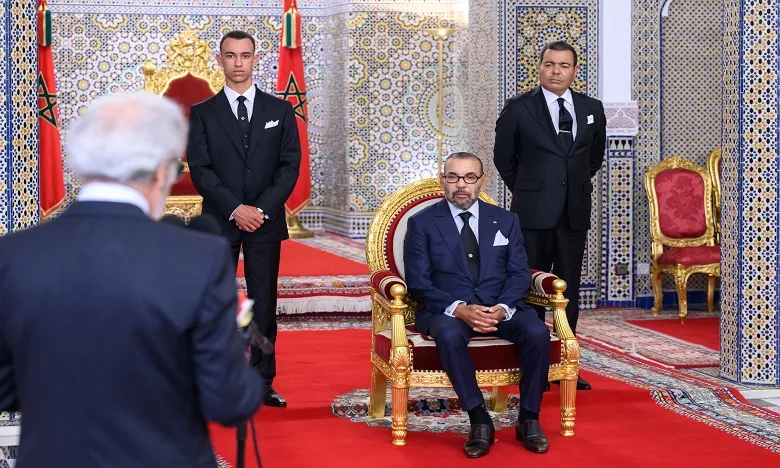
Marrakech – King Mohammed VI, accompanied by Crown Prince Moulay El Hassan and Prince Moulay Rachid, received Abdellatif Jouahri, Governor of Bank Al-Maghrib, at the Royal Palace in Tetouan on Tuesday.
Jouahri presented the central bank’s annual report on Morocco’s economic, monetary, and financial situation for 2024.
Jouahri’s case for cautious optimism
In his address to the King, Jouahri reported that despite strong uncertainties in the international environment and consecutive years of drought, the national economy showed notable improvement in 2024.
The economy grew by 3.8% overall and 4.8% in non-agricultural activities. Inflation significantly decreased, averaging 0.9%.
Jouahri explained that, considering the dissipation of inflationary pressures and to support economic recovery, Bank Al-Maghrib began easing its monetary policy. The central bank reduced its key interest rate twice while continuing to fully satisfy banks’ liquidity requests.
On the labor market front, Jouahri stated that the economy created 82,000 jobs. This number remains insufficient to reverse the upward trend in unemployment, which averaged 13.3%.
Regarding public finances, budget consolidation continues with the deficit dropping to 3.9% of GDP, thanks to strong performance in tax revenues and significant income from innovative financing mechanisms.
For external accounts, Jouahri confirmed that the current account deficit remained contained at 1.2% of GDP. This was achieved through continued momentum in the automotive industry, sales of phosphates and derivatives, reduced energy costs, tourism receipts, and remittances from Moroccans living abroad.
Bank Al-Maghrib’s official reserve assets strengthened to over MAD 375 billion ($37.5 billion), equivalent to nearly 5.5 months of imports of goods and services.
A visionary King
Jouahri then discussed achievements since the beginning of the millennium. He pointed out that under the monarch’s leadership, Morocco has undertaken one of the most ambitious agendas of institutional, economic, and social reforms, alongside an unprecedented investment program to equip the country with quality infrastructure.
This vision, which, according to Jouahri, international institutions consider as a reference, has allowed notable progress on several fronts.
However, during the last decade, with successive shocks and persistent uncertainty in the external environment, the national economy experienced slowed growth and weakened job creation.
To address this situation, Jouahri recalled that the King initiated important reforms and projects aimed at accelerating growth and human development.
These include qualitative and quantitative infrastructure upgrades to tackle water security, energy and food sovereignty, and preparation for hosting major continental and international events.
Morocco’s steep but promising way forward
Royal initiatives have set in motion a wave of momentum that positions 2024 as a decisive year for unlocking economic growth and boosting employment. To translate this momentum into measurable outcomes, Jouahri argued, public action must zero in on three strategic priorities aligned with the King’s vision.
First, strengthening resilience to shocks through efficient governance, consolidation of the productive fabric, and mobilization of the private sector to play its role in investment and job creation.
Second, enhancing the agility of public action to strengthen reaction and readjustment capabilities based on context evolution, requiring close monitoring of implementation and regular evaluation of results.
Third, continuing efforts to preserve macroeconomic balances, particularly by maintaining budget consolidation. This would require accelerating projects to revise the organic finance law, implementing a budget rule, and completing pension reform.
Jouahri stressed that conditions are now ripe to solidify this emerging momentum, pointing to the King’s bold and coherent vision – already materializing through major economic, social, and infrastructure projects. He also mentioned Morocco’s stability and credibility as key assets reinforcing the country’s growing international standing.
Finally, Jouahri called on all of Morocco’s vital forces to better organize and fully mobilize for the deployment of this vision, especially as the North African country faces major deadlines by 2030.
For him, Morocco’s real challenge is to turn these deadlines into a springboard for sustained momentum – pushing the country beyond the current horizon and into the ranks of higher-income nations.