


 Join on WhatsApp
 Join on Telegram
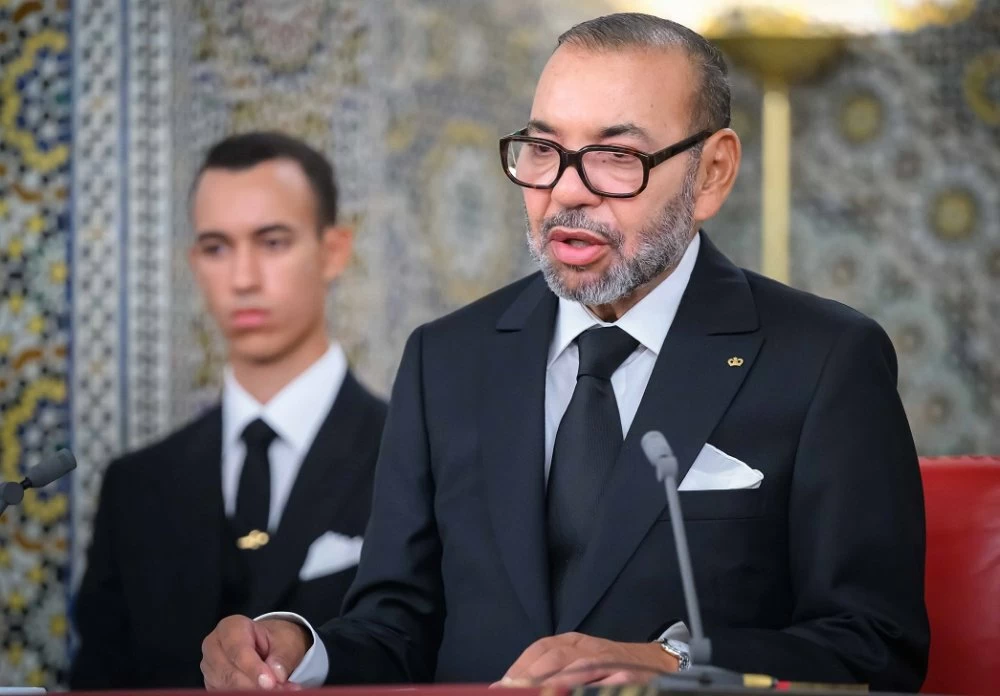
Marrakech – In his Throne Day speech marking 26 years since his accession, King Mohammed VI confronted regional disparities and vowed Tuesday night that Morocco must eliminate socioeconomic gaps to ensure development benefits reach all citizens.
“There is no place today or tomorrow for a Morocco moving at two speeds,” the King proclaimed in his address to the nation broadcast at 9 p.m.
The monarch insisted that, despite significant economic advancement, economic achievements remain hollow without tangible improvements in citizens’ daily lives.
“You know well that I will never be satisfied, regardless of the level of economic development and infrastructure, if it does not contribute tangibly to improving citizens’ living conditions from all social categories and in all regions and areas without discrimination or exclusion,” he affirmed.
The monarch referenced the 2024 population census, which revealed substantial demographic, social, and spatial transformations that must guide public policy preparation and implementation.
While multidimensional poverty decreased nationally from 11.9% in 2014 to 6.8% in 2024, the King lamented that “unfortunately, there are still some areas, especially in rural regions, suffering from manifestations of poverty and vulnerability due to lack of infrastructure and basic facilities.”
“This does not align with our vision for today’s Morocco, nor with our efforts to promote social development and achieve territorial justice,” he declared, demanding a pivot from traditional social development approaches to an integrated territorial development approach.
What distinguished this royal address was its sovereign declaration character, establishing a clean break with traditional development models.
The sovereign stressed that Morocco’s achievements weren’t coincidental but resulted from deep strategic choices, while simultaneously emphasizing that development cannot be measured by numbers alone but by citizen dignity.
To tackle these disparities, King Mohammed VI commanded the government to adopt a new generation of territorial development programs grounded in local specificities, advanced regionalization, and principles of complementarity and solidarity.
This marks a structural recalibration of the state’s trajectory – shifting from a purely social model to one anchored in territorial equity – confronting Morocco’s core national challenge: the gap between growth centers and peripheries.
The new model places water, education, health, and employment at its core, which constitutes a forward-thinking intelligence that captures the demographic and spatial transformations revealed in the recent census.
These programs must unite efforts around clear priorities and impactful projects focusing on four key areas: employment support through regional economic potential, strengthening basic social services in education and healthcare, sustainable water resource management, and launching integrated territorial development projects aligned with major national initiatives.
This royal directive follows fresh data from Morocco’s High Commission for Planning (HCP) revealing that, despite sustained economic growth, social disparities continue to deepen across the country.
A February report warned that while poverty has declined, economic vulnerability has intensified, particularly in urban areas, with 4.75 million people classified as economically vulnerable in 2022.
The report cautioned that the middle class faces erosion, with 47.2% of vulnerable individuals now residing in cities, compared to 36% in 2014.
Morocco recently crossed the threshold of the Human Development Index (HDI), placing the country in the “high human development” category this year.
The kingdom has maintained significant growth rates despite consecutive drought years and international crises, with industrial exports more than doubling since 2014, particularly in the automotive, aerospace, renewable energy, food processing, and tourism sectors.
Elections to proceed as constitutionally scheduled
Addressing the political horizon, King Mohammed VI confirmed that legislative elections will proceed on their regular constitutional and legal schedule, approximately one year from now.
He demanded that the general framework governing the House of Representatives elections must be established and known before the end of this year.
“We have given our high instructions to the Minister of Interior for proper preparation of the upcoming legislative elections and to open political consultations with various stakeholders,” the King stated firmly.
This announcement clarifies the electoral timeline amid recent media speculation. Moroccan newspapers had reported that legislative elections are scheduled for September 2026, with some questioning whether regional and local elections might be rescheduled to coincide with the legislative vote.
Official sources cited by Moroccan media dismissed any plans to alter the electoral calendar.
The political landscape already shows signs of pre-election positioning, with both government coalition and opposition parties mobilizing for the contest.
Analysts have observed that parties have been forming strategic alliances, with expectations that the National Rally of Independents (RNI) party will lead efforts to secure the top position in the upcoming elections.
Some political commentators have criticized what they perceive as a shift from genuine political engagement to electoral maneuvering.
Many analysts argue that parties now prioritize securing parliamentary seats over developing substantive policies to improve citizens’ economic and living conditions.
Political observers suggest that many of the current parties have transformed from political parties to merely electoral parties.




