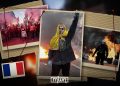
Rabat – Jailed activist Nasser Zefzafi expressed gratitude to Morocco’s prison authority for exceptionally allowing him to attend his father’s funeral in Al Hoceima today.
“The prison administration, especially through the person of the Delegate [Mohamed Salah Tamek], made a great effort,” Zefzafi said, saying that it was not as simple as one might imagine for him to reach Al Hoceima to attend his father’s funeral.
Speaking from the rooftop of his family home to a crowd that had gathered to honor him and his late father’s memory, the prominent activist described the late Ahmed Zefzafi as “the father of the free.”
“This merit goes first to God, then to the Delegate personally, and to all the staff who worked until the very last hours to make this wish come true,” he said.
Beyond his tribute to his father, Zefzafi also made an emotional speech that earned him a round of applause from those who attended the touching moment on-site and his followers online.
In the speech, Zefzafi reaffirmed his devotion to Morocco, stressing that “nothing is above the interests of the nation.”
He declared, “We are ready to sacrifice everything for this nation.”
“As we have always said, we are ready to sacrifice everything for the sake of this country,” he said, recalling that his father also devoted his life to the sake of Morocco.
“And by ‘nation,’ I mean its Sahara, its South, its East, its North, and its West.”
Al Hoceima police arrested Zefzafi on May 29, 2017, for disrupting a Friday sermon and insulting a local imam.
The judiciary accused and condemned Zefzafi for undermining the security of the country and inciting people to join the social protests.
A year after his initial arrest, a Moroccan court sentenced the activist to 20 years. He appealed the verdict, which was upheld on appeal on April 5, 2019.
In 2016, a wave of social uprising came about when Mohcine Fikri, a local fishmonger who was crushed in a garbage truck while trying to retrieve his confiscated goods.
Zefzafi, a prominent leader of the Rif Hirak movement, held several protests in the region following Fikri’s death, condemning the socio-economic crisis and societal gaps in the Al Hoceima region.