
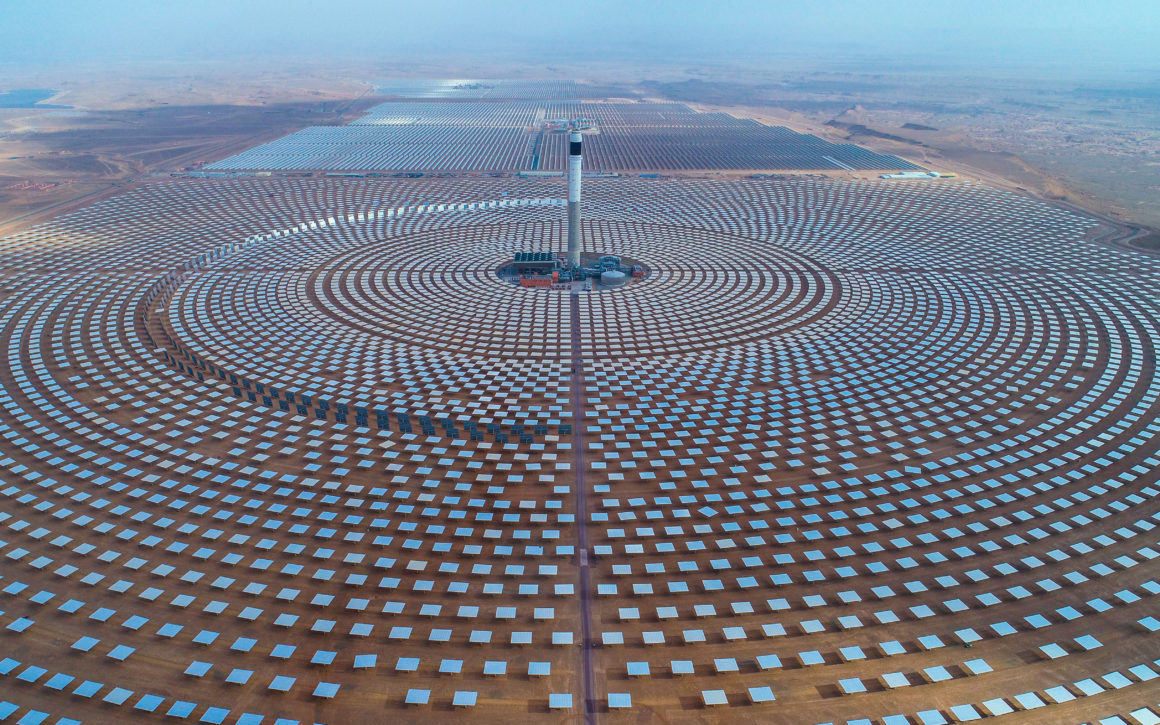
Rabat – A new report, The Renewable Energy Investment Case for Africa, has hailed Morocco’s NOOR Complex as one of Africa’s most important success stories in renewable energy.
The report highlights the remarkable progress Morocco has made in recent years in terms of clean energy transition. It describes the country’s solar plant as a “world-class utility-scale solar complex” and an example of how Africa can attract private capital to power its clean energy transition.
The NOOR Complex is one of the largest concentrated solar power plants in the world. With a total capacity of 582 megawatts, it combines concentrated solar power (510 MW) and photovoltaic technologies (72 MW). Its ability to store energy in molten salt allows Morocco to produce electricity even after sunset, which helps the country meet peak demand.
The report explains that the project was made possible through a public-private partnership between Morocco’s Agency for Sustainable Energy (MASEN) and a consortium led by the company ACWA Power
International financial institutions, including the World Bank, the African Development Bank and the European Investment Bank, provided concessional loans that lowered the project’s costs by up to 25%.
According to the report, “NOOR’s success demonstrates that for pioneering, capital-intensive technologies like CSP, a cohesive national vision can be effective at mitigating project risk and scaling infrastructure.”
Since its launch, NOOR has had a strong impact on Morocco’s energy sector. It provides electricity to more than 1.1 million people and accounts for around 5% of the country’s power supply.
Read also: Morocco’s Noor Ouarzazate III Solar Plant Resumes Operations After Year-Long Shutdown
It also reduces Morocco’s reliance on imported energy, a key issue for a nation that used to import over 97% of its energy. In addition, the project offsets about 690,000 tons of carbon dioxide each year. The project also created thousands of jobs during construction and spurred new training programs and infrastructure in the Ouarzazate region.
However, the report notes some challenges, especially water use in the arid area where the complex is built. Later phases of the project adopted dry cooling technology to reduce this problem.
The NOOR Complex is central to Morocco’s long-term energy ambitions. The country aims to produce 52% of its electricity from renewable sources by 2030, and solar energy plays a major role in that plan.
The report, jointly produced by Enzi Ijayo Africa Initiative (EIAI) and Africa Climate Insights (ACI), also places Morocco’s achievement in a wider African context. Despite holding 60% of the world’s best solar resources, Africa added less than 1% of global renewable capacity in 2024.
Financing is the biggest obstacle for the continent. “Africa must triple its annual growth rate to meet the Nairobi Declaration goal,” the report warns, referring to the 2023 pledge by African leaders to increase renewable energy capacity from 56 GW in 2022 to 300 GW by 2030.
If successful, this transition could transform the continent’s economy. A 100% renewable energy system in Africa could save up to $5 trillion by 2050 and create millions of jobs.