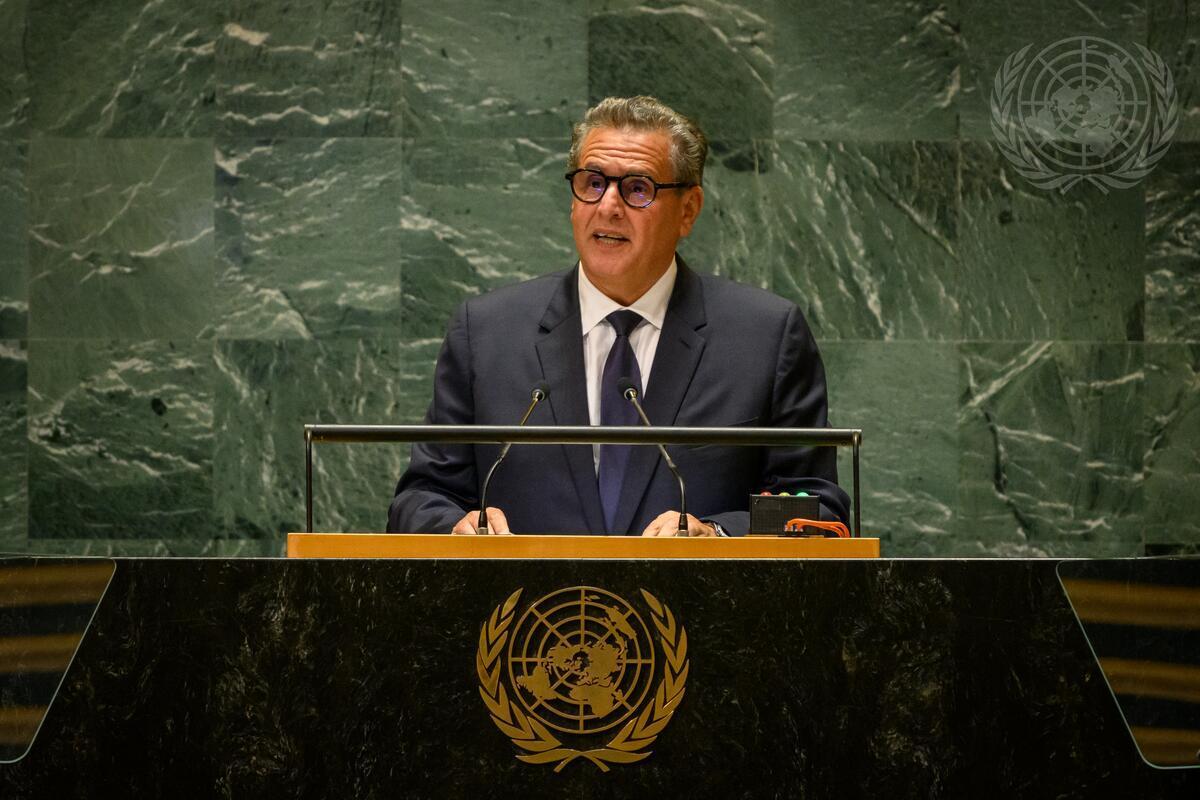
At the 80th United Nations General Assembly in New York, Moroccan Head of Government Aziz Akhannouch said the Autonomy Plan under Moroccan sovereignty is “the only realistic and durable solution” to the Sahara issue.
Speaking on behalf of Morocco, he underlined that the international momentum driven by King Mohammed VI shows “a large majority of the international community considers the plan as the sole pragmatic and credible basis to finally resolve this regional dispute.”
Akhannouch said this clear support proves “it is high time to turn the page on this artificial conflict in full respect of national sovereignty and territorial integrity.”
He also pointed out that the southern provinces are undergoing a socio-economic transformation, thanks to the new development model and royal Atlantic initiatives, stressing that “this region of the Kingdom is now emerging as a strategic platform serving peace, security, and co-development.”
He reaffirmed that “Morocco fully supports the efforts of the UN Secretary-General and his Personal Envoy to reach a final settlement to this artificial dispute.”
World Cup 2030 proves Morocco’s global reach
Turning to the 2030 FIFA World Cup, which Morocco will co-host with Spain and Portugal, Akhannouch stated the event demonstrates “the capacity of Morocco, under the clear-sighted leadership of King Mohammed VI, to commit to projects of global scale.”
He said by hosting such a planetary event, “the Kingdom once again proves its ability to mobilize infrastructure and expertise and to showcase the radiant face of Africa to the world.”
The prime minister added the tournament “is a tool of cultural diplomacy and international outreach with a lasting impact on socio-economic and human development.”
He affirmed Morocco regards sport as “a catalyst for empowerment and social integration, and a symbol of international cooperation and intercultural dialogue.”
Africa stands at the heart of initiatives
The speech also placed Africa at the center of Morocco’s international vision. Akhannouch framed the continent as “Morocco’s strategic depth and natural extension,” and “stands at the heart of international initiatives launched under the impetus of King Mohammed VI.”
He told the Assembly that “the King has placed our continent at the center of a strategic vision for a united and prosperous Africa, respectful of its identity while opening up to balanced international partnerships.”
He cited the Rabat Process on African Atlantic States as “a civilizational project based on new geopolitical solidarity,” explaining that it will make the Atlantic façade a hub for security, stability, and socio-economic opportunities.
He also mentioned the Africa-Atlantic Gas Pipeline as “a perfect illustration of this farsighted vision,” noting that the initiative “provides concrete answers to challenges linked to energy, the economy, and the climate, and highlights an Africa fully integrated in the global economy.”
He recalled that the King has repeatedly said Africa must “turn its challenges into opportunities for growth, harness its assets, prioritize its own vision of development, and take full control of its destiny.”
He concluded that “Africa is now asserting itself as a space of renewal and innovation, thanks to a series of structuring initiatives and projects accelerating its integration into the global system.”
Development, climate policies, and digital transition
Akhannouch also spoke about Morocco’s domestic trajectory, saying “the Kingdom has engaged in wide-ranging development projects under the guidance of King Mohammed VI.”
He said Morocco has taken “important steps in the field of energy transition, betting on renewable energy and boosting its ability to confront climate change.”
He added that Morocco insists on “the importance of collective action to overcome these challenges threatening international peace and security and to achieve common goals for humanity.”
Addressing water stress caused by climate change, drought, and demographic pressure, he asserted that Morocco has “designed innovative policies to counter this problem, in line with the High Directives of King Mohammed VI.”
He cited measures such as “water transfers between river basins, seawater desalination, reuse of treated water, promotion of water-saving agricultural irrigation systems, and dam construction.”
On technological change, he described the rapid rise of artificial intelligence as “a global revolution,” pointing to Morocco’s “Digital Morocco 2030” strategy that aims to accelerate digital transformation.
He said AI offers “huge opportunities in health, education, and agriculture, but also requires adaptation to the rapid shifts it constantly generates.” He added, “this new technology must not be synonymous with exclusion or division, but rather a lever for shared progress.”
Gaza crisis demands immediate two-state solution
On the Middle East, Akhannouch said Morocco remains convinced “that the two-state solution is the only path to establish a lasting and comprehensive peace.”
Speaking as the voice of a country led by the Chair of the Al-Quds Committee, he reaffirmed this solution “can neither be postponed nor marginalized, but must instead become a moral obligation and an immediate political requirement.”
He stressed Morocco supports “the establishment of an independent Palestinian state on the June 1967 borders, with East Jerusalem as its capital and Gaza as an integral part of this state.”
He continued that “the process must include a credible political solution with a clear timeline guaranteeing the legitimate rights of the Palestinian people.”
He said Morocco calls for “strengthening the Palestinian Authority so it can meet its people’s expectations for security, dignity, and development.” He stressed the need for “durable security mechanisms rooted in international law and mutual respect.”
Akhannouch also renewed the country’s call for “mobilizing the international community to end the current crisis and achieve an immediate ceasefire, while resuming negotiations.”
He urged “guaranteeing humanitarian aid entry to Gaza and the West Bank without obstacles or conditions, strengthening UNRWA’s vital role, and implementing the reconstruction roadmap adopted at the Arab extraordinary summit under Palestinian Authority leadership and joint Arab-international supervision.”
He reiterated Morocco’s commitment “to defending holy sites, especially Al-Aqsa Mosque,” pointing out that this commitment is reflected through “the combined work of Moroccan diplomacy and the Bayt Mal Al-Quds Agency, the executive arm of the Al-Quds Committee.”
He said this agency “implements vital projects on the ground to preserve Jerusalem’s legal status, protect its cultural identity, and support the rights and aspirations of the Palestinian people.”
He added Morocco stands “in solidarity with Qatar, Syria, and Lebanon in the face of Israeli attacks on their territories.”
Finally, Akhannouch said Morocco “calls for peaceful solutions in Libya, Yemen, Sudan, and Somalia, which respect national sovereignty and territorial integrity, away from foreign interference.”
MWN with MAP