
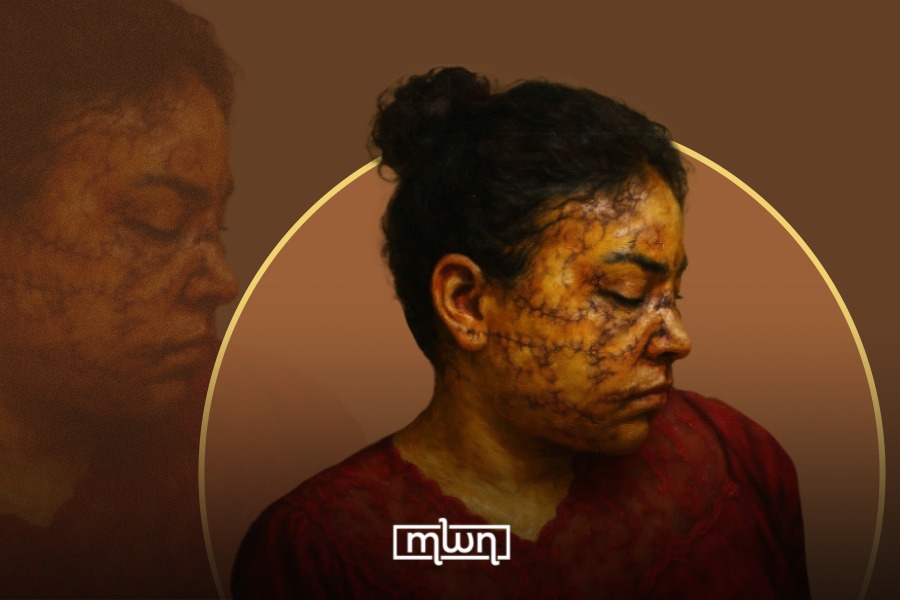
Rabat – A shocking act of extreme violence in Taza has reignited debates over women’s rights and protection in Morocco.
A young woman, named Imane, was reportedly brutally attacked in broad daylight on September 23 by her ex-husband, who slashed her face with a knife, punctured her hand, and left her with deep wounds that required dozens of stitches.
“He butchered my face. Now even my own child is terrified of me whenever I try to approach or hold him,” Imane told Medi1TV.
After a short chase, the police managed to arrest the suspect, who is reportedly 29-years-old and has a criminal record. The assault, activists say, is not an isolated act but part of a larger, systemic failure to protect women from cycles of violence, silence, and legal neglect.
A never-ending cycle of violence
According to accounts shared by women’s rights activists, the victim has endured years of repeated abuse. She was previously raped, resulting in pregnancy, and was then forced into marriage with her rapist under the pretext that marriage could “legitimize” the child and reform the aggressor.
What followed was years of humiliation, physical abuse, and verbal assaults that ended only when she obtained a divorce.
Yet six months later, her ex-husband allegedly returned to haunt her life, harassing her and culminating in this latest violent attack. For many Moroccans, her story epitomizes how institutional gaps and outdated laws expose women to continuous harm, even when they seek to escape.
Outrage and urgent demands
The case has provoked outrage among feminist activists, who are demanding urgent medical and psychological support for the young woman, as well as free legal representation to ensure a fair trial and a severe sentence for the perpetrator.
Activists warn that without immediate intervention from specialized surgeons, the victim’s scars may become irreversible, physically and psychologically.
Women’s rights advocates are seizing this moment to demand far-reaching reform. They denounce the persistence of outdated practices that once allowed rapists to escape prosecution by marrying their victims, an injustice that strips women of dignity, silences survivors, and legitimizes violence.
Although Article 475 of the Penal Code, which sanctioned such marriages, was abolished in 2014, activists stress that social and familial pressures still coerce women into forced unions in violent contexts. The Taza case is a painful reminder that Morocco’s system often continues to treat women as second sex, exposing them to compromises that perpetuate harm and deny them security.
This is neither the first nor the last time Moroccan women endure such brutality, only to see their persecutors walk away with little accountability. Violence against women in Morocco is a recurring reality, to the point of becoming normalized, leaving survivors scarred and persecuted for life, while many aggressors receive minimal punishment and continue with their lives.
In May, outrage erupted after the Primary Court in Mechraa Belksiri sentenced a man who disfigured a woman’s face to just two months in prison and a fine of MAD 3,000 (about $325). The victim, known as “Khadija” dubbed “Lady of 88 Stitches,” required extensive facial surgery and a medical certificate confirming 35 days of incapacity.
A video went viral showing her weeping outside the courthouse, slapping her scarred face in despair and shouting: “What is this, people? He destroyed my face and you gave him only two months?” The lenient ruling, condemned by women’s rights groups as unjust and insulting, shows the wider crisis: for too many Moroccan women, justice remains out of reach.
Morocco out of step with women’s rights
While Morocco has made reforms in recent decades, critics argue that progress remains superficial and uneven. Laws meant to protect women often lack enforcement, while loopholes continue to allow perpetrators of sexual violence to evade accountability.
In particular, the persistence of legal frameworks that enable rapists to marry their victims reveals how deeply patriarchal assumptions are embedded in the justice system.
International rights reports frequently note Morocco’s shortcomings in gender equality. Despite being party to international conventions against discrimination and violence, the country still lags behind in implementing comprehensive protections for women. For many activists, the Taza assault has reopened wounds of frustration: promises of reform are too often delayed, while women continue to pay the price with their bodies and lives.
Until 2014, Moroccan law allowed rapists to marry their victims, a practice rooted in the taboo surrounding premarital pregnancy or the loss of virginity outside wedlock. While the infamous Article 475 was abolished, women’s rights advocates argue that the mentality behind it persists, reinforced by a culture that stigmatizes women before the law ever does.
Underage marriages remain widespread, sexual harassment is pervasive, and existing legal protections are often undermined by weak enforcement and a society that routinely blames survivors rather than aggressors. In Morocco, women are too often condemned twice, first by culture, then by law, trapped in a system that continues to deny them equal protection and dignity.
Now or never
The brutality of the September 23 attack has stirred rage across social media, where activists and ordinary citizens alike have expressed disbelief and fury. Posts denouncing the assault describe the victim as not just an individual survivor, but as a mirror of countless women silenced by fear, stigma, or institutional neglect.
On social media, images of the victim quickly went viral, triggering a wave of emotion and outrage. Under the hashtags #كلنا_إيمان (“We Are All Imane”) and a broader call; #لا_للعنف_ضد_النساء (“No to Violence Against Women”), users are demanding justice and denouncing the normalization of domestic violence.
“This case is not just about one young woman in Taza, it is about every Moroccan woman left unprotected by the state,” one netizen wrote online. The anger is directed not only at the alleged attacker, but at a system that activists say repeatedly enables such violence, whether through weak enforcement, cultural taboos, or outdated laws.
Women’s rights groups insist this case must become a turning point. They argue that the government must prioritize women’s protection as a national cause, ensuring harsher sentences for abusers, specialized medical and psychological support for survivors, and the elimination of laws that legitimize forced marriages between victims and their aggressors.
The Taza victim’s ordeal should not fade into another forgotten headline. Instead, it should act as a rallying cry, a reminder that justice in Morocco remains unfinished, and that women’s lives cannot be collateral to outdated traditions or legal complacency.