


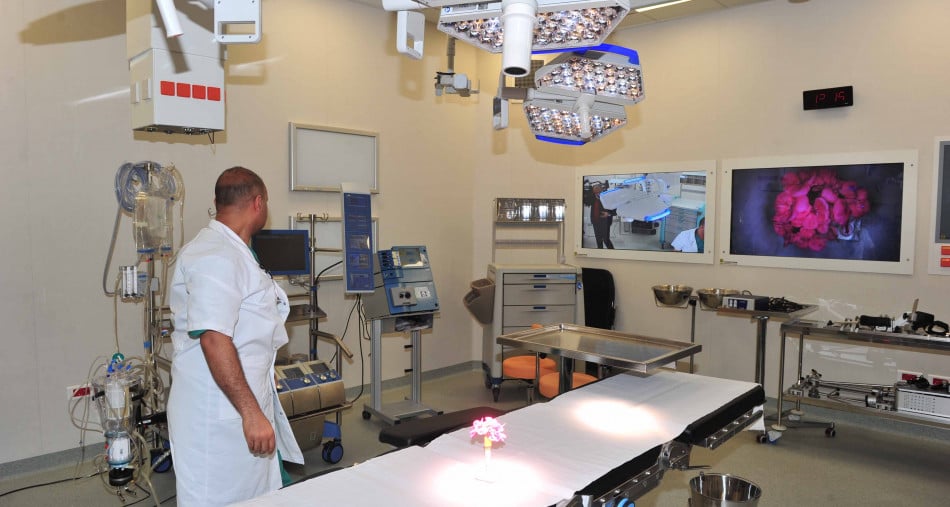
Rabat – Moroccan medical teams have successfully carried out cochlear implant surgeries with the help of a surgical robot, a first not only in Morocco but also across Africa.
The operations were performed at two major hospitals: the Mohammed V Military Teaching Hospital in Rabat and the 20 August Hospital under the Ibn Rochd University Hospital Center in Casablanca.
Cochlear implants help people with severe hearing loss by inserting small electrodes into the inner ear to stimulate the auditory nerve, bypassing damaged parts of the cochlea. With robotic assistance, surgeons can perform these delicate movements with exceptional precision and safety to ensure better hearing recovery and protect the ear’s internal structures.
Lieutenant General Fouad Benariba, Head of the Head Surgery Department at the Mohammed V Military Hospital, said that thanks to the “visionary leadership” of King Mohammed VI, “Morocco continues to promote innovation in health sciences,” MAP news agency reported.
He explained that the hospital’s ear, nose, and throat (ENT) department organized a special day of robot-assisted cochlear implant surgeries in coordination with the Military Health Service and the Lalla Asmae Foundation for the Deaf and Hard of Hearing.
“These surgeries are carried out for adults who suffer from severe or profound deafness and no longer respond to traditional hearing aids, as well as for children under five with congenital hearing loss,” Benariba told the media.
He added that the Moroccan team is now among the first in Africa to use robotic technology for such procedures. This technological advance allows for a very stable and precise speed of 0.1 millimeters per second, greater precision than the human hand can achieve, he explained.
The robotic device also reduces pressure inside the cochlea, protecting inner ear cells and preserving residual hearing, which can be vital for patients’ sound perception. Benariba noted that ongoing genetic research offers hope that preserving these cells could one day make gene therapy possible for hearing restoration.
Similarly, the ENT and Head and Neck Surgery Department at Casablanca’s 20 August Hospital performed robot-assisted cochlear implant surgeries during the “Innovation Week in Ear Medicine and Hearing Technology,” organized in partnership with the Lalla Asmae Foundation.
The event included live surgeries, scientific sessions, and discussions with international experts from Saudi Arabia, Germany, and France. Professor Hicham Afif, Director of the Ibn Rochd University Hospital Center, said the program allowed Moroccan teams to exchange best practices and enhance their capacity to care for people with hearing loss.




