Often described as calm, kind, and discreet, I have learned that our temperament quietly reveals the world that shaped us. I grew up to the voices of Fayrouz, Charles Aznavour, Jack Brel, Nina Simone, the Beatles, Dave Brubeck – all my father’s timeless playlist. He never missed a chance to introduce us to the music that shaped his own youth. Jazz, blues, and classical compositions filled our home; Mozart and Beethoven were familiar names long before I understood their genius. One of my earliest memories is the sound of my father playing the piano, savoring each note as if it carried a story, a memory, or a lesson. I learned that music is not simply heard, it is lived and magically felt in the bones. And allow me a small confession: as I write these lines, Dave Brubeck is playing in the background, helping me find the rhythm and clarity behind every word.
With such a foundation, it was only natural that I grew passionate about music. My heart learned to beat in rhythm, and my mind found refuge in lyricism. Almost instinctively, I taught myself to heal by writing, transforming emotions into poetry rather than letting them fade unspoken. Over time, I realized how extraordinary and underexplored the power of music truly is; not just entertainment, not merely a melody to accompany a celebration, but a form of therapy, an instrument for emotional and intellectual awakening.
My conviction found resonance when I crossed paths with Dr. Mariam Dahbi. Our encounter confirmed that what I had long felt intuitively could, in fact, reinvent education and public policy. Her work demonstrates how music can redefine learning, elevate teaching, and invite us to rethink one of the most crucial pillars of any nation: education.
Guided by a desire to spread transformative ideas rather than let them remain unspoken, I invited Dr. Mariam Dahbi — Harvard-educated, pioneering, and profoundly insightful — as the distinguished guest of my Road to Diplomacy Conference Series, organized under the auspices of JCI Rabat.
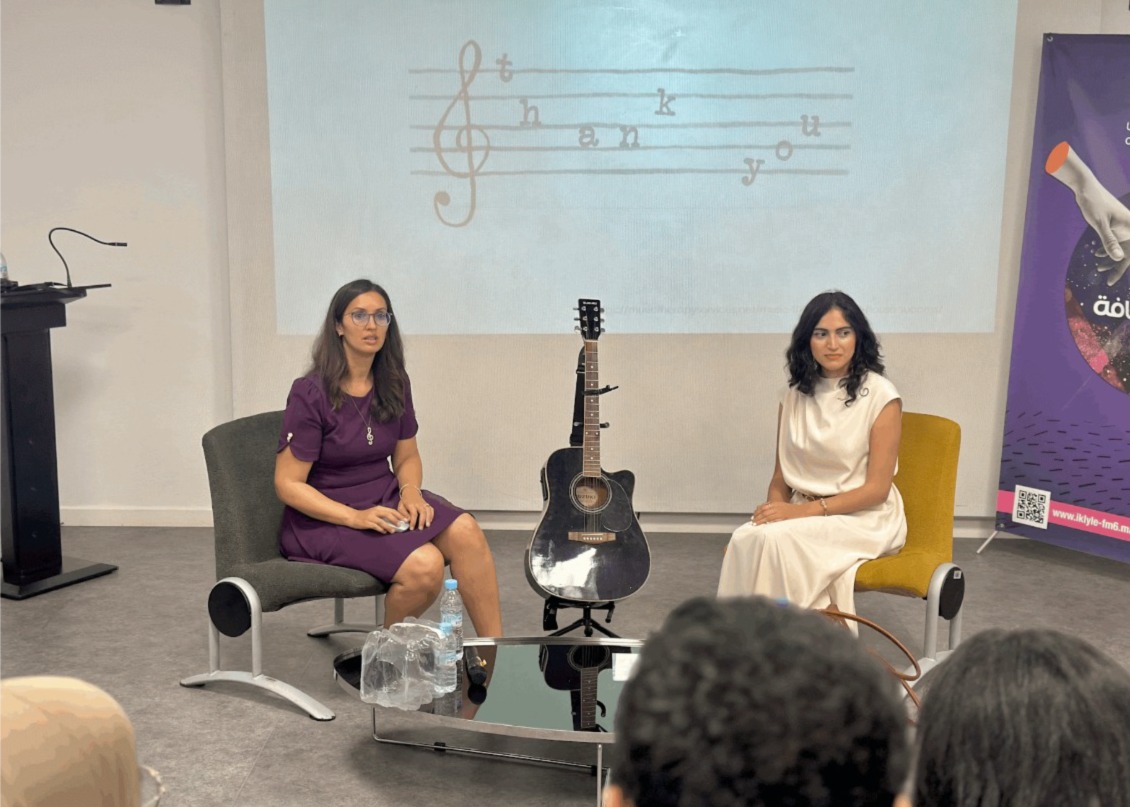
In collaboration with the Iklyle Cultural Center of Rabat, the conference offered participants an experience far beyond a typical learning session. It was immersive, deeply emotional, and uniquely interactive, where music was not only discussed, but felt and experienced in real time. Dr. Dahbi made it clear that she would provide no answers; instead, we would discover them ourselves, guided by her singing with her guitar: “Now is the time, to face the music, to ask all the questions, and to be the answer.”
It was a precious opportunity to explore how music, education, and public policy can intersect — an invitation to envision new possibilities for future generations.
The conference: music as a tool for public policy
On November 12, 2025, an emotional evening unfolded at the Iklyle Cultural Center of Rabat, bringing together young minds, educators, and policymakers eager to explore the intersection between education and music. Dr. Mariam Dahbi, an education researcher, singer-songwriter, and independent consultant dedicated to reimagining learning as a path toward harmony and human flourishing, was one esteemed guest. She earned her PhD in Education from Harvard University, where her work explored multilingualism, literacy, emotion, and creativity in early learning. Bridging research and lived experience, she weaves art, science, and philosophy to advance a more compassionate and holistic vision of education; one grounded in love, agency, and authenticity. The atmosphere of the conference was charged with anticipation, as participants sensed they were about to experience something far beyond a conventional lecture.
Dr. Mariam Dahbi began the session in a way that immediately set the tone: she invited everyone to breathe together, hum together, and connect through the simplest yet most profound act: a shared breath. Accompanied by soft guitar notes, she reminded participants that everything begins with a breath, a pause that grounds the mind, centers attention, and opens the heart. In that moment, the audience became more than listeners, they became part of the workshop itself, attuned to rhythm, presence, and collective energy.
From that opening, the evening unfolded like a carefully orchestrated symphony, research insights intertwined with personal anecdotes, policy principles harmonized with musical improvisation, and participants experienced first-hand how music can embody the principles of inclusive, empathetic, and transformative education showing how classrooms, curricula, and reforms might be reimagined through creativity, emotion, and presence.
For me, the use of music in this session was undeniable proof of its power. I have led many conferences before, and I have often seen faces grow tired, fighting to stay focused, sitting tall and still as one does in any formal lecture. But this time was different. Music softened the space. Faces relaxed, bodies were at ease, unfreezing from the rigidity we are used to performing in academic settings. Within seconds, the entire audience was fully present, engaged, and naturally connected to the content. Within moments, an unbreakable link was created, carried by music in service of education.
What an experience this conference turned out to be.
Research insights: music as a catalyst for transformative education
Following the collective breathing and humming session, Dr. Dahbi shared insights from her years of research, illustrating how music can fundamentally reshape learning environments. Drawing from her Harvard studies, she emphasized that music is not simply a pedagogical tool for engagement, but a mechanism to foster inclusivity, creativity, and emotional intelligence in the classroom.
Dr. Dahbi and her colleagues conducted a U.S-based Harvard University study titled “Music in Early Childhood Classrooms: Teachers’ Perceptions, Practices, and Challenges in Supporting Linguistically Diverse Students.” The research revealed several key insights for policymakers:
- Teachers perceive music as a valuable instrument for engagement, particularly for students from diverse linguistic and cultural backgrounds.
- Music is already widely used during classroom transitions and routines, demonstrating its practical utility, but often in limited or ad hoc ways.
- A lack of resources, training, and multilingual materials limits the full integration of music into educational practices.
These findings highlight a critical policy opportunity: integrating music into national curricula and teacher development programs can strengthen learning outcomes, promote inclusivity, and nurture well-rounded, creative citizens.
A musical system for harmonious education: seven guiding principles
Dr. Dahbi then introduced her framework, “A Musical System for Harmonious Education in Morocco,” a vision that translates musical principles into concrete strategies for educational reform. She began with rhythm, the pulse of learning, reminding us that education — like music — thrives on balanced cycles of focus and pause, and that policy must reflect this natural cadence.
She spoke of listening as the pedagogy of presence — where true reform requires policymakers and educators to listen to students, teachers, and communities with the same attentiveness musicians give one another. She evoked the power of ensemble, describing schools and nations as orchestras whose strength comes from collaboration and shared direction.
She highlighted craft as the freedom born of mastery, urging investment in teacher training and professional growth. With improvisation, she called for flexibility and agency, allowing educators and learners to adapt creatively to diverse needs. Through conduction, she redefined leadership as guidance without domination, a model that inspires rather than controls. And finally, she concluded with resonance, the echo of meaning, insisting that education must leave a lasting intellectual and emotional imprint, and that reform must aim for transformation that endures rather than reforms that merely satisfy the moment.
Tears of resonance: a moment that unlocked the heart
As the session unfolded, each moment more immersive than the last, a question quietly emerged, one that lingers long after the session ends: Are our classrooms truly spaces of learning? That simple inquiry opened a reflection in me, one I could not ignore. Because what I witnessed that evening was, without hesitation, real learning. The kind that reaches beyond instruction… into transformation. Her session pushed me to dig deeper into the meanings that have shaped my own life. It was one of those rare encounters, the kind that happens once in a decade if fate is generous.
In fact, the last time I experienced such resonance was in 2021, when I crossed paths with Hajar El Khiri, a meeting that rewrote the meaning of sisterhood for me. The woman I call my sister, and who could be nothing less than a sister to me and beyond — my companion on this journey through life, one of those rare souls whose presence becomes a lighthouse. These encounters are precious, few, and unforgettable. That is exactly how this session felt. And allow me to share this with the same sincerity: from the very first moment, something in my heart stirred and remained awake, fully, intensely, through every second of the experience. The culmination arrived when Dr. Dahbi shared a video of herself performing with the Cordelia Band, singing the words “She found her dream.”
That line struck me with the quiet force of relief, as if it finally translated the beauty swelling in my chest into tears — tears of resonance, tears of chemistry, those rare tears you almost wish to shed from time to time because they remind you that you are alive, connected, present. I left that room grateful, grateful to feel deeply again, holistically, and with every layer of my being.
Leadership, music, and policy reform
Education reform is not merely administrative, it is political, strategic, and cultural. Music, as Dr. Dahbi demonstrated, provides both a metaphor and a methodology for creating policies that are inclusive, human-centered, and innovative. By the end of the session, the message was unmistakable: reform in education must start with human connection and awareness.
As an aspiring diplomat and advocate for transformational policy, I believe that workshops like this highlight a fundamental truth: true reform begins with presence, reflection, and connection, just as every musical journey begins with a single breath.
The “Road to Diplomacy Conference Series” continues to serve as a platform where ideas meet practice, dialogue sparks discovery, and Morocco’s next generation of policymakers can experience first-hand how creativity, empathy, and culture can shape the nation’s future.